Context
- Pakistan is preparing to send its first astronaut into space under a human-spaceflight cooperation programme with China.
- Two Pakistani candidates are undergoing training, with one expected to undertake a short-duration mission aboard China’s Tiangong Space Station as a payload specialist, primarily conducting scientific experiments.
- The development highlights the expanding role of Tiangong in international space cooperation.
About Tiangong Space Station
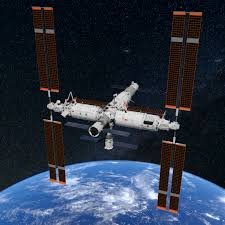
- Tiangong, meaning “Heavenly Palace” or “Sky Palace”, is China’s permanently crewed modular space station in Low Earth Orbit (LEO).
- It represents the third and final phase of China’s human-spaceflight programme, following the development of crewed spacecraft and experimental space laboratories.
- Construction began with the launch of the Tianhe core module in April 2021, while its basic three-module configuration was completed in 2022.
- It generally operates at an altitude of around 340–450 km, broadly comparable to the orbital region of the International Space Station (ISS).
- Tiangong normally accommodates three astronauts, with additional capacity during crew handovers.
Major Modules of Tiangong
Tiangong has a T-shaped three-module configuration:
- Tianhe: Core module containing crew living quarters, life-support systems, station controls and docking facilities.
- Wentian: Laboratory module supporting scientific research while providing additional facilities for crew and spacewalks.
- Mengtian: Laboratory module primarily designed for microgravity science and technology experiments.
China has also proposed expanding Tiangong with additional modules, increasing its research and docking capacity.
Tiangong as a Space Laboratory
Tiangong provides a long-duration microgravity research environment, allowing experiments that are difficult to conduct under Earth’s gravity.
Major research areas include:
- Space life sciences and biotechnology,
- Microgravity fluid physics and combustion,
- Materials science,
- Fundamental physics and space medicine.
The station also provides external experiment platforms, allowing scientific equipment and materials to be directly exposed to the space environment.
- Xuntian: China’s planned space telescope will operate independently in a similar orbit but is designed to dock with Tiangong for servicing and maintenance.
Tiangong vs International Space Station
- Ownership: Tiangong is operated by China, whereas the ISS is a multinational collaborative programme.
- Scale: Tiangong is considerably smaller and lighter than the ISS.
- Configuration: Tiangong currently has three main modules, compared with the much larger modular structure of the ISS.
Significance of Pakistan’s Mission
- Human spaceflight: The mission would give Pakistan its first experience of sending an astronaut into space.
- Scientific exposure: A payload specialist can participate in microgravity experiments and space-based research.
- Space cooperation: The mission demonstrates how countries without independent crewed-spaceflight capability can access space infrastructure through international partnerships.
- Space diplomacy: It also reflects China’s growing use of Tiangong as a platform for scientific and technological cooperation with other countries.
FAQs
Q1. What is Tiangong?
Tiangong is China’s permanently crewed modular space station in Low Earth Orbit.
Q2. What is the core module of Tiangong?
The core module is Tianhe.
Q3. What are the two laboratory modules of Tiangong?
They are Wentian and Mengtian.
Q4. Is Xuntian one of Tiangong’s three main modules?
No. Xuntian is a separately orbiting space telescope designed to dock with Tiangong for servicing.
Q5. What will be the role of Pakistan’s selected astronaut?
The astronaut is expected to serve as a payload specialist, primarily conducting scientific experiments.