Context
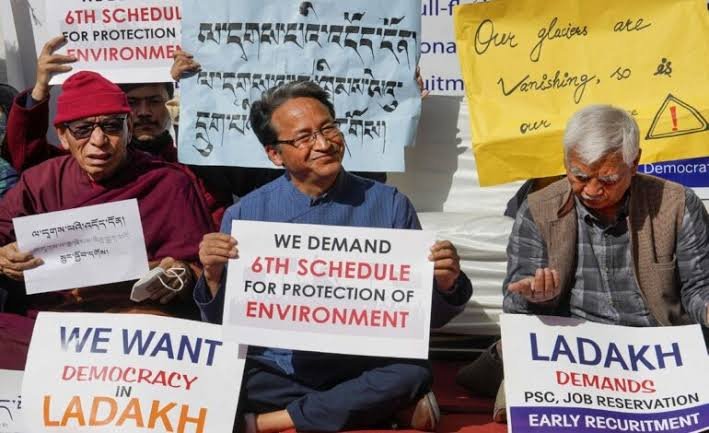
Ladakh’s demand for greater constitutional safeguards has renewed attention to the Sixth Schedule and the possibility of a Ladakh-specific constitutional arrangement.
Ladakh’s Constitutional Position
- Ladakh became a Union Territory without a legislature following the 2019 reorganisation of the erstwhile State of Jammu and Kashmir. Before 2019, it was part of Jammu and Kashmir and had representation through four members in its Legislative Assembly.
- The demand seeks stronger safeguards for land, culture, language, customary practices, natural resources and political representation. Ladakh currently has Autonomous Hill Development Councils in Leh and Kargil, whose legislative and governing powers are described as limited in the source material.
Sixth Schedule: Constitutional Framework
The Sixth Schedule provides special arrangements for the administration of tribal areas in:
- Assam
- Meghalaya
- Tripura
- Mizoram
Its constitutional framework is linked to:
- Article 244(2): Provides for the administration of tribal areas in the four States in accordance with the Sixth Schedule.
- Article 275(1): Provides for grants-in-aid for specified purposes relating to Scheduled Tribes and their administration.
The Sixth Schedule provides for Autonomous District Councils (ADCs) and, in specified circumstances, Autonomous Regional Councils.
Depending on the applicable provisions, these institutions may exercise powers concerning:
- Land
- Forests
- Agriculture
- Water
- Village administration
- Social customs and customary practices
- Certain judicial matters
- Certain taxation matters
The distribution of powers varies among the four States, allowing the framework to accommodate State-specific forms of autonomous administration.
Proposed Article 371K
Instead of extending the Sixth Schedule directly to Ladakh, the Centre has proposed a Ladakh-specific constitutional arrangement under Article 371K.
The proposal envisages a directly elected governing body at the Union Territory level, with proposed legislative powers relating to:
- Land
- Culture and language
- Forests and environment
- Natural resources
The proposed arrangement seeks to provide greater democratic representation and local participation in a Union Territory without a Legislative Assembly.
Article 371K is a proposed provision and is not an existing constitutional provision.
Sixth Schedule and Proposed Article 371K: Key Distinctions
| Basis | Sixth Schedule | Proposed Article 371K |
| Institution | Autonomous District/Regional Councils | Directly elected UT-level governing body |
| Area covered | Designated tribal areas in four northeastern States | Entire Union Territory of Ladakh |
| Constitutional framework | Existing constitutional framework | Proposed new constitutional provision |
| Powers | Constitutionally specified and State-specific | Specifically defined for Ladakh |
| Governance model | Autonomous administration of designated tribal areas | Tailor-made elected governance arrangement |
Constitutional Significance
- The proposal illustrates asymmetric federalism, under which different regions may have differentiated constitutional arrangements based on their particular historical, social, cultural and administrative circumstances.
- Special provisions under Articles 371 to 371J demonstrate that the Constitution can accommodate differentiated institutional arrangements across regions.
- The proposed Article 371K would be distinctive because it seeks to establish a region-specific constitutional framework for a Union Territory without a legislature.
Governance and Institutional Challenges
The proposed arrangement raises questions regarding the practical distribution of authority among the elected body, Lieutenant Governor and existing LAHDCs.
The principal unresolved areas include:
- Executive authority: The extent of administrative powers to be exercised by the proposed institution.
- Financial arrangements: The degree of financial autonomy available to it.
- Planning authority: Its role in development planning and implementation.
- Institutional jurisdiction: The division of responsibilities between the proposed body, Lieutenant Governor and LAHDCs.
- Security functions: The allocation of responsibilities for police and law and order.
The effectiveness of the proposed framework would therefore depend on the precise powers and responsibilities ultimately assigned to the institution.
Local Autonomy and National Security
- Ladakh’s location along India’s northern frontier adds a strategic dimension to the governance question.
- The proposed framework would therefore need to balance greater local participation with the requirements of effective administration and national security.
Way Forward
- Clearly define the powers and responsibilities of the proposed governing body.
- Establish an unambiguous framework for its interaction with the Lieutenant Governor and LAHDCs.
- Provide adequate financial and administrative capacity to discharge its assigned functions effectively.
- Ensure clarity regarding planning and security-related responsibilities.
- Align constitutional safeguards with the protection of land, culture, language, customary practices and natural resources.
- Maintain an appropriate balance between local democratic participation and the strategic requirements of the Union Territory.
Conclusion
- Ladakh’s demand reflects the broader constitutional challenge of accommodating regional aspirations within a framework of effective governance and national security.
- The proposed Article 371K offers a distinct constitutional approach rather than directly extending the Sixth Schedule to Ladakh. Its effectiveness will depend on how the proposed framework translates constitutional recognition into clear institutional responsibilities and meaningful local participation.
UPSC FAQs
- What is the present constitutional position of Ladakh?
Ladakh is a Union Territory without a legislature, following the 2019 reorganisation of the erstwhile State of Jammu and Kashmir.
- Has any region outside the Northeast been included in the Sixth Schedule?
According to the source material, no region outside the Northeast has been included in the Sixth Schedule.
- Which institution has recommended Sixth Schedule protection for Ladakh?
The National Commission for Scheduled Tribes (NCST) has recommended Sixth Schedule protection for Ladakh, according to the source material.
- Which constitutional provisions illustrate differentiated arrangements under Article 371?
The source material cites Articles 371A, 371F and 371J as examples of special constitutional arrangements for particular States or regions.
- What is the distinctive institutional feature proposed under Article 371K?
The proposal envisages a directly elected governing body at the Union Territory level, providing a governance model distinct from the Autonomous District Council structure of the Sixth Schedule.