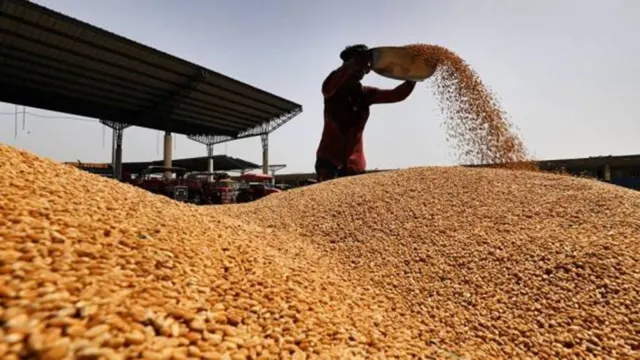
India has resumed wheat exports amid comfortable supplies, with production estimated at ~120 million tonnes and central pool stocks at ~48 million tonnes, well above the ~20 million-tonne buffer norm.
About Wheat
- Wheat is a major staple for nearly two-thirds of India’s population; India is the world’s second-largest wheat producer.
- Types: Bread wheat is used for bread, roti and chapati, while durum wheat is mainly used for pasta and macaroni.
- It is a Rabi crop requiring a cool season, sunshine during ripening and 50–75 cm annual rainfall.
- Major growing regions include the Ganga-Sutlej plains and parts of the Deccan, with Uttar Pradesh, Punjab, Haryana, Madhya Pradesh, Rajasthan and Bihar as key producers.
2022 Export Restriction and Its Implications
- High Inflation: In April 2022, retail inflation was 7.8%, food inflation was above 8%, and wheat inflation was nearly 10%, increasing food-security concerns.
- Lower Government Procurement: Domestic wheat prices rose above the Minimum Support Price (MSP), reducing procurement by the Food Corporation of India (FCI).
- Declining Stocks: Lower production and falling buffer stocks increased concerns over domestic wheat availability, especially for the Public Distribution System (PDS).
- Policy Uncertainty: India had initially encouraged wheat exports after the Russia–Ukraine conflict disrupted global supplies and raised international prices, but later imposed restrictions.
- Global Impact: The restrictions limited exporters’ gains from high global prices and were criticised by Group of Seven (G7) agriculture ministers, who sought greater Indian wheat supplies for global markets.
Challenges to Sustained Wheat Exports
- Weather Risk: A possible strong El Niño and a monsoon around 15% below normal may affect the next wheat crop.
- Water Stress: Punjab and Haryana face rainfall deficits and rising groundwater extraction due to irrigation dependence. Rajasthan faces both low rainfall and limited groundwater availability.
- Warmer Winter: Higher temperatures, particularly in March, can reduce the grain-filling period and lower wheat yields.
- Production Uncertainty: The sugar export experience shows that expected surpluses may change with actual production, creating risks for export decisions.
Way Forward
- Evidence-based Exports: Base export decisions on production forecasts, weather conditions, procurement trends and domestic demand.
- Food-security Buffer: Maintain adequate buffer stocks before allowing large-scale exports, especially when future production is uncertain.
- Climate-resilient Production: Promote water-efficient irrigation and climate-resilient wheat varieties to reduce dependence on groundwater and weather conditions.
FAQs
Q1. Why did India restrict wheat exports in 2022?
Ans. High inflation, lower procurement and declining buffer stocks raised concerns over domestic food security.
Q2. What are the major wheat-producing states in India?
Ans. Uttar Pradesh, Punjab, Haryana, Madhya Pradesh, Rajasthan and Bihar are major wheat-producing states.
Q3. Why can a warmer winter reduce wheat yields?
Ans. Higher temperatures in March can shorten the grain-filling period, reducing wheat productivity.
Q4. How can El Niño affect wheat production?
Ans. A strong El Niño can disrupt rainfall patterns and increase weather-related risks for wheat production.