Context
The Organisation of Islamic Cooperation (OIC) recently welcomed progress on the Palestinian Reform Plan. India, meanwhile, rejected references to Kashmir in the Joint Communique of the OIC Contact Group on Jammu and Kashmir.
About OIC
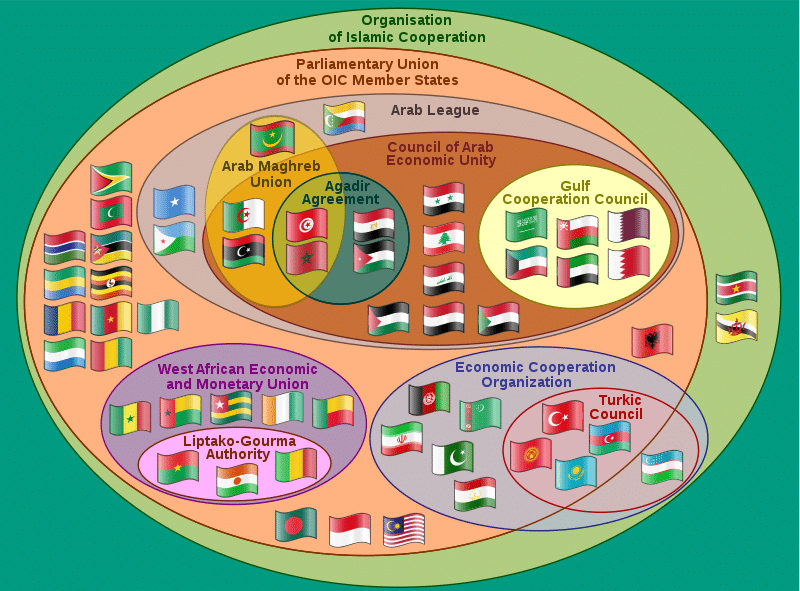
- The OIC is an intergovernmental organisation comprising 57 member states across four continents. It is the second-largest intergovernmental organisation after the United Nations.
- Its objectives include preserving Islamic values, protecting the sovereignty and independence of member states, and contributing to international peace and security.
- The organisation describes itself as the collective voice of the Muslim world and seeks to protect the interests of its members in the economic, social and political spheres.
- It was established on 25th September 1969 at the Rabat Summit in Morocco, following the deliberate burning of the Al-Aqsa Mosque in Jerusalem.
- The organisation operates under the OIC Charter, originally adopted in 1972 and substantially revised at the 2008 Dakar Summit.
- In June 2011, its name was changed from Organisation of Islamic Conference to Organisation of Islamic Cooperation at the 38th Council of Foreign Ministers in Astana.
- Headquarters: Jeddah, Saudi Arabia
- Official languages: Arabic, English and French
Institutional Framework
The OIC functions as an intergovernmental mechanism through its principal organs:
- Islamic Summit Conference (ISC): The supreme authority, meeting every three years to determine the organisation’s broad policy.
- Council of Foreign Ministers (CFM): Meets annually to review implementation of decisions within the policy framework established by the ISC.
- General Secretariat: Acts as the executive organ and implements decisions of the Summit and CFM.
- Independent Permanent Human Rights Commission (IPHRC): Established in 2011.
Important specialised and affiliated institutions include the Islamic Development Bank (IsDB), Islamic Educational, Scientific and Cultural Organization (ICESCO) and Statistical, Economic and Social Research and Training Centre for Islamic Countries (SESRIC).
Key Areas of Engagement
The OIC’s agenda has historically focused on:
- The Palestinian question and status of Jerusalem
- Solidarity among Muslim states
- Countering Islamophobia
- Economic and scientific cooperation
It also works with international mechanisms, governments and civil society organisations on issues concerning its member states and the Muslim world.
India and OIC
India has largely pursued engagement with Gulf and Arab countries through bilateral channels, while maintaining its position on the OIC’s references to Jammu and Kashmir.
- 1969: India was invited to the inaugural OIC summit in Rabat, but was disinvited following opposition from Pakistan.
- 2019: India participated for the first time in an OIC Council of Foreign Ministers meeting as the Guest of Honour.
- Jammu and Kashmir: India rejects the OIC’s locus standi on matters concerning its sovereign territory and maintains that the organisation has no mandate to comment on such matters.
Conclusion
The OIC serves as a major platform for political coordination and cooperation among 57 member states. For India, its relevance lies particularly in managing OIC-related positions while continuing to develop bilateral relations with Gulf and Arab countries.
FAQs
- When and why was the OIC established?
The OIC was established on 25 September 1969 at the Rabat Summit following the arson of the Al-Aqsa Mosque in Jerusalem. - What is the highet authority of the OIC?
The Islamic Summit Conference is the supreme authority and meets every three years to determine the organisation’s broad policy. - What is the role of the Council of Foreign Ministers?
The CFM meets annually to review implementation of decisions and address issues within the policy framework established by the Islamic Summit. - What is the IPHRC?
The Independent Permanent Human Rights Commission, established in 2011, is one of the principal bodies of the OIC dealing with human-rights matters. - Which major institutions are associated with the OIC?
Important specialised and affiliated institutions include the Islamic Development Bank (IsDB), ICESCO and SESRIC. - What is India’s position on OIC references to Jammu and Kashmir?
India rejects the OIC’s locus standi on matters concerning Jammu and Kashmir and maintains that such matters fall within India’s sovereign jurisdiction.