Context
Several Ganesh idols immersed in an artificial pond were recently found near the jetty adjoining Vasai Fort in Maharashtra, triggering concern over post-immersion management around a protected heritage landscape.
The incident has renewed attention on the need to balance religious practices, civic management and heritage conservation.
About Vasai Fort
- Vasai Fort, also known as Bassein Fort, is located at Vasai in Palghar district, Maharashtra.
- It lies along the western coast near the Mumbai Metropolitan Region.
- Its coastal position made it important for maritime trade, defence and shipbuilding.
Historical Evolution
Gujarat Sultanate
Vasai was an important settlement under Bahadur Shah, Sultan of Gujarat, in the early 16th century.
Portuguese Phase
The Portuguese acquired Bassein in the 1530s and developed it into a fortified colonial town with:
- churches and convents;
- administrative buildings;
- warehouses;
- residential quarters;
- defensive works.
It subsequently became an important centre of Portuguese power on India’s western coast.
Maratha Capture
In 1739, the Marathas under Chimaji Appa captured Vasai from the Portuguese after a major military campaign.
The victory significantly weakened Portuguese influence in the northern Konkan.
British Phase
The fort later became part of the wider Anglo-Maratha struggle before British control was consolidated in the region.
Architectural Features
- The fortified complex extends across roughly 110 acres.
- Its defensive walls run for about 4.5 km and include 11 bastions.
- Its coastal setting strengthened natural defence, while fortified landward approaches protected access.
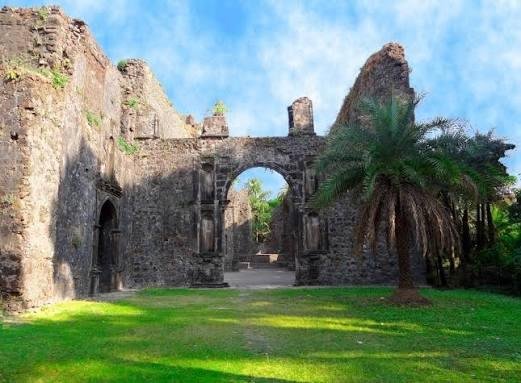
- Surviving ruins include Portuguese churches, arches, facades, bastions and civic structures.
Why Is Vasai Fort Important?
- Maritime significance: Its location connected coastal defence with trade and shipbuilding.
- Layered political history: Gujarat Sultanate, Portuguese, Maratha and British phases are represented at one site.
- Cultural heritage: Church ruins and colonial structures preserve an important phase of Indo-Portuguese history.
- Regional military history: The 1739 Maratha conquest marked an important shift in power along the western coast.
Heritage Conservation Challenge
The recent controversy highlights wider pressures on historic coastal sites:
- unmanaged waste;
- heavy visitor footfall;
- coastal pollution;
- encroachment;
- weak event management.
Conservation therefore requires coordination between archaeological protection, municipal administration and environmental management.
FAQs
Q1. Where is Vasai Fort located?
In Vasai, Palghar district, Maharashtra.
Q2. What was Vasai Fort also called?
Bassein Fort.
Q3. Who captured it from the Portuguese in 1739?
Chimaji Appa of the Maratha forces.
Q4. Which European power developed it into a major fortified settlement?
The Portuguese.
Q5. Why was Vasai strategically important?
Its coastal location supported trade, shipbuilding and maritime defence.