Context
The National Payments Corporation of India (NPCI) has introduced Merchant Discount Rate (MDR) on specified UPI person-to-merchant (P2M) transactions above ₹2,000, while person-to-person (P2P) payments remain free, to support the financial sustainability of digital payments.
About UPI and Its Significance
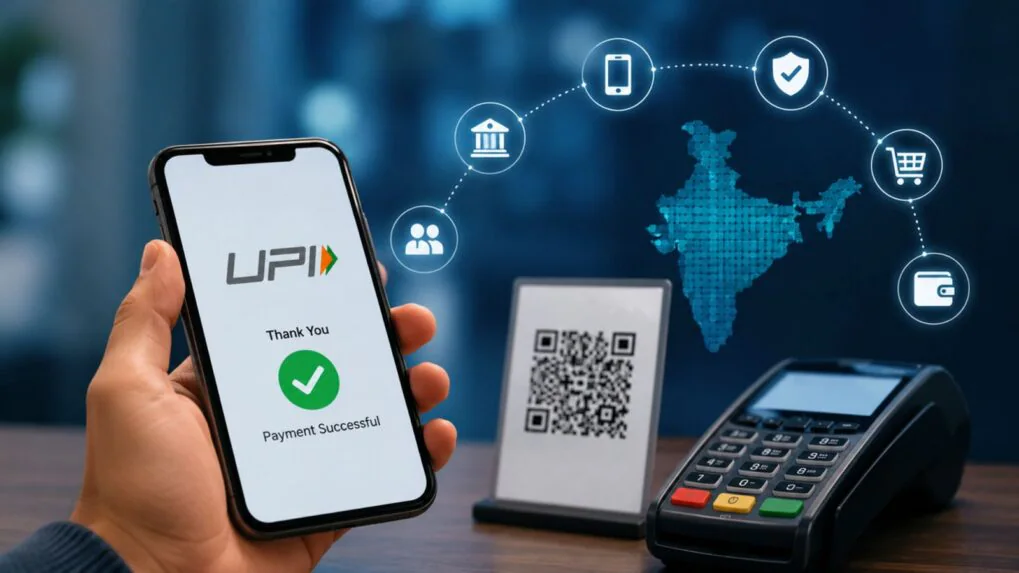
- Definition: Unified Payments Interface (UPI) is an interoperable payment system enabling instant bank-to-bank transfers through UPI IDs, mobile numbers and QR codes.
- Launch: Developed by NPCI and launched in 2016, UPI enables both P2P and P2M payments.
- NPCI: It is an RBI-regulated entity and a Section 8, not-for-profit company under the Companies Act, 2013. It operates retail payment systems under the Payment and Settlement Systems Act, 2007.
- Interoperability: UPI connects multiple banks on a common platform, allowing seamless transfers across banks.
- Financial Inclusion: Enables simple, low-cost digital payments, including for small businesses and individuals.
- Formalisation: Creates a digital transaction trail, supporting formalisation and transparency.
- Digital Governance: Supports electronic government payments, including Direct Benefit Transfers (DBT).
- Digital Economy: Strengthens India’s retail digital-payment ecosystem and promotes wider adoption of digital payments.
What is MDR?
- Definition: Merchant Discount Rate (MDR) is the fee charged for processing a digital payment received by a merchant.
- Purpose: It compensates banks, payment processors and other payment-system participants involved in processing for maintaining payment infrastructure and related services.
- Who Pays: MDR is generally borne by the merchant and deducted from the amount settled to the merchant; RBI directions for card payments have also required that it should not be passed on to customers.
Key Features of the New MDR Framework
- Standard P2M (Person → Merchant): 0.4% MDR on eligible merchant transactions above ₹2,000, capped at ₹300 per transaction.
- P2P: Person-to-person transfers remain MDR-free.
- Small Merchants: UPI receipts up to ₹1 lakh/month qualify for MDR exemption, subject to the applicable framework.
- Essential Services: ₹5 flat MDR for sectors such as railways, telecom, insurance, fuel, electricity, water, piped gas, education and agricultural inputs.
- Capital Markets: 0.02% MDR, subject to a ₹300 cap, for eligible transactions involving areas such as securities, mutual funds and stockbroking.
- UPI AutoPay: Recurring UPI payments remain outside this MDR framework. NPCI separately regulates the UPI AutoPay system.
Why is MDR Being Introduced?
- Financial Sustainability: Rapid growth in UPI requires continuous investment in payment infrastructure, technology and cybersecurity.
- Reduce Fiscal Dependence: Earlier, the government provided incentives to support low-value BHIM-UPI transactions under the zero-MDR framework. MDR can reduce reliance on such support.
- Cost Sharing: MDR can help share payment-system costs across the ecosystem and support continued investment in digital-payment infrastructure.
Concerns and Challenges
- Merchant & MSME Burden: MDR can raise transaction costs and affect the margins of small businesses and MSMEs.
- Consumer Impact: Merchants may pass the cost to consumers through higher prices or additional charges.
- Digital Adoption: Higher costs could encourage some merchants to shift towards cash payments, affecting digital-payment adoption.
- Sustainability–Inclusion Trade-off: Ensuring the financial sustainability of UPI without reducing the affordability and inclusiveness of digital payments remains a key challenge.
Way Forward
- Protect Small Merchants: Keep low-value transactions and eligible MSME payments affordable to preserve financial inclusion.
- Differentiated, Cost-Based MDR: Link MDR to transaction value, merchant size, sector and actual processing costs.
- Targeted Government Support: Continue subsidies for socially important and low-value transactions while reducing excessive fiscal dependence.
- Transparency & Cybersecurity: Ensure transparent use of MDR revenues for payment infrastructure, fraud prevention and cybersecurity.
- Consumer Protection & Interoperability: Prevent undisclosed charges on consumers and preserve UPI’s interoperability and accessibility.
FAQs
Q1. What is Merchant Discount Rate (MDR)?
Ans. MDR is a fee associated with processing merchant digital payments, generally borne by the merchant.
Q2. What is the difference between P2P and P2M transactions?
Ans. P2P (Person-to-Person) refers to transfers between individuals, while P2M (Person-to-Merchant) refers to payments made by consumers to businesses or merchants.
Q3. What is UPI?
Ans. UPI is an interoperable payment system developed by NPCI that enables instant bank-to-bank P2P and P2M payments.
Q4. Is NPCI a statutory body?
Ans. No. NPCI is a Section 8 not-for-profit company incorporated under the Companies Act, 2013. It operates payment systems under the Payment and Settlement Systems Act, 2007.