Context
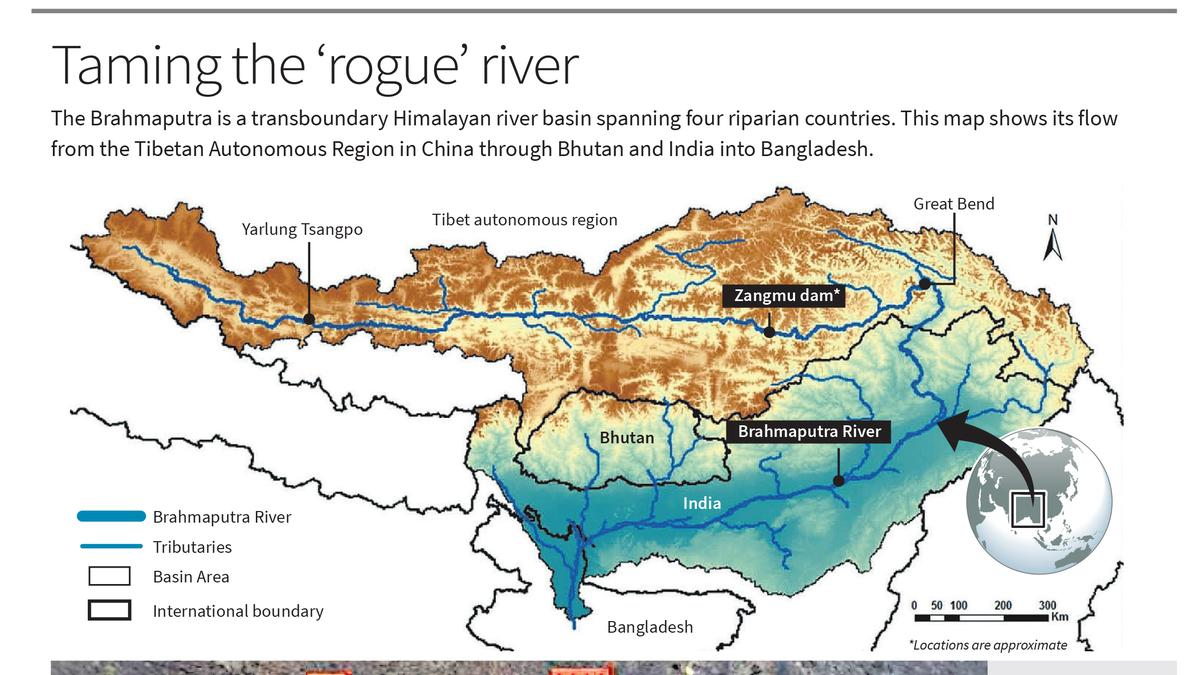
China is developing a mega hydropower project on the lower reaches of the Yarlung Tsangpo, the Tibetan name for the Brahmaputra River. The project has gained greater significance after the recent devastating floods along the Nepal–China border, highlighting the vulnerability of Himalayan infrastructure to extreme natural events.
Understanding the Yarlung Tsangpo–Brahmaputra System
- Origin: The river originates in the Tibetan Plateau, near the Himalayan region, and flows through Tibet as the Yarlung Tsangpo before entering India through Arunachal Pradesh.
- Course in India: After entering Arunachal Pradesh, the river flows into Assam, where it becomes a major source of water for the region before eventually flowing into Bangladesh.
- Major Geographical Feature: The river makes a great bend in the eastern Himalayas, creating a region with a very large elevation drop and significant hydropower potential.
- Existing Chinese Development: China has already developed hydropower projects on the upper reaches, including the Zangmu Dam, while the proposed mega project represents a much larger expansion of hydropower generation.
Why is China Building the Mega Dam?
- Energy Security: China is seeking to expand hydropower generation as part of its strategy to meet rising energy demand and strengthen energy security.
- Renewable Energy Transition: Hydropower provides electricity without direct fossil-fuel combustion and can complement other renewable sources such as solar and wind.
- Strategic Importance: Control over infrastructure on a major transboundary river gives the upstream country greater influence over water management, although the project is officially presented primarily as an energy-development initiative.
Major Concerns for India
- Seasonal and Ecological Flow: India is concerned that large-scale water infrastructure upstream could influence the quantity and timing of downstream flows of the Brahmaputra.
- Agriculture and Livelihoods: The Brahmaputra is important for agriculture, fisheries, wetlands and livelihoods in Arunachal Pradesh and Assam.
- Seismic Vulnerability: The project is located in a tectonically active Himalayan region, where earthquakes and associated landslides are major hazards.
- Downstream Consequences: Any major structural failure or sudden release of water could potentially have serious consequences for downstream settlements and infrastructure in India.
- River Ecosystem: Large dams can modify river discharge, sediment transport and aquatic habitats, potentially affecting downstream ecosystems.
- Sedimentation: Changes in the movement and deposition of sediments can alter river morphology and channel behaviour, particularly in a dynamic Himalayan river system.
- Hydrological Information: India has repeatedly emphasised the importance of timely sharing of hydrological and meteorological data on transboundary rivers.
Hydropower Potential: India vs China
- China’s Rapid Expansion: China has significantly expanded its hydropower capacity through large-scale investment, geological research and development of major river projects.
- India’s Slower Growth: India has substantial hydropower potential, particularly in the Himalayan and Northeast regions, but development has been constrained by ecological concerns, geological risks, land acquisition and local opposition.
- Strategic Gap: The contrasting pace of development has created concerns that India may fall behind China in harnessing the hydropower potential of Himalayan rivers.
Hydropower: Development vs Ecology
- Energy Security: India’s rising population, urbanisation and industrialisation are increasing electricity demand. Hydropower can provide low-carbon electricity and grid flexibility, particularly when combined with intermittent solar and wind power.
- Climate Concerns: Climate change is altering glacier melt, rainfall patterns and extreme weather events, creating uncertainty in river flows and making long-term hydropower planning more difficult.
- Extreme Rainfall: Events such as intense cloudbursts can produce extremely high short-duration flows. Such extremes can challenge the safety and operational capacity of dams and downstream infrastructure.
- Ecological Flow: Large dams can create stretches of dewatered river channels if adequate environmental flows are not maintained. This can affect aquatic biodiversity, sediment movement and downstream ecosystems.
- Himalayan Fragility: The Himalayas combine active tectonics, steep slopes, fragile geology, glacier systems and extreme rainfall. Therefore, large infrastructure projects require particularly careful environmental and geological assessment.
Way Forward
- Strengthen Transboundary Cooperation: India and China should strengthen mechanisms for regular hydrological data sharing, flood forecasting and communication regarding major projects on the Brahmaputra.
- Joint Disaster Risk Assessment: Projects in the Himalayan region should undergo detailed assessments covering earthquakes, landslides, glacial hazards, extreme rainfall and dam-break scenarios.
- Maintain Ecological Flows: Dam operations should ensure adequate environmental flows to sustain downstream ecosystems, agriculture and livelihoods.
- Improve Himalayan Infrastructure Standards: Hydropower projects in fragile mountain regions should adopt climate-resilient and disaster-resilient engineering, supported by continuous geological monitoring.
- Diversify India’s Energy Mix: India should expand hydropower where environmentally and geologically feasible while simultaneously strengthening solar, wind, storage and pumped-storage capacity.
- Strengthen Regional Institutions: Existing bilateral and regional mechanisms should be used to address transboundary water management, disaster preparedness and climate risks.
- Balance Development with Ecology: Hydropower development should follow a basin-level approach rather than isolated project-by-project planning, particularly in ecologically sensitive Himalayan regions.
FAQs
Q1. What is the Yarlung Tsangpo?
It is the name of the Brahmaputra River in Tibet. The river enters India through Arunachal Pradesh and subsequently flows through Assam.
Q2. Why is China’s mega dam a concern for India?
India is concerned about possible impacts on downstream water flows, sediment transport, ecological systems and disaster risks, particularly because the project is located in a seismically active Himalayan region.
Q3. Why is hydropower important for India?
Hydropower provides low-carbon electricity, energy security and grid-balancing capacity, especially as India expands solar and wind power.
Q4. What is ecological flow?
Ecological flow refers to the quantity, timing and quality of water flows required to maintain the health of a river ecosystem and support dependent communities.
Q5. What are the major risks of Himalayan hydropower projects?
Major risks include earthquakes, landslides, flash floods, extreme rainfall, glacier-related hazards and sedimentation.
Q6. Why are transboundary rivers a source of conflict?
Upstream activities can influence water availability, timing of flows, floods and sediment movement downstream, creating competing interests among riparian countries.
Q7. What is the way forward for India?
India needs a combination of transboundary cooperation, hydrological data sharing, ecological-flow management, climate-resilient infrastructure and sustainable hydropower development.