Context
Recent observations provide magnetic and auroral evidence of a huge ocean beneath Ganymede’s icy surface. However, scientists are still investigating whether this ocean is directly connected to salts found on the surface.
About Ganymede
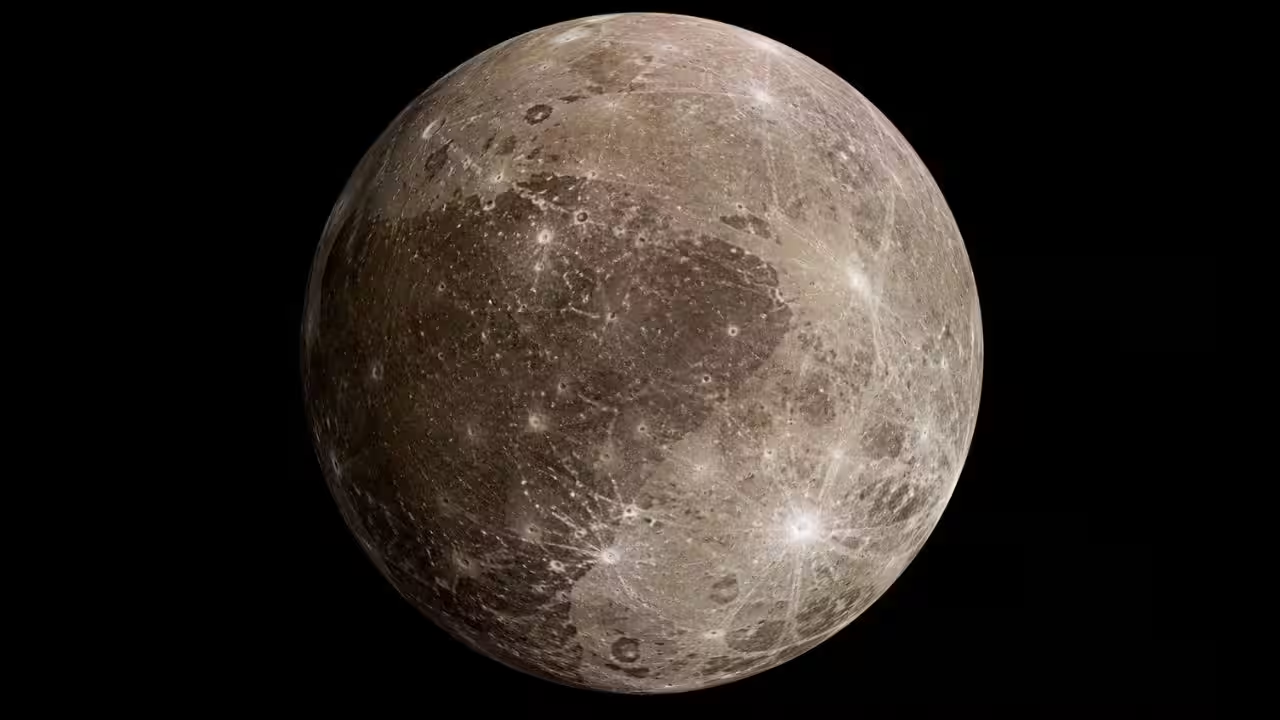
- Ganymede is the largest moon of Jupiter and the largest natural satellite in the Solar System.
- It is also the only known moon with its own magnetic field.
- Galileo Galilei discovered Ganymede in 1610. Its name comes from a figure from Greek mythology associated with Zeus, the Greek counterpart of Jupiter.
- With a diameter of about 5,270 km, Ganymede is larger than Mercury, although it has much less mass.
- Ganymede is about 1 million km from Jupiter and follows synchronous rotation, meaning the same side of the moon always faces Jupiter.
- Its low density suggests that Ganymede is made up of roughly half rock and half water ice by mass.
- Internal structure: It is believed to have:
- A metallic iron core
- A layer of rock
- A very thick outer layer mainly made of water ice
- Scientists believe that a saltwater ocean exists beneath its icy surface, making Ganymede an important target in the search for potentially habitable environments beyond Earth.
- Ganymede has a thin atmosphere, mainly containing hydrogen, with possible traces of compounds such as carbon dioxide.
- Exploration: The Jupiter Icy Moons Explorer (JUICE) mission is studying Ganymede along with other icy moons of Jupiter to understand their oceans, geology and evolution.
FAQs
Q1. What is Ganymede?
It is Jupiter’s largest moon and the biggest natural satellite in the Solar System, even larger than Mercury.
Q2. Who discovered Ganymede and why is it unique?
Discovered by Galileo Galilei in 1610, it is the only known moon with its own magnetic field.
Q3. What is Ganymede’s internal structure?
Believed to have a metallic iron core, a rocky layer, and a thick outer shell of water ice, with a possible subsurface saltwater ocean.
Q4. What evidence suggests an ocean beneath Ganymede’s surface?
Magnetic and auroral observations indicate a huge ocean beneath its icy crust, making it a candidate for habitable environments.
Q5. How is Ganymede being explored today?
The European Space Agency’s JUICE mission is studying Ganymede and other icy moons to understand their oceans, geology, and evolution.