Context
- The Supreme Court is examining the proposal to use EVM totalisers for vote counting.
- The Central Government has been asked to state its position, while the Election Commission of India (ECI) has been asked to submit its formal proposal.
What is an EVM Totaliser?
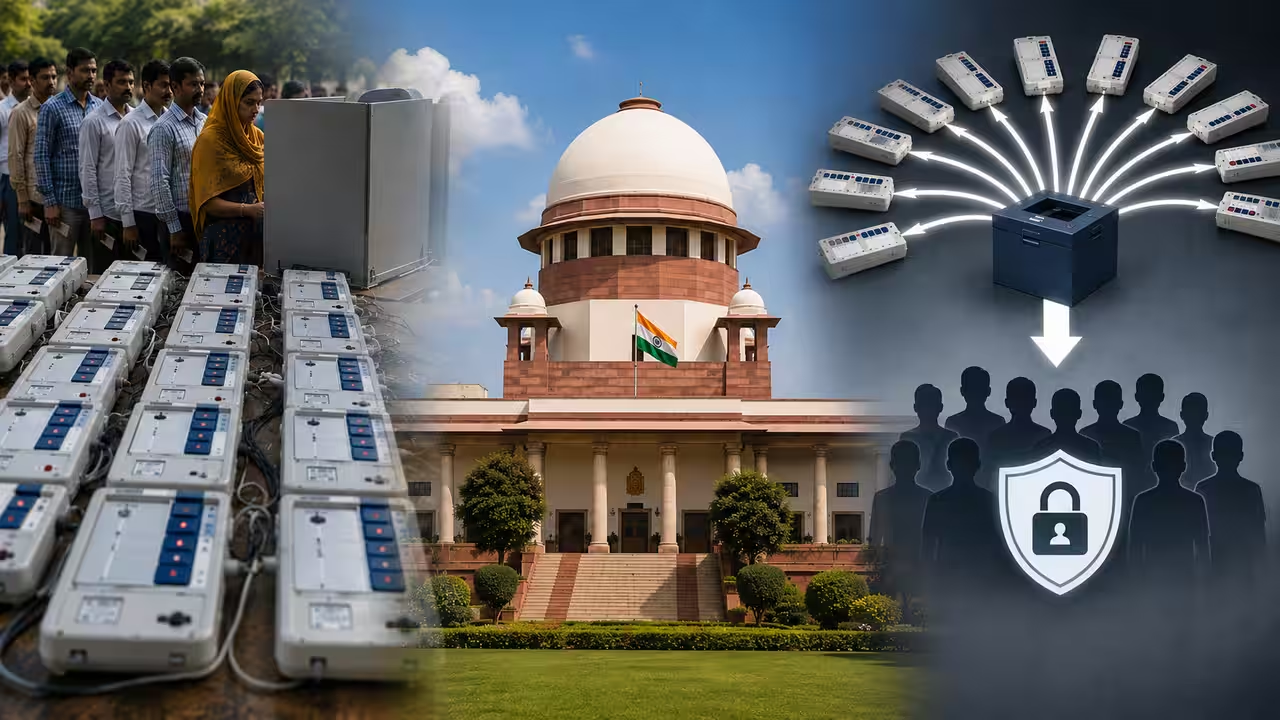
- An EVM totaliser combines votes from around 14 polling booths and displays a single candidate-wise result for the group.
- It functions as an interface connected to the Control Units of 14 EVMs.
- By combining the results, it does not reveal the voting pattern of any one booth separately.
- The system was developed by Bharat Electronics Limited (BEL), Bengaluru, and Electronics Corporation of India Limited (ECIL), Hyderabad.
Background
- The issue dates back to 2014, when Yogesh Gupta and Imran Khan filed a Public Interest Litigation (PIL) seeking the mixing of votes from different polling stations within a constituency.
- They argued that separate booth results could reveal the voting preferences of particular areas and create a risk of intimidation or retaliation.
- The petition referred to an alleged incident involving Ajit Pawar in the Baramati constituency, where EVM data was reportedly linked to identifying anti-party voting patterns.
Views of the Centre and ECI
- Central Government
- The Centre has historically opposed the introduction of totalisers.
- In 2017, it argued that booth-wise results could help candidates identify areas with low support and improve their efforts there.
- A Law Ministry affidavit referred to a Group of Ministers headed by Rajnath Singh, which considered large-scale voter intimidation unlikely in the era of media activism.
- In 2018, the Additional Solicitor General raised concerns about a possible data breach before counting.
- The Centre has also raised concerns about possible EVM data leaks before counting.
- Election Commission of India
- The ECI has supported totalisers for several years.
- It first proposed the idea to the UPA Government in 2008.
- In 2018, it told the Supreme Court that the time had come to introduce totalisers.
- At the same time, the ECI has highlighted practical and legal issues concerning booth-wise verification and VVPAT.
Supreme Court’s Proceedings
- The Court has asked the Centre to clarify whether there are any impediments to introducing totalisers and whether the system could have any negative impact.
- The ECI has also been given two weeks to respond to concerns about possible data leaks before counting.
Significance
- The debate focuses on balancing the secrecy of voting with the use of booth-level election information.
- A totaliser can make it difficult to identify the voting pattern of a particular booth.
- At the same time, data security, booth-level verification and VVPAT remain important issues.
EVM Totaliser FAQs
Q1. What is the basic idea behind an EVM totaliser?
Ans: It combines votes from multiple polling booths before displaying the result. This prevents the voting pattern of an individual booth from being shown separately.
Q2. Why was the issue raised before the Supreme Court?
Ans: The petitioners argued that separate booth results could reveal the voting preferences of particular areas and potentially expose voters to intimidation or retaliation.
Q3. What is the difference between the Centre’s and the ECI’s positions?
Ans: The Centre has opposed the proposal, citing concerns including data security, while the ECI has supported it but has also pointed to verification and VVPAT-related issues.
Q4. What is a Public Interest Litigation?
Ans: A PIL allows a matter involving wider public interest to be brought before the court. The present case began with a PIL filed in 2014.
Q5. Why is VVPAT relevant to the debate?
Ans: VVPAT is linked to the verification of EVM voting. The ECI has identified practical and legal questions concerning booth-wise verification and VVPAT.
Q6. Why is data security an issue in this matter?
Ans: The Centre has raised concerns about the possibility of EVM data leaks before counting, making data protection an important part of the debate.