Context
The Bihar Government has modified its consent policy concerning the Central Bureau of Investigation (CBI). The move highlights the constitutional and federal issue of State consent for CBI investigations within a State.
About CBI
- The CBI was established in 1963 through a Central Government resolution.
- It is not a statutory body, as it was not created through an Act of Parliament.
- Its investigative powers are primarily derived from the Delhi Special Police Establishment (DSPE) Act, 1946.
- The CBI functions under the Department of Personnel and Training (DoPT), Ministry of Personnel, Public Grievances and Pensions.
Why Does CBI Need State Consent?
- Police is a State List subject under Entry 2 of List II of the Seventh Schedule.
- Therefore, the Centre cannot ordinarily extend CBI’s police powers into a State without its consent.
Key Provisions of DSPE Act, 1946
- Section 3: The Central Government specifies the offences/classes of offences that can be investigated by the CBI.
- Section 5: Allows the Central Government to extend CBI’s jurisdiction to areas within a State.
- Section 6: Such extension requires the consent of the concerned State Government.
General Consent vs Specific Consent
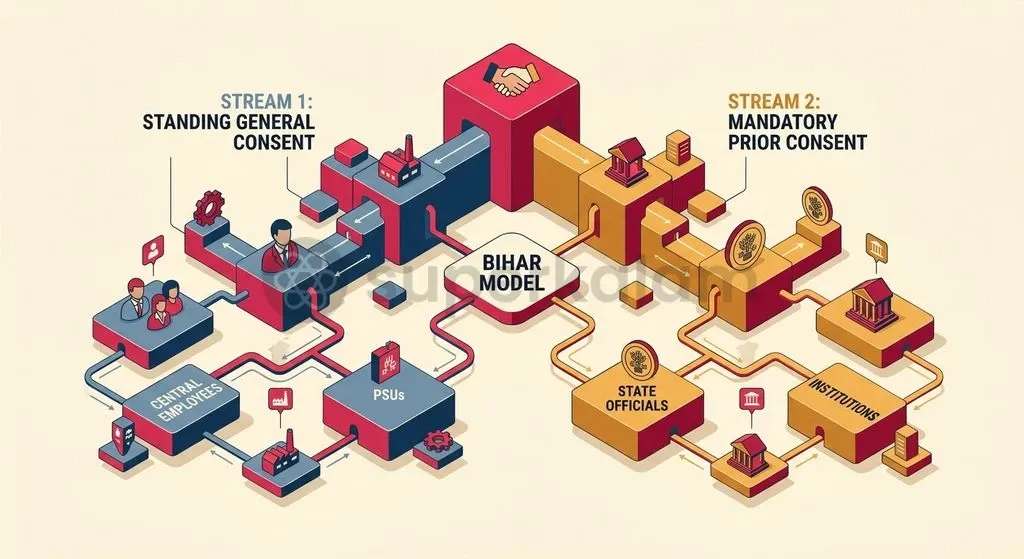
- General Consent: A State allows the CBI to investigate specified categories of cases without seeking permission for every individual case.
- Withdrawal of General Consent: The CBI ordinarily requires specific consent from the State Government before registering a fresh case within that State.
- However, withdrawal does not automatically invalidate cases already registered or investigations already underway.
Can CBI Investigate Without State Consent?
- The Supreme Court or a High Court can order a CBI investigation in a State without obtaining State consent.
- This power arises from the constitutional jurisdiction of the higher judiciary, and not from Section 6 of the DSPE Act.
- Thus, judicial intervention acts as an important exception to the State-consent requirement.
Federal Significance
- The consent requirement reflects India’s federal structure, particularly the division of powers between the Centre and States.
- It protects the State’s authority over policing and investigation while allowing the CBI to investigate cases having wider national implications.
- Frequent disputes over CBI consent also highlight tensions between central investigative agencies and State governments.
Way Forward
- Ensure transparent and clearly defined guidelines for granting or withdrawing general consent.
- Strengthen Centre-State consultation on inter-State and nationally significant investigations.
- Maintain the professional autonomy and credibility of investigative agencies.
- Develop institutional mechanisms to prevent investigative powers from becoming a source of Centre-State friction.
FAQs
- Is the CBI a statutory body?
No. It was established through a 1963 executive resolution. Its investigative powers primarily flow from the DSPE Act, 1946. - Why does CBI require State consent?
Because police is a State List subject, and Section 6 of the DSPE Act requires State consent for extending CBI jurisdiction. - What is general consent?
It is permission given by a State allowing CBI to investigate specified categories of cases without seeking permission in every individual case. - Can a State withdraw general consent?
Yes. After withdrawal, CBI ordinarily requires specific consent to register a fresh case within that State. - Can courts order CBI investigation without State consent?
Yes. The Supreme Court and High Courts can direct a CBI investigation using their constitutional powers. - Which Act provides the legal basis for CBI investigations?
The Delhi Special Police Establishment Act, 1946 provides the primary statutory basis for CBI’s investigative powers.