Context
The Central Bureau of Investigation (CBI) has arrested the last absconding accused in the 2002 Garhwa Fort idol theft, dacoity, and murder case.
About Garhwa Fort
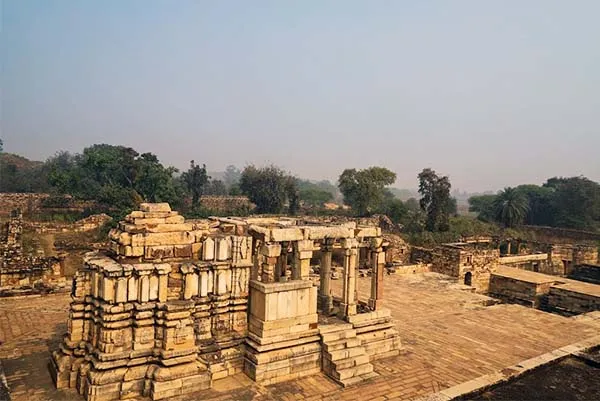
- Garhwa Fort is a historic fortified Hindu temple complex located in Garhwa village, Prayagraj district, Uttar Pradesh.
- The temples within the complex date to the Gupta period, while the present fortifications were built around 1750 CE by the Baghel ruler Vikramaditya.
- During the Gupta period, the site was known as Bhattagram or Bhattapraya. It is protected as a Monument of National Importance by the Archaeological Survey of India (ASI).
- Seven inscriptions from the reigns of Chandragupta II, Kumaragupta I, and Skandagupta have been discovered at the site, highlighting its importance during the Gupta period.
- The principal temple, believed to be of Gupta origin, follows a Panchakona (five-sided) plan. It consists of a square sanctum (garbhagriha) and a pillared mandapa, with an east-facing entrance.
- The fort complex extends over nearly 2 km and has bastions at all four corners and two perennial stepwells.
- The complex preserves sculptures and inscriptions dating from the Gupta period to the British era. Its most notable artefact is an 11th–12th century sculpture depicting the Dashavatara (Ten Incarnations of Lord Vishnu).
- Most of the sculptures have been shifted to the State Museum, Lucknow, for conservation.
- Gupta-period sculptures are carved from pink sandstone, whereas medieval-period sculptures are carved from grey sandstone.