Context
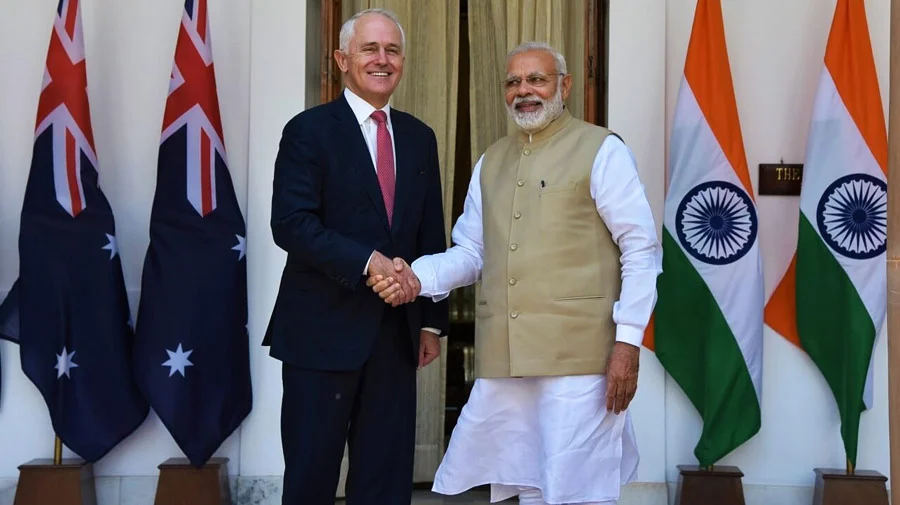
The 3rd India–Australia Annual Summit (2026), held in Melbourne, marked a significant milestone in deepening the Comprehensive Strategic Partnership through agreements spanning defence, trade, critical minerals, clean energy, technology, education, and cultural cooperation. The summit reflects the growing strategic convergence between the two countries amid evolving geopolitical and economic challenges in the Indo-Pacific.
Strategic Significance
India and Australia reaffirmed their commitment to:
- A free, open, inclusive, and rules-based Indo-Pacific.
- Freedom of navigation and adherence to the United Nations Convention on the Law of the Sea (UNCLOS).
- Strengthening cooperation under the Quad framework.
- Peaceful resolution of disputes through dialogue and diplomacy.
- Joint efforts to combat cross-border terrorism.
The summit reinforces India–Australia cooperation in promoting a secure maritime order, resilient supply chains, and a rules-based regional architecture.
Key Outcomes of the Summit
Defence and Maritime Cooperation
- Adopted a Joint Declaration on Defence and Security Cooperation to deepen strategic engagement through:
-
- Enhanced strategic consultations and military interoperability.
- Expansion of bilateral and multilateral military exercises.
- Collaboration in defence technology, research, and industrial supply chains.
- Stronger defence industrial partnerships.
- Launched the India–Australia Defence Innovation Corridor to promote defence innovation, co-development, and collaboration between industries and start-ups.
- Adopted a Maritime Security Roadmap to strengthen maritime domain awareness, shipbuilding, ship repair, logistics support, and regional maritime security across the Indo-Pacific.
Civil Nuclear Cooperation
- Operationalised the 2014 India–Australia Civil Nuclear Agreement through the finalisation of an administrative arrangement.
- The agreement will:
- Enable Australian uranium exports for India’s peaceful nuclear programme.
- Support India’s clean energy transition and long-term energy security.
- Provide Australia with a reliable long-term export market for uranium.
Economic and Trade Cooperation
- Agreed to expedite negotiations on the Comprehensive Economic Cooperation Agreement (CECA) and the Bilateral Investment Treaty (BIT).
- Building on the gains of the Economic Cooperation and Trade Agreement (ECTA), both sides agreed to:
- Reduce non-tariff barriers.
- Improve institutional financing.
- Encourage greater private-sector investment.
Energy and Critical Minerals
- Expanded cooperation in critical minerals, renewable energy technologies, and energy security.
- Decided to establish a Joint Rooftop Solar Training Academy in Gujarat under the PM Surya Ghar Yojana to train women and youth in rooftop solar installation and maintenance.
Technology and Innovation
- Launched the Partnership on Cyber, Critical Technologies and Supply Chains (PACTS) to strengthen cooperation in cybersecurity, semiconductors, critical technologies, and resilient supply chains.
- Australia, Canada, and India signed the Australia–Canada–India Technology and Innovation (ACITI) framework to strengthen collaboration in trusted and resilient technologies.
Education and Skill Development
Expanded cooperation in higher education, vocational training, and skill development through:
- A Letter of Intent for Flinders University to establish a campus in Bengaluru.
- Approval for Victoria University to establish a campus in Gurugram.
- Establishment of a National Centre of Excellence for Skilling in Mining at the National Skill Training Institute, Bhubaneswar.
Cultural Cooperation
- Australia agreed to repatriate three antiquities from Tamil Nadu:
- Granite Nandi sculpture.
- Bronze Trident with Bhadrakali.
- Basalt six-headed Skanda (Karthikeya) sculpture.
- India agreed to repatriate the remains of an Australian First Nations ancestor preserved at the Government Museum, Chennai.
India–Australia Bilateral Relations
- India and Australia share a Comprehensive Strategic Partnership and are members of the Commonwealth of Nations.
- Bilateral relations encompass trade, defence, technology, education, migration, sports, and strong people-to-people linkages.
- Bilateral trade stands at approximately US$32.6 billion, with India recording a trade deficit.
- Australia is a key supplier of coal, LNG, uranium, and critical minerals, while India is an important market for Australian education and a major partner in information technology and pharmaceuticals.
- Defence cooperation includes the AUSINDEX (Navy) and AUSTRAHIND (Army) exercises.
- Both countries cooperate through the Quad, East Asia Summit (EAS), Indian Ocean Rim Association (IORA), and other regional forums.
- Bilateral engagement is further supported by the Centre for Australia–India Relations.
Significance for India
- Advances India’s Indo-Pacific Vision and complements the Act East Policy.
- Strengthens defence and maritime cooperation in the Indo-Pacific.
- Diversifies critical mineral and clean energy supply chains, enhancing strategic resilience.
- Strengthens economic resilience through deeper trade, investment, and technology partnerships.
- Promotes innovation, skill development, higher education, and clean energy capacity.
- Enhances India’s strategic presence and partnerships across the Indo-Pacific.
Conclusion
The outcomes of the 3rd India–Australia Annual Summit reaffirm the expanding scope of bilateral cooperation across strategic, economic, technological, and people-centric domains. As trusted Indo-Pacific partners, India and Australia are well positioned to advance regional stability, resilient supply chains, sustainable development, and a free, open, and rules-based Indo-Pacific.