Context
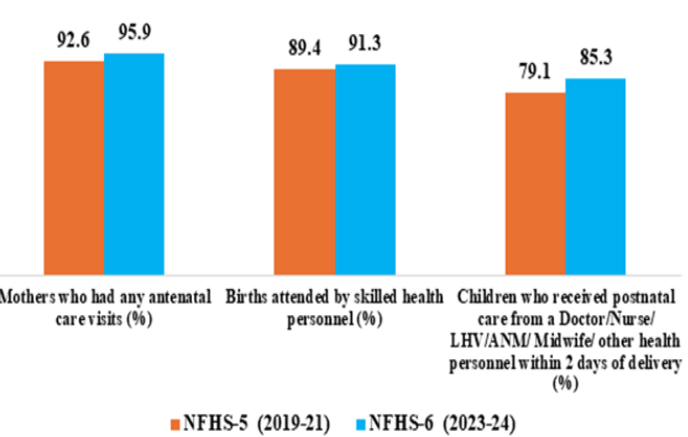
The fact sheets of NFHS-6 (2023–24) indicate improvements in maternal health, nutrition, and women’s empowerment. However, compared to NFHS-5, the survey has reduced the number of indicators covered, raising concerns regarding data continuity, programme evaluation, and evidence-based policymaking.
National Family Health Survey (NFHS)
- The National Family Health Survey (NFHS) is a large-scale household survey conducted by the Ministry of Health and Family Welfare, with the International Institute for Population Sciences (IIPS), Mumbai, serving as the nodal agency.
- It provides comprehensive data on health, nutrition, fertility, population, and socio-economic indicators.
- NFHS serves as a key source for policy formulation, programme monitoring, and developmental planning.
Evolution of NFHS
| Survey Round | Key Features |
| NFHS-4 (2015–16) | Introduced district-level estimates and digital data collection |
| NFHS-5 (2019–21) | Expanded coverage to disability, preschool education, menstrual hygiene, and other social indicators |
| NFHS-6 (2023–24) | Covered nearly 6.8 lakh households across all States and UTs except Manipur
|
Unlike earlier rounds that progressively expanded coverage, NFHS-6 adopts a more selective approach by introducing new themes while removing several existing indicators.
New Areas Covered in NFHS-6
- Direct Benefit Transfer (DBT) utilisation.
- Self-Help Group (SHG) membership.
- Digital literacy and financial transactions.
- Hepatitis-B and Hepatitis-C testing among adults.
- Hepatitis-B testing among children through dried blood spot sampling.
- Reintroduction of biological HIV testing.
These additions reflect the growing importance of digital inclusion, financial empowerment, and disease surveillance.
Key Improvements Reported
- Maternal and Child Health
- Increase in antenatal care coverage.
- Rise in institutional deliveries, indicating improved access to healthcare services.
- Nutrition Outcomes
- Decline in child stunting, reflecting progress in nutritional interventions.
- Women’s Empowerment
- Significant increase in internet usage among women.
- Reduction in reported incidents of spousal violence.
Social Protection
- Expansion of health insurance coverage in several states.
- Greater integration of beneficiaries with welfare delivery systems.
Major Indicators Removed from NFHS-6
Anaemia Indicators
Indicators relating to anaemia among:
- Children
- Women
- Pregnant women
have been excluded.
Concerns regarding the accuracy of finger-prick haemoglobin testing have led to a shift towards specialised biomarker-based surveys using venous blood samples.
Mortality Indicators
The following indicators are no longer included:
- Neonatal Mortality Rate (NMR)
- Infant Mortality Rate (IMR)
- Under-Five Mortality Rate (U5MR)
These are expected to be tracked through the Sample Registration System (SRS).
Gender Indicators
The survey no longer reports:
- Overall sex ratio.
- Sex ratio at birth.
These indicators are important for assessing gender balance and monitoring sex-selective practices.
Sanitation and Clean Cooking Fuel
Indicators related to:
- Access to sanitation facilities.
- Use of clean cooking fuel.
have also been removed.
Cancer Screening Indicators
Indicators relating to screening for:
- Cervical cancer.
- Breast cancer.
- Oral cancer.
have been discontinued after a single survey round.
Implications of the Changes
Data Gaps
The removal of key indicators creates gaps in monitoring:
- Anaemia prevalence.
- Mortality outcomes.
- Sex ratio trends.
- Sanitation coverage.
- Clean cooking fuel usage.
- Cancer screening rates.
Constraints on Programme Evaluation
The absence of these indicators may limit assessment of initiatives such as:
- Swachh Bharat Mission.
- Pradhan Mantri Ujjwala Yojana.
- Anaemia Mukt Bharat.
- Other health and nutrition programmes.
Impact on Long-Term Analysis
- Reduces comparability across NFHS rounds.
- Weakens long-term trend analysis at national, state, and district levels.
- Limits understanding of socio-economic disparities in health outcomes.
Evidence-Based Policymaking
- Reduced availability of comparable data may affect policy formulation, resource allocation, and outcome-based governance in the health and social sectors.
Significance of NFHS-6
Methodological Advancements
- Greater emphasis on improving data quality and scientific accuracy.
- Reintroduction of biological HIV testing strengthens disease surveillance.
Capturing Emerging Development Trends
- Incorporates indicators related to digital inclusion, financial participation, and community-based institutions.
- Reflects changing patterns of welfare delivery and governance.
Policy and Governance Relevance
- Provides insights into health, nutrition, gender, and socio-economic conditions.
- Supports targeted interventions and evidence-based decision-making.
Challenges and Way Forward
| Challenges | Way Forward |
| Removal of several long-tracked indicators | Retain a core set of indicators across survey rounds to ensure continuity |
| Data gaps in areas such as anaemia, mortality, and sex ratio | Ensure timely release and integration of complementary surveys and datasets |
| Reduced ability to evaluate flagship welfare programmes | Continue monitoring indicators linked to major public schemes |
| Limited district-level and socio-economic analysis for some indicators | Strengthen granular data collection across alternative data systems |
| Lack of clarity regarding indicator selection and exclusion | Publish detailed methodological justifications and consultation reports |
| Balancing survey expansion with respondent burden | Adopt a modular survey design while preserving critical indicators |
Conclusion
NFHS-6 continues to be a critical source of evidence for India’s health and social sector policies. While the inclusion of new themes reflects evolving developmental priorities, maintaining continuity in core indicators remains essential for monitoring long-term trends, evaluating public programmes, and supporting evidence-based policymaking.