Context
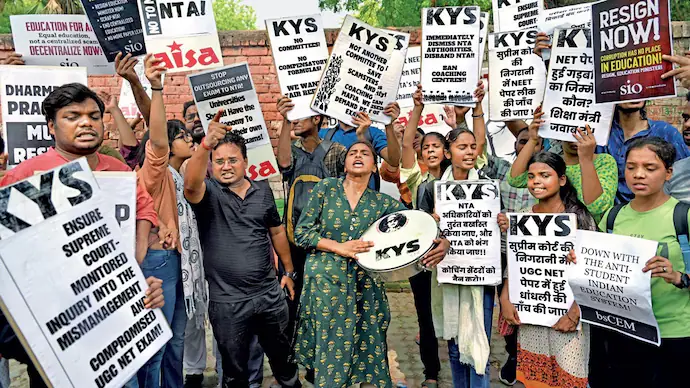
The National Testing Agency (NTA) recently ordered a re-test for NEET after reports of examination compromise emerged shortly after nearly 22 lakh candidates appeared for the exam. The decision triggered widespread concern among students and parents regarding the credibility, transparency, and administrative functioning of national-level examinations.
NEET 2024 Controversy
- In 2024, 67 out of the top 100 candidates secured full marks, compared to only 2 in 2023.
- The unusually high scores led to severe rank inflation and intensified competition for medical admissions.
- Around 13 lakh students qualified for NEET, while only nearly 1.1 lakh MBBS seats were available.
- Investigations later indicated that nearly 155 students may have benefited from leaked question papers.
- Despite allegations of irregularities, no re-test was conducted in 2024, raising concerns regarding consistency in institutional response.
NTA’s “Zero Error, Zero Tolerance” Policy
Following earlier controversies, NTA introduced stricter security measures for NEET examinations.
- GPS-tracked transportation of question papers
- CCTV surveillance at examination centres
- Aadhaar-based biometric verification
- Frisking through metal detectors
- Real-time central monitoring
- Police escort for confidential materials
The agency also acted against online platforms allegedly spreading fake papers and misleading candidates.
Recommendations of the Radhakrishnan Committee
Following the NEET-UG 2024 controversy, the Ministry of Education constituted a committee headed by former ISRO chief K. Radhakrishnan to recommend examination reforms. The recommendations include:
- Shift NEET from the conventional pen-and-paper format to Computer-Based Testing (CBT) to reduce risks of paper leaks and logistical breaches.
- Introduce a Computer-Assisted Secure Pen-and-Paper system involving:
- Encrypted digital transmission of question papers
- Printing of papers at examination centres shortly before the exam
- Reduce dependence on physical transportation and handling of confidential material.
Challenges and Way Forward
| Challenges | Way Forward |
| Online misinformation and fraud mislead aspirants. | Strengthen cyber monitoring and coordinated action against digital fraud networks. |
| Inconsistent handling of exam irregularities creates uncertainty among students. | Develop uniform protocols for investigations and re-tests. |
| Weak accountability mechanisms reduce public trust. | Strengthen institutional oversight and transparency. |
Conclusion
The repeated controversies surrounding NEET have exposed structural weaknesses in India’s examination system. Although NTA introduced stricter safeguards, delays in implementing technological and institutional reforms continue to affect examination credibility. Strengthening digital infrastructure, accountability, and transparent governance will be essential to restore public confidence in competitive examinations.