Context
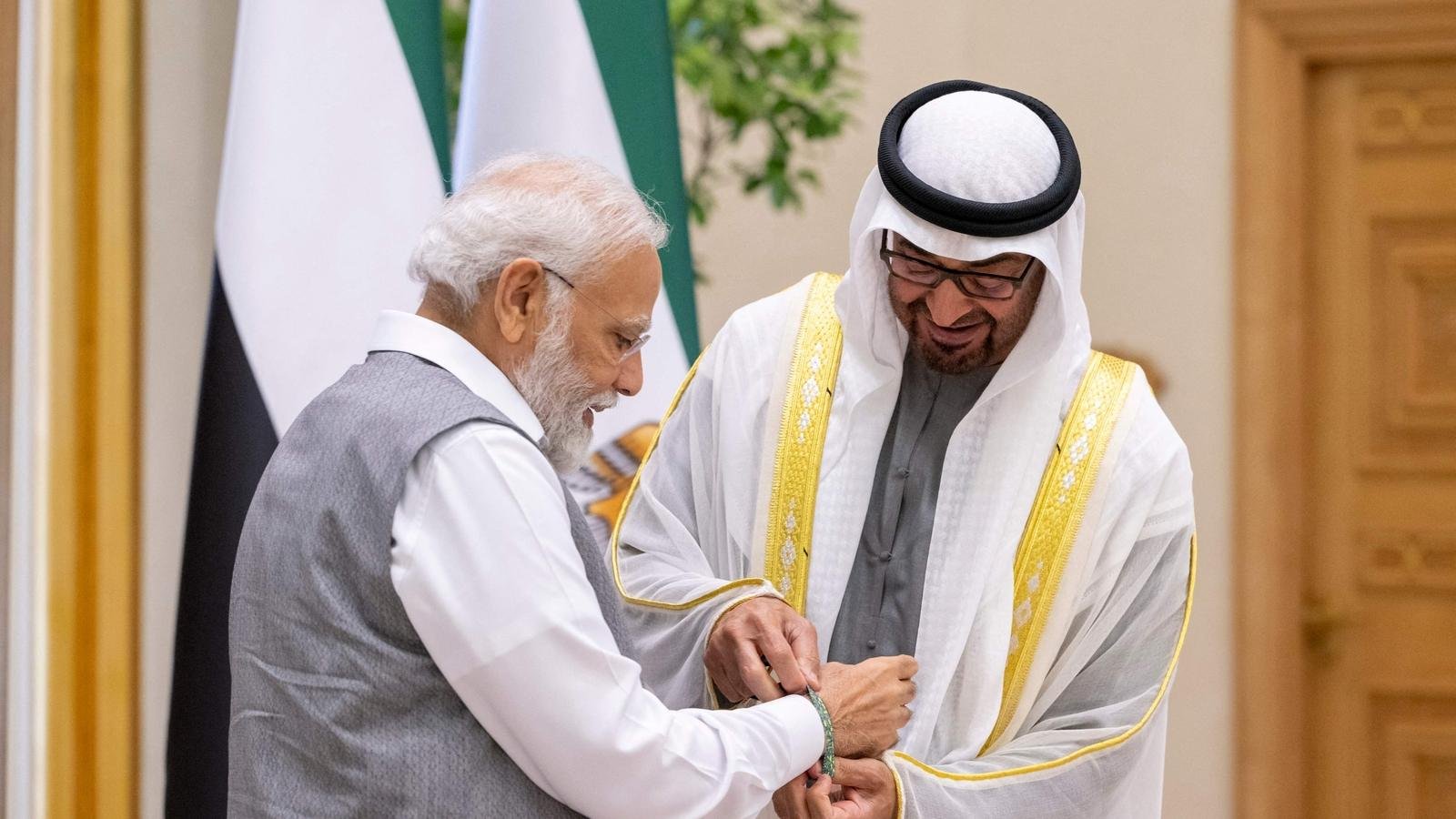
The Indian Prime Minister visited the United Arab Emirates (UAE) during his multi-nation European tour and held discussions with UAE President Mohamed bin Zayed Al Nahyan in Abu Dhabi. The visit took place amid growing instability in West Asia and concerns regarding disruptions in global energy supplies through the Strait of Hormuz. During the visit, both countries signed agreements in energy, defence, technology, trade, and maritime sectors, while the UAE announced fresh investments in India.
Diplomatic Relations
- India and the United Arab Emirates (UAE) established diplomatic ties in 1972.
- Bilateral relations acquired greater strategic depth after the Prime Minister’s visit to the UAE in 2015.
- Since then, engagement has expanded from traditional trade and energy cooperation to a comprehensive strategic partnership.
Economic Partnership
- The Comprehensive Economic Partnership Agreement (CEPA) has accelerated bilateral trade and investment.
- Trade between the two countries has crossed USD 100 billion.
- The UAE is India’s third-largest trading partner and an important destination for Indian exports.
- The partnership supports India’s integration with global and regional value chains.
Strategic and Regional Cooperation
- India and the UAE cooperate in regional groupings such as I2U2 and the India-Middle East-Europe Economic Corridor (IMEC).
- The relationship forms a major component of India’s “Link West Policy”.
- Both countries increasingly collaborate on regional connectivity, maritime security, and economic stability in West Asia.
Indian Diaspora
- The UAE hosts nearly 3.5 million Indians, making it one of the largest Indian diaspora communities abroad.
- Remittances from the UAE contribute significantly to India’s foreign exchange inflows.
- The diaspora also acts as a strong cultural and economic bridge between the two countries.
India’s Position on West Asia Stability
- India condemned attacks on the UAE and reiterated support for peaceful resolution of regional conflicts through dialogue and diplomacy.
- India also highlighted the strategic importance of the Strait of Hormuz because:
- A major share of global crude oil and LNG trade passes through this route.
- India’s energy imports from the Gulf depend heavily on it.
- Any disruption can affect inflation, shipping costs, and global supply chains.
Major Areas of Cooperation
- Energy Partnership and its relevance
- Cooperation between ISPRL and ADNOC to expand participation in India’s Strategic Petroleum Reserves (SPRs).
- Possible collaboration in LNG and LPG storage infrastructure.
- Long-term LPG supply agreement between IOCL and ADNOC.
- India’s strategic petroleum reserves are located at Visakhapatnam, Mangaluru, and Padur.
- Enhances India’s preparedness against energy disruptions.
- Strengthens long-term energy security.
- Reduces risks arising from geopolitical instability.
- Defence and Security Cooperation and its importance
- Defence manufacturing
- Joint military training and exercises
- Maritime security
- Cyber security
- Advanced defence technologies
- Expands India’s strategic engagement in the Gulf region.
- Secures critical maritime trade routes.
- Strengthens cooperation in the Indian Ocean Region (IOR).
- Maritime Cooperation and its importance
Agreements between Cochin Shipyard Limited and Drydocks World focus on:
- Ship-repair facilities in Gujarat
- Offshore fabrication infrastructure
- Skill development in shipbuilding and repair
- Supports the Sagarmala Programme.
- Promotes India as a maritime services hub.
- Generates employment and industrial growth.
- Technology and Digital Cooperation and its importance
- Partnership between C-DAC and G42 for establishing an “8 Exaflop Supercomputing Cluster”.
- Strengthens India’s artificial intelligence and computing capabilities.
- Supports climate modelling, defence research, and data analytics.
- Expands cooperation in emerging technologies.
- Trade and Connectivity and its objectives
- India and the UAE operationalised a Virtual Trade Corridor under the MAITRI framework.
- Digital integration of customs and ports
- Faster cargo movement
- Lower logistics costs
- Greater trade efficiency
- Improves ease of doing business.
- Enhances trade connectivity.
- Strengthens India’s role in global supply chains.
- UAE Investments in India and its importance
The UAE announced investments worth nearly USD 5 billion in:
- Infrastructure
- Banking
- Financial services
- Reflects confidence in India’s growth prospects.
- Supports infrastructure financing.
- Deepens long-term economic cooperation.
Challenges and Way Forward
| Challenges | Way Forward |
| Regional instability threatens energy and trade routes. | Diversify energy sources and expand strategic reserves. |
| Heavy dependence on Gulf energy imports increases vulnerability. | Accelerate renewable energy transition and alternative partnerships. |
| Disruptions in the Strait of Hormuz can affect trade and inflation. | Strengthen maritime security and naval cooperation. |
| Balancing ties with UAE, Iran, Saudi Arabia, and Israel remains sensitive. | Continue balanced diplomatic engagement in the region. |
| Limited defence industrial cooperation restricts strategic depth. | Promote joint production and technology transfer. |
| Logistics and connectivity gaps reduce trade efficiency. | Expand digital trade corridors and modernise port infrastructure. |
Conclusion
India–UAE relations have evolved from a traditional energy partnership into a comprehensive strategic relationship covering defence, technology, trade, connectivity, and investment. The recent agreements strengthen India’s energy security, economic resilience, and strategic presence in West Asia while supporting deeper regional and global integration.