Context
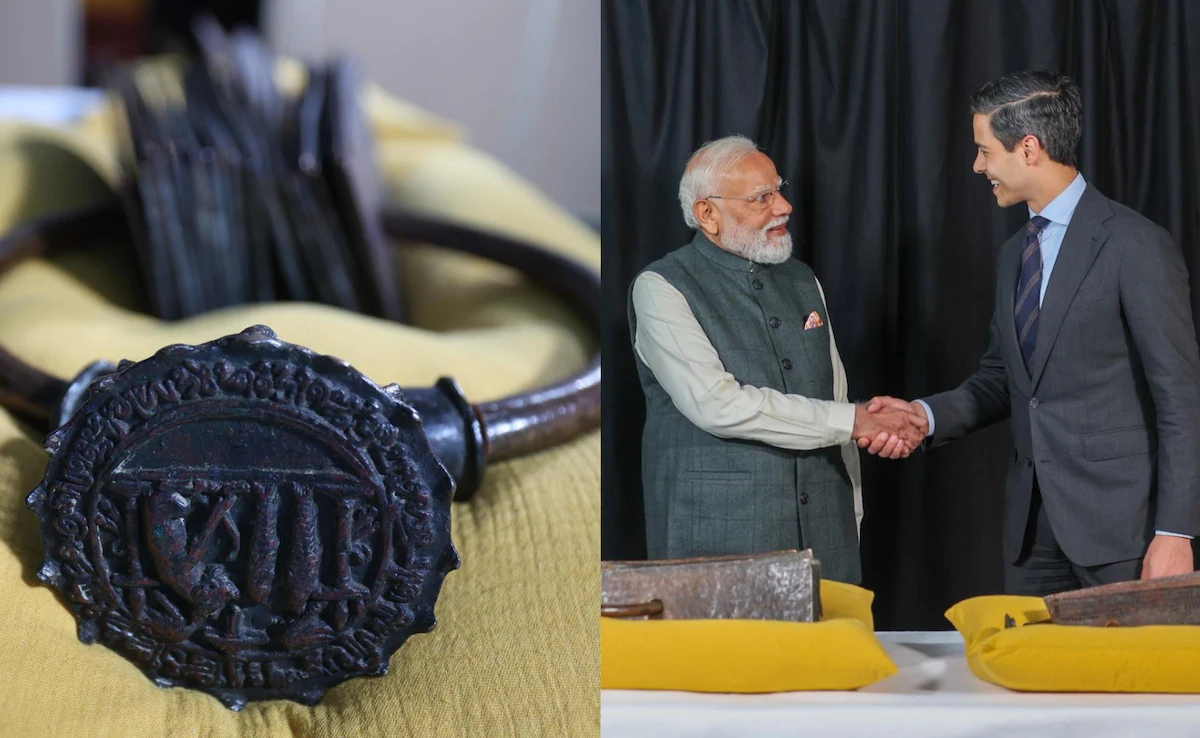
During Prime Minister Narendra Modi’s recent visit to the Netherlands, the Dutch government returned 11th-century Chola-era copper plates to India after nearly fourteen years of diplomatic efforts.
About the Copper Plates
- The artefacts belong to the reign of Rajaraja Chola I.
- One object consists of 21 copper plates weighing around 30 kilograms, containing inscriptions in Sanskrit and Tamil.
- Another set includes three copper plates with Tamil inscriptions.
- The plates are bound together by bronze rings bearing the royal seal of the Chola dynasty.
Historical Importance
The inscriptions provide valuable information regarding:
- Land grants
- Administrative systems
- Taxation practices
- Socio-economic conditions of medieval South India
Such records are considered important primary sources for understanding the governance structure of the Chola Empire.
Significance of Repatriation
- The artefacts were reportedly taken to the Netherlands during Dutch control over Nagapattinam in the early 18th century.
- Their return highlights India’s increasing success in recovering cultural artefacts from abroad.
- It also reflects growing international recognition of the need to preserve and restore civilisational heritage.
- Similar repatriation efforts in recent years have involved countries such as the United States, Australia and several European nations.
India–Netherlands Relations
India and the Netherlands share a broad and evolving partnership rooted in trade, technology, investment and cultural exchanges. In recent years, cooperation has expanded into strategic sectors such as climate adaptation, renewable energy, semiconductors and sustainable infrastructure.
Historical Background
- Bilateral contact began in the 17th century through the Dutch East India Company’s trade activities in India.
- Diplomatic relations were formally established after India’s independence in 1947.
- Over time, engagement moved beyond commerce to include agriculture, scientific research, environmental management and technological collaboration.
Major Areas of Cooperation
- Strategic and Technological Cooperation
Both countries maintain regular political engagement through ministerial visits and institutional dialogue.
Key Areas
- Water management and flood-control systems
- River rejuvenation and climate resilience
- Renewable energy and green hydrogen
- Semiconductor and high-technology sectors
- Agricultural innovation and food processing
- Port development and logistics modernisation
- Economic Relations
Economic cooperation remains the foundation of bilateral ties.
Important Features
- The Netherlands is one of India’s major trading partners in Europe.
- Bilateral trade crossed USD 27 billion in 2023–24.
- India’s exports mainly include petroleum products, pharmaceuticals, textiles, machinery and chemicals.
- Imports from the Netherlands consist largely of advanced machinery, medical equipment and technology-based products.
- Dutch investments in India are concentrated in renewable energy, manufacturing, logistics and technology sectors.
3. Cultural and Educational Links
People-to-people interaction has strengthened bilateral goodwill.
- The Netherlands hosts the largest Indian-origin community in mainland Europe.
- Indian students increasingly prefer Dutch universities for higher education, especially in science and technology disciplines.
- Cultural exchanges and diaspora engagement continue to deepen social ties between the two countries.
4. Cooperation in Global Forums
India and the Netherlands work together on several international issues, including:
- Climate change and sustainable development
- Maritime security and free trade routes
- Promotion of a rules-based international order
- The Netherlands has also supported closer India–European Union engagement in trade and technology.
Conclusion
India–Netherlands relations have developed into a multidimensional partnership driven by economic cooperation, technological collaboration and shared global interests. The return of the Chola-era copper plates has added a significant cultural dimension to bilateral ties while reinforcing the importance of protecting historical heritage.