Important Questions for UPSC Prelims, Mains and Interview
|
Context
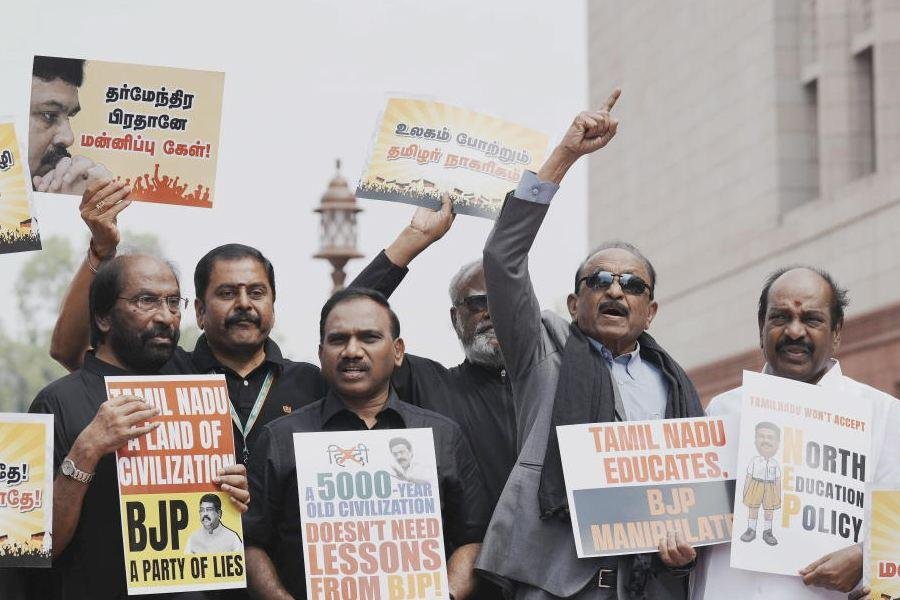
A political disagreement between the Union government and Tamil Nadu has revived debate over the Three-Language Formula under NEP 2020, highlighting tensions between linguistic diversity and federal autonomy.
Q1. What is the Three-Language Formula, and how has it evolved in India’s education policy framework since 1968?
- The Three-Language Formula is an education policy introduced in 1968 to promote multilingual learning among students. It requires students to learn three languages:
- Regional/mother tongue
- Hindi (or another Indian language in non-Hindi states)
- English
- The policy aimed to promote national integration, cultural diversity, and linguistic skills.
- Over time, it has been reaffirmed in various policies, including the National Education Policy (NEP) 2020, which emphasizes flexibility and multilingualism.
- Recent implementation steps include making a third language mandatory from Class 6 in CBSE schools (from 2026–27).
Q2. How does the Three-Language Formula under NEP 2020 attempt to balance multilingualism, national integration, and regional diversity?
- The policy promotes multilingualism by encouraging students to learn multiple languages from an early stage.
- It supports national integration by enabling communication across different linguistic regions.
- At the same time, it protects regional diversity by prioritising mother tongue or local language education, especially in early schooling.
- NEP 2020 highlights that no language will be imposed, allowing states flexibility in choosing languages.
- It also promotes learning of at least two Indian languages, strengthening cultural connections across regions.
Q3. Why has the implementation of the Three-Language Formula triggered political and constitutional debates, particularly in southern states?
- The issue has sparked debates due to concerns over centralisation of education policy, which is a Concurrent subject.
- Southern states perceive the policy as potentially favouring Hindi, raising fears of linguistic imbalance.
- The debate is also linked to federalism, where states demand greater autonomy in designing education policies.
- Political sensitivities around language identity have intensified issue, especially during elections.
- Thus, it reflects broader tension between uniform national policies & regional preferences.
Q4. What are the key concerns raised by Tamil Nadu regarding linguistic imposition and federal autonomy in education policy?
- Tamil Nadu argues that the policy indirectly promotes Hindi dominance in non-Hindi regions.
- It highlights the lack of reciprocity, as Hindi-speaking states are not equally required to learn southern languages.
- The state raises concerns about administrative challenges, including shortage of teachers and unclear funding support.
- It also points to equity issues, claiming the policy may disadvantage certain regions.
- Additionally, it links the issue to fiscal federalism, alleging that funds are being used to influence state compliance.
Q5. How does the Union government justify the Three-Language Formula as a tool for multilingual empowerment rather than imposition?
- The Union government maintains that the policy is flexible and not mandatory, rejecting claims of language imposition. It emphasises mother tongue-based education, especially in early years, to improve learning outcomes.
- Policy is presented as way to build cognitive skills, cultural awareness & global competitiveness.
- It argues that multilingual education leads to “linguistic empowerment”, not dominance of any one language.
- The Centre also highlights financial support schemes and claims that some states are not fully utilising available opportunities.
Q6. What are the major structural and implementation challenges in enforcing the Three-Language Formula across India?
- There is a significant shortage of qualified language teachers, especially for less commonly taught languages.
- Infrastructure and funding gaps make implementation uneven across states.
- Lack of transparent data on language adoption and outcomes creates monitoring difficulties.
- Uneven implementation across regions, particularly in Hindi-speaking states, raises concerns of imbalance.
- Political disagreements and policy politicisation further complicate effective execution.
Q7. How can India reconcile linguistic diversity with national integration while ensuring cooperative federalism in education policy?
- Strengthening cooperative federalism via structured dialogue between Centre & States is essential. Policies should allow state-specific flexibility instead of imposing uniform framework.
- Encouraging reciprocal language learning across regions can promote fairness and inclusivity.
- Ensuring transparent and rule-based funding will reduce mistrust between governments.
- Investing in teacher training and institutional capacity will improve implementation quality.
- A balanced approach should aim to preserve linguistic diversity while fostering national unity.
Conclusion
The debate over the Three-Language Formula reflects deeper tensions between national integration and regional identity. A cooperative, flexible, and inclusive approach is key to maintaining India’s unity in diversity.