Important questions for UPSC Pre/ Mains/ Interview:
|
Context
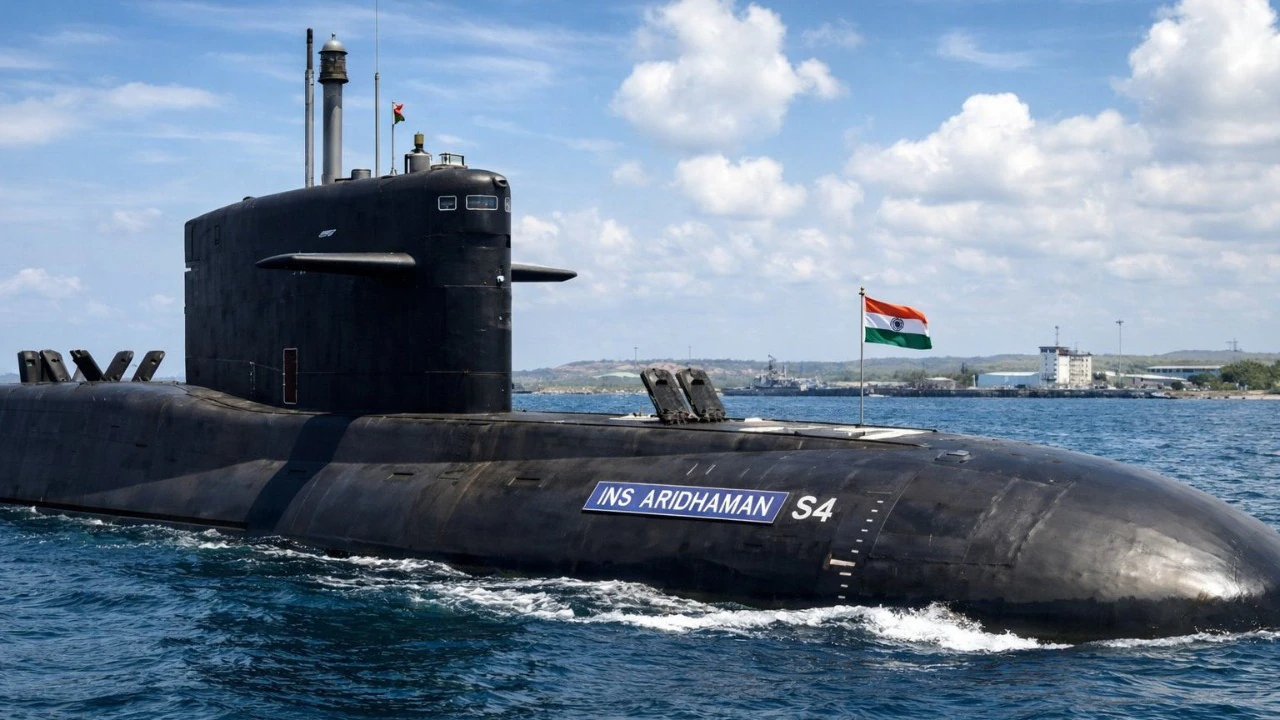
India has quietly inducted its third nuclear-powered ballistic missile submarine, INS Aridhaman, strengthening its sea-based nuclear deterrence. The induction at Visakhapatnam follows the pattern of earlier Arihant-class submarines and marks a major step in enhancing India’s strategic defence capability.
Q1. What is INS Aridhaman and why is it significant?
- Third SSBN (nuclear-powered ballistic missile submarine) of India
- Part of indigenous Arihant-class programme
- Significance: Strengthens credible nuclear deterrence and enhances survivability of nuclear arsenal.
- Milestone: India now operates three SSBNs.
Q2. What are the key features of INS Aridhaman?
- Displacement: ~7,000 tonnes
- Armament: 8 vertical launch tubes (higher than predecessors)
- Missile capability: K-15 (≈700 km range) and K-4 (≈3,500 km range)
- Propulsion: Nuclear-powered reactor
- Advantage: Can remain submerged for months with high stealth and survivability.
Q3. How does it strengthen India’s nuclear triad?
- Nuclear Triad = Land (Agni Missiles) + Air (Rafale, Su-30MKI, Mirage 2000) + Sea capability (SSBNs (Arihant-class))
- Outcome: Ensures multi-platform nuclear capability
- India joins the select group (US, Russia, China, France).
Q4. What is its role in second-strike capability?
- India follows No First Use doctrine
- Role of SSBNs: Operate stealthily in oceans
- Function: Ensure retaliatory strike even after first attack
- Result: Maintains credible deterrence
Q5. How has India’s SSBN programme evolved?
- INS Arihant (2016): First nuclear submarine which completed deterrence patrol (2018).
- INS Arighaat (2024): Improved technology and design
- INS Aridhaman: Higher missile capacity and capability
- Development: Indigenous effort with support from DRDO and Russian technical assistance.
Q6. What are India’s future submarine plans?
- Fourth SSBN: Larger and more advanced
- SSN programme: Nuclear-powered attack submarines
- Leasing: Submarine from Russia (by 2027–28)
- Project-75I: 6 conventional submarines with AIP technology
- Goal: Expand underwater warfare capability
Q7. What are the strategic implications?
- Security / Defence
- Strengthens sea-based deterrence
- Improves stealth and survivability
- Technological
- Boosts indigenous defence capability
- Advances nuclear propulsion technology
- Geopolitical
- Enhances India’s position among major powers
- Narrows gap with US, China and Russia.
- Operational Challenges
- Limited submarine fleet
- Maintenance reduces availability
- Capability gap vs major navies
Conclusion
The induction of INS Aridhaman marks a critical advancement in India’s nuclear deterrence architecture, reinforcing the sea-based leg of the nuclear triad. As India expands its submarine fleet, sustained focus on technology, capacity building, and strategic planning will be essential to ensure credible and effective deterrence.