Important questions for UPSC Pre/ Mains/ Interview:
|
Context
Indian Railways has approved the expansion of the KAVACH system across multiple zones to enhance railway safety and reduce accidents.
Q1. What is the KAVACH system and what are its key features?
- KAVACH is an indigenously developed Automatic Train Protection (ATP) system designed to prevent train accidents.
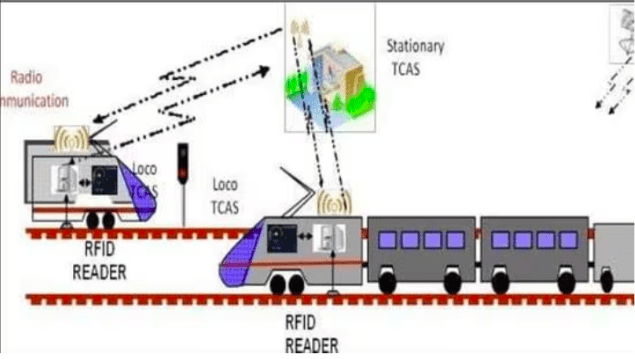
- It functions as a Train Collision Avoidance System (TCAS) by automatically applying brakes when a collision risk is detected.
- It provides continuous real-time updates to locomotive pilots for safe train operation.
- It prevents Signal Passing at Danger (SPAD) by automatically stopping trains.
- It enables loco-to-loco communication to avoid head-on, rear-end, and side collisions.
- Additional features include signal display in fog, automatic horn activation, and emergency Stop-on-Sight (SoS) alerts.
Q2. How does the KAVACH system function as a technological safety mechanism?
- The system uses a combination of RFID tags, onboard devices, and trackside equipment.
- It relies on ultra-high frequency radio communication between trains and control systems.
- A network of Optical Fibre Cables (OFC) & telecom towers ensures uninterrupted data transmission.
- It follows pre-programmed safety logic to detect unsafe conditions & trigger automatic braking.
- It continuously monitors train speed, location & signal conditions for real-time decision-making.
Q3. What has been the progress of KAVACH implementation in Indian Railways?
- Field trials have been ongoing since 2016 before large-scale deployment. As of December 2025:
- Over 7,000 km of Optical Fibre Cable has been laid.
- Around 860 telecom towers have been installed.
- Nearly 767 railway stations are connected to data systems.
- Trackside equipment covers over 3,400 km.
- More than 4,100 locomotives are equipped with KAVACH.
- Around 40,000 personnel have been trained, indicating large-scale adoption capacity.
Q4. What is the significance of the KAVACH system for railway safety and efficiency?
- It significantly enhances passenger safety by preventing collisions.
- It reduces human errors, which are a major cause of railway accidents.
- It improves operational efficiency through real-time monitoring and automation.
- It supports safe train movement even in low visibility conditions like fog.
- It strengthens India’s push towards indigenous and advanced railway technology.
- It contributes to a major reduction in railway accidents over the years.
Q5. What are the challenges in the large-scale implementation of the KAVACH system and what measures can be taken to address them?
| Challenges | Measures to Address Them |
| 1. High installation and infrastructure costs across vast railway networks | Adopt phased implementation and prioritise high-density and high-risk routes |
| 2. Requirement of integration with existing (legacy) railway systems | Upgrade signalling infrastructure and ensure standardisation |
| 3. Need for continuous maintenance and technological upgrades | Establish dedicated maintenance units and conduct regular system audits |
| 4. Dependence on reliable communication networks for real-time functioning | Strengthen telecom infrastructure and provide backup communication systems |
| 5. Requirement of skilled manpower and training | Expand training programmes and build technical capacity |
Conclusion
KAVACH represents a major step towards zero-accident railways, and its successful expansion will depend on technological integration, investment, and skilled implementation.