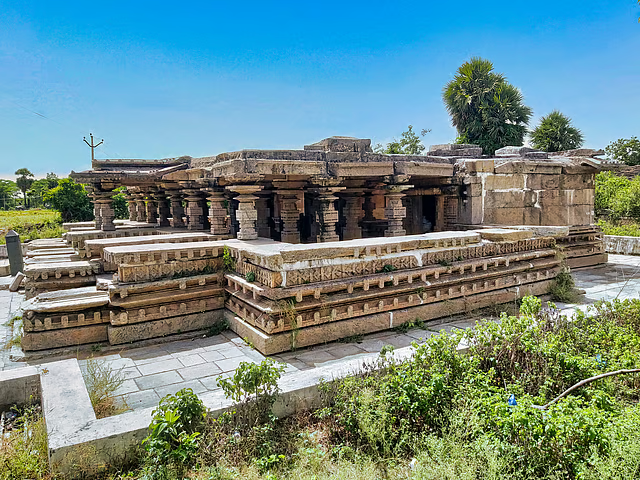
The Kakatiya Dynasty was a prominent South Indian power that reigned over the eastern Deccan region, primarily modern-day Telangana and Andhra Pradesh, between the 11th and 14th centuries. Initially serving as loyal feudatories to the Western Chalukyas of Kalyani, the Kakatiyas eventually carved out a sovereign empire that became a bastion of Telugu culture, innovative irrigation, and magnificent temple architecture. From the legendary rule of Rudrama Devi to the UNESCO-recognized Ramappa Temple, the Kakatiya era remains a golden chapter in Indian history.
Origin and Territorial Expansion
The Kakatiya lineage emerged from the decline of the Western Chalukyas. They established their authority in the fertile lands between the Krishna and Godavari rivers.
- The Founder: Kakati Rudradeva (Prataparudra I) is credited with establishing the dynasty’s independence. Around 1162 AD, he defeated the Chalukya ruler Tailapa III, signaling the birth of a new sovereign state.
- Capitals: The early seat of power was Hanumakonda. As the empire grew, the capital was shifted to the more fortified Orugallu (modern-day Warangal), which featured a formidable stone fort.
- Conquests: At its zenith, the dynasty expanded by subduing the Yadavas of Devagiri and the Cholas of Velanadu, reaching as far as Kanchi and Kurnool.
Legendary Rulers of the Kakatiya Lineage
The dynasty was shaped by visionaries who prioritized both military strength and public welfare.
- Rudradeva (1158–1195): The first independent sovereign. He was a great builder who initiated the Thousand-Pillared Temple and constructed massive irrigation tanks like Bhadrakali Lake.
- Ganapati Deva (1199–1262): The longest-reigning and perhaps greatest Kakatiya king. He unified the Telugu-speaking lands and promoted maritime trade through the port of Motupalli.
- Rudrama Devi (1262–1289): One of the few female monarchs in Indian history. She took the name Rudradeva Maharaja to ascend the throne. She was a brilliant tactician who repelled Yadava invasions and fortified the Warangal Fort.
- Prataparudra II (1289–1323): The last great ruler. While he restored the dynasty’s prestige initially, his reign was marked by the relentless onslaught of the Delhi Sultanate.
Sophisticated Administration and the Nayaka System
The Kakatiyas introduced a distinct administrative framework that balanced central authority with local military leadership.
- The Nayaka System: The kingdom was divided into territorial units governed by Nayakas (military chiefs). To prevent them from becoming too powerful, the King frequently transferred them and limited their land holdings.
- Administrative Units: The empire was hierarchically organized: Nadu (large province) → Sthala (a group of villages) → Village (managed by a headman and panchayat).
- Brahmadeya and Temples: Land grants to Brahmins (Brahmadeya) and temples were common, with temples acting as centers of governance and economic redistribution.
The Agrarian Economy and Trade
The Kakatiya economy was a pioneer in “Tank Irrigation,” a legacy that still influences the region today.
- The Tank Revolution: Rulers and nobles built massive reservoirs called Samudrams (e.g., Ramappa and Laknavaram lakes) to turn arid lands into fertile fields.
- Revenue: The primary income was land revenue. The state also taxed pastures, mines, and merchandise (Sunkams).
- Maritime Trade: The Italian explorer Marco Polo, who visited during Rudrama Devi’s reign, marveled at the prosperity of the kingdom and the fine quality of its muslins. The port of Motupalli was a vital gateway for international commerce.
Social Fluidity and Religious Evolution
Unlike the rigid social structures seen elsewhere, Kakatiya society was characterized by social mobility.
- Eminence over Caste: Social identity was often based on military service and administrative rank rather than the Varna system. Non-Brahmins frequently rose to high positions.
- Rights of Women: Women enjoyed significant status. They held property rights (Stridhana) and were active patrons of temples.
- Religion: Early rulers were patrons of Jainism (e.g., Padmakshi Temple). Later, the dynasty shifted toward Shaivism, specifically the Pasupata and Aradhya sects. The Golaki Mathas became centers of religious and social activity.
Architectural Marvels and Literature
The Kakatiya style is a unique blend of Chalukyan heritage and indigenous innovation, characterized by the use of Black Granite.
- The Ramappa (Rudreshwara) Temple: A UNESCO World Heritage Site. Built in 1213 CE, it is famous for its “floating bricks,” sandbox foundations to resist earthquakes, and exquisite dolerite carvings.
- The Thousand-Pillared Temple: Located in Hanumakonda, it is renowned for its perforated stone screens and magnificent star-shaped plan.
- Literature: Sanskrit and Telugu flourished.
- Vidyanatha wrote Prataparudrayasobhushana.
- Jayapasenani composed Nrityaratnavali (a treatise on dance).
- Gona Budda Reddi authored the Ranganatha Ramayanam, a unique Telugu version of the epic.
The Decline and Fall (1323 AD)
The dynasty’s end was precipitated by the expansionist policies of the Delhi Sultanate.
- Invasions: The first major blow came from Malik Kafur (General of Alauddin Khilji) in 1310.
- Final Siege: In 1323, the forces of Ghiyasuddin Tughlaq, led by Ulugh Khan (later Muhammad bin Tughlaq), captured Orugallu.
- The End: Prataparudra II was taken prisoner. Legend suggests he committed suicide on the banks of the Narmada while being taken to Delhi. The city of Warangal was renamed Sultanpur.
FAQs
WHO WAS THE FOUNDER OF THE KAKATIYA DYNASTY?
The dynasty was founded by Kakati Rudradeva (Prataparudra I), who declared independence from the Western Chalukyas in 1162 AD.
WHICH KAKATIYA RULER IS KNOWN AS ONE OF THE FEW FEMALE MONARCHS IN INDIA?
Rudrama Devi is the legendary female ruler who governed the empire for nearly three decades with great military and administrative skill.
WHAT IS THE SIGNIFICANCE OF THE RAMAPPA TEMPLE?
The Ramappa Temple is a UNESCO World Heritage Site known for its earthquake-resistant sandbox foundation, floating bricks, and intricate black granite carvings.
WHICH FAMOUS EUROPEAN TRAVELER VISITED THE KAKATIYA KINGDOM?
The Italian explorer Marco Polo visited the kingdom during the reign of Rudrama Devi and wrote extensively about its wealth and textiles.
WHAT WAS THE “NAYAKA SYSTEM” IN KAKATIYA ADMINISTRATION?
It was a system where military chiefs (Nayakas) were given land and administrative authority over specific regions in exchange for providing military support to the King.
WHAT WAS THE CAPITAL OF THE KAKATIYA DYNASTY?
The early capital was Hanumakonda, which was later shifted to the more secure fort city of Orugallu (modern-day Warangal).
WHICH PORT WAS THE PRIMARY HUB FOR MARITIME TRADE IN THE KAKATIYA EMPIRE?
Motupalli was the most important seaport, and Ganapati Deva issued an “Abhaya Sasana” (charter of safety) here to protect foreign merchants.
ON WHICH RIVER BANK DID THE KAKATIYA KINGDOM FLOURISH?
The kingdom was primarily situated in the Deccan plateau between the Krishna and Godavari rivers.
WHO WAS THE LAST RULER OF THE KAKATIYA DYNASTY?
Prataparudra II was the last significant ruler; his reign ended with the conquest of Orugallu by the Tughlaq Dynasty in 1323 AD.
WHAT IS THE “THOUSAND-PILLARED TEMPLE” FAMOUS FOR?
Located in Hanumakonda, it is famous for its star-shaped architecture, intricate pillars, and a large monolithic Nandi statue.