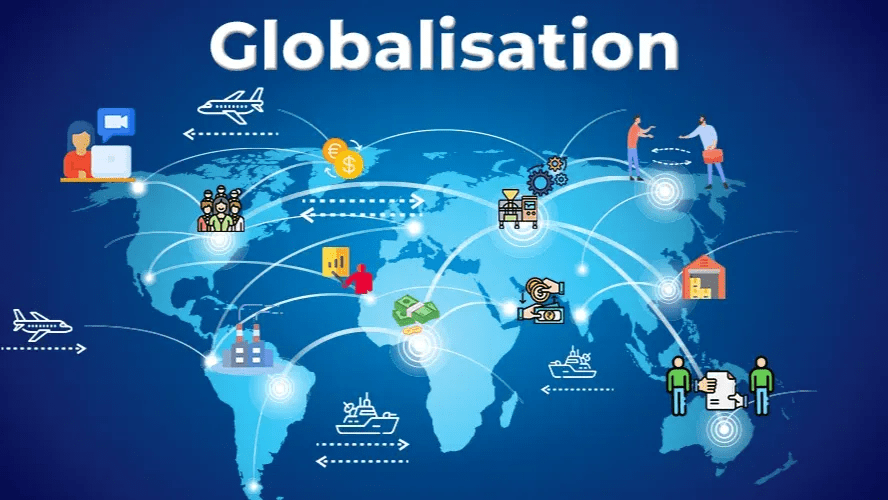
Globalisation represents the profound and growing interdependence of the world’s economies, cultures, and populations. It is a multidimensional process driven by cross-border trade in goods and services, the rapid flow of investment (FDI), the migration of people, and the instantaneous exchange of information. While global integration has existed for centuries, the term became a defining characteristic of the modern era in the early 1990s following the end of the Cold War. In India, the landmark Economic Reforms of 1991 acted as the primary catalyst, fundamentally altering the nation’s socioeconomic fabric.
1 Drivers of Globalisation in the Indian Context
The transition of India into a globalised player was facilitated by a combination of policy shifts, technological revolutions, and inherent demographic strengths.
The 1991 Economic Liberalisation
Facing a severe balance of payments crisis, India adopted the LPG (Liberalisation, Privatization, and Globalisation) model. This involved:
- Reducing Trade Barriers: Slashing import duties and eliminating the “License Raj.”
- Deregulating Industries: Allowing private players into sectors previously reserved for the government.
- Opening FDI: Actively seeking foreign capital by easing investment restrictions across diverse sectors.
Technological and Human Capital Factors
- The IT Revolution: India’s proficiency in English and a highly skilled technical workforce turned the country into a global hub for IT and software outsourcing.
- Infrastructure Expansion: Strategic investments in ports, international airports, and high-speed digital networks enhanced physical and virtual connectivity.
- The Global Diaspora: Millions of Indians living abroad acted as cultural ambassadors and financial conduits, facilitating trade, investment, and the global spread of Indian values.
Soft Power and Institutional Support
- Cultural Export: The international popularity of Yoga, Indian cuisine, and Bollywood has created a massive market for Indian lifestyle “products.”
- Multilateral Frameworks: As a member of the World Trade Organization (WTO), India adheres to global trade rules, ensuring a predictable environment for international business.
2 The Positive Paradigm: How Globalisation Transformed India
Globalisation has acted as an engine for growth, modernisation, and social evolution in the subcontinent.
Economic Prosperity and “Brain Gain”
India has emerged as the fourth-largest market globally in terms of market capitalization. The LPG model spurred significant GDP growth, reaching peaks such as the 9.7% rate in the 2007-2008 fiscal year. Furthermore, the “Brain Drain” of the past is reversing into a “Brain Gain,” as skilled professionals return to lead India’s indigenous tech and start-up ecosystems.
Social and Educational Evolution
- Education: Collaborations between Indian and foreign universities have introduced global standards and opened new paradigms for research and learning.
- Mindset Shifts: Exposure to global markets has helped reduce internal stereotypes and broadened the outlook of the Indian middle class.
- Women’s Empowerment: The corporate boom provided women with better wages, flexible working hours, and economic independence, helping them balance domestic and professional roles more effectively.
Consumer Choice and Quality of Life
Globalisation has democratized access to technology and variety. Television access in India leaped from 20% in 1991 to 90% by 2009, while the internet has become a basic utility in urban centers, empowering citizens with information.
3 The Adversarial Side: Challenges and “Adverse Effects”
Despite the benefits, the rapid influx of global influences has created significant friction points in traditional Indian structures.
Socio-Cultural Erosion
- “McDonaldization” and Health: The spread of global fast-food chains has altered traditional eating habits, leading to lifestyle diseases and a shift away from indigenous diets.
- Erosion of Traditional Values: The transition from joint family systems to nuclear families has impacted social cohesion. Traditional norms, such as deep reverence for elders (Atithi Devo Bhava), are occasionally overshadowed by Western individualism.
- Cultural Homogenization: There is a risk of losing local identities to a “Global Culture,” evidenced by the mass celebration of Western holidays at the cost of regional festivals.
Economic and Structural Disparities
- Rural-Urban Divide: While cities have become high-tech hubs, rural areas often lag, creating vast disparities in healthcare and employment access.
- The “Walmartisation” Effect: Large multinational corporations (MNCs) can exert immense pressure on local retailers, occasionally forcing small businesses out of the market and creating a form of “economic colonisation.”
- Tribal Displacement: Large-scale infrastructure projects required for global connectivity have frequently led to the displacement of indigenous communities, threatening their traditional habitats.
Global Vulnerabilities
The interconnectedness of the world means that crises travel fast. The rapid global spread of COVID-19 serves as a stark reminder of how biological and economic shocks are now shared across borders instantly.
4 Strategic Measures for a Balanced Future
To navigate globalisation effectively, India must adopt a “cautious openness” that protects vulnerable sections while embracing growth.
- Preserving Diversity: Governments and civil society must actively promote heritage conservation and regional languages to prevent them from being subsumed by global English-centric culture.
- Shielding the Vulnerable: India’s refusal to join the RCEP (Regional Comprehensive Economic Partnership) over concerns regarding cheap Chinese imports and the dairy industry demonstrates a commitment to protecting local farmers and MSMEs.
- Sustainable Development: Adopting eco-friendly technologies to mitigate the environmental degradation caused by hyper-consumerism.
- Inclusive Growth: Strengthening social safety nets to ensure that the wealth generated by the IT and corporate sectors trickles down to the marginalised communities.
FAQs
WHAT IS THE PRIMARY MEANING OF GLOBALISATION IN THE INDIAN CONTEXT?
It refers to the integration of India’s economy with the global economy through the removal of trade barriers, the influx of Foreign Direct Investment (FDI), and the exchange of technology and culture.
HOW DID THE 1991 REFORMS IMPACT GLOBALISATION?
The 1991 Economic Reforms introduced Liberalisation, Privatization, and Globalisation (LPG), which opened the Indian market to international competition and ended the restrictive “License Raj.”
WHAT IS “MCDONALDIZATION”?
It is a term used to describe the spread of a standardized global culture, particularly in food and service industries, which can replace local traditions with a fast-paced, uniform global model.
HOW HAS GLOBALISATION AFFECTED THE INDIAN FAMILY STRUCTURE?
It has accelerated the shift from the traditional joint family system to the nuclear family system, largely due to urbanisation and migration for work.
WHICH ORGANIZATION REGULATES GLOBAL TRADE RULES?
The World Trade Organization (WTO) is the primary international body that sets and enforces the rules of global trade among nations.
WHAT IS “BRAIN GAIN” IN THE ERA OF GLOBALISATION?
“Brain Gain” occurs when highly skilled Indian professionals, who previously moved abroad, return to India to start businesses or work in local industries, bringing back global expertise.
CAN GLOBALISATION LEAD TO INCOME INEQUALITY?
Yes, if the benefits of growth are concentrated in urban areas or high-tech sectors, it can widen the gap between the wealthy and the poor, as well as between rural and urban populations.
HOW HAS GLOBALISATION IMPACTED INDIAN CINEMA?
It has given Bollywood and regional Indian cinema a global platform, increasing international revenue and fostering cross-border artistic collaborations.
WHAT IS “WALMARTISATION”?
It refers to the phenomenon where large multinational retailers enter a local market and displace smaller, traditional mom-and-pop stores due to their superior scale and lower prices.
WHAT ROLE DOES THE INDIAN DIASPORA PLAY IN GLOBALISATION?
The diaspora acts as a bridge, facilitating investment flows (Remittances), networking for Indian businesses, and spreading Indian culture and soft power globally.