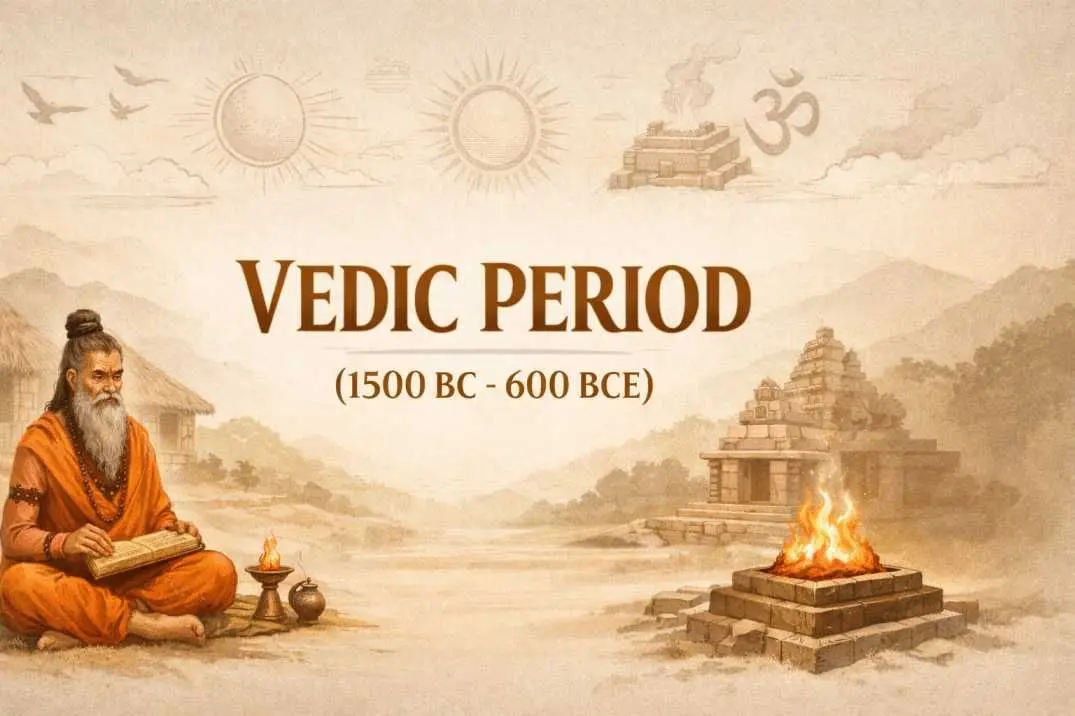
The Vedic Civilization represents a foundational era in Indian history, bridging the gap between the Indus Valley Civilization and the rise of the Mahajanapadas. Spanning nearly a millennium, this period saw the composition of the Vedas, the establishment of the Varna system, and the transition from a semi-nomadic pastoral life to a settled agrarian society. This article explores the intricate details of Vedic life, governance, and philosophy that continue to influence Indian culture today.
1 The Essence of the Vedas: Sacred Knowledge and Literature
The word Veda originates from the Sanskrit root ‘vid’, meaning “to know.” The Vedas are considered Apaurusheya (not of human origin) and Shruti (that which is heard), representing an oral tradition passed down through generations.
The Four Samhitas
- Rigveda: The oldest and most significant Veda, containing 1,028 hymns divided into 10 Mandalas. It includes the famous Gayatri Mantra and the Purusha Shukta, which describes the origin of the four Varnas.
- Samaveda: Known as the “Veda of Melodies,” it consists of Rigvedic verses set to music for the Udagatar priest. It is the root of Indian classical music.
- Yajurveda: A ritual manual for the Adhvaryu priest, written primarily in prose. It is divided into Krishna (Black) and Shukla (White) Yajurveda.
- Atharvaveda: The latest Veda, featuring magical spells and charms to ward off diseases and evil spirits. It provides insights into ancient Indian medicine and folk traditions.
The Layers of Vedic Literature
Each Veda is structured into four distinct parts to guide different stages of life:
- Samhitas: Collections of mantras and hymns.
- Brahmanas: Prose explanations of sacrificial rituals and their significance.
- Aranyakas: “Forest books” that interpret rituals in a symbolic and philosophical manner for hermits.
- Upanishads: Philosophical texts (108 in total) exploring the nature of Atman (soul) and Brahman (ultimate reality), marking the end of the Vedic period (Vedanta).
2 Geographical Expansion: From Sapta-Sindhu to the Gangetic Plains
The migration and settlement patterns of the Vedic Aryans significantly altered the geography of ancient India.
- Early Vedic Geography (Sapta-Sindhu): The Aryans initially settled in the “Land of Seven Rivers,” covering eastern Afghanistan, Punjab, and Haryana. The rivers included the Sindhu, Vitasta (Jhelum), Asikni (Chenab), Parushni (Ravi), Vipash (Beas), Shutudri (Sutlej), and the Sarasvati.
- Later Vedic Geography (Aryavarta): With the help of iron tools, the Aryans cleared forests and moved eastward into the Indo-Gangetic divide. They occupied regions like Kosala (Eastern U.P.) and Videha (North Bihar).
3 Political Transformation: Tribal Chiefdoms to Territorial Kingdoms
The political structure evolved from a simple tribal assembly system to a complex territorial administration.
| Feature | Early Vedic Period (1500–1000 BCE) | Later Vedic Period (1000–600 BCE) |
| Social Unit | Jana (Tribe) was the primary unit. | Janapada (Territorial state) emerged. |
| The King | Rajan was a tribal chief; not an absolute monarch. | The King became a territorial protector with titles like Samrat. |
| Assemblies | Power shared with Sabha, Samiti, and Vidatha. | Vidatha disappeared; Sabha became a council of nobles. |
| Succession | Election by tribal assemblies was common. | Kingship became hereditary. |
| Taxes | Bali was a voluntary tribute. | Bali, Bhaga, and Shulka became compulsory taxes. |
4 Social Structure and the Varna System
Social organization transitioned from an egalitarian tribal setup to a rigid hierarchical structure.
The Varna-Ashrama System
In the Early Vedic period, society was flexible; “Varna” referred to skin color or occupation, and one’s trade did not depend on birth. However, the Later Vedic period saw the crystallization of the four-fold Varna system: Brahmanas (priests), Kshatriyas (warriors), Vaishyas (producers/traders), and Shudras (laborers).
Status of Women
- Early Vedic: Women enjoyed a high status. They attended assemblies (Sabha), chose their partners, and were educated. Famous female scholars included Lopamudra and Ghosha.
- Later Vedic: Their position declined. They were barred from political assemblies, child marriage appeared, and they were considered subordinate to men.
5 Religious Evolution:
The religious landscape shifted from personifying nature to complex priestly sacrifices.
- Deities: The Early Vedic people worshipped Indra (God of Rain/War), Agni (Fire), and Varuna (Cosmic Order). In the Later Vedic period, these were superseded by Prajapati (The Creator), Vishnu, and Rudra.
- Sacrifices (Yajnas): Rituals became elaborate and expensive. Major sacrifices included the Ashvamedha (Horse sacrifice for sovereignty), Rajasuya (Consecration), and Vajapeya (Chariot race).
- Upanishadic Reaction: Toward 600 BCE, thinkers reacted against animal sacrifices and priestly dominance, leading to the philosophical depth found in the Upanishads.
6 Economic Life:
The discovery of iron (Krishna Ayas) revolutionized the Vedic economy.
- Pastoralism to Farming: The Rigvedic economy was pastoral; cows were the primary measure of wealth (Gomat). By the Later Vedic period, agriculture became the main occupation.
- Crops: While Barley (Yava) was the main Early Vedic crop, the Later period saw the cultivation of Rice (Vrihi), Wheat, and Lentils.
- Technology: The use of iron-tipped ploughshares and socketed axes allowed for deeper cultivation and larger surpluses.
- Trade: Transactions moved from a barter system involving cows to the use of gold coins called Nishka.
FAQs
WHICH VEDA IS REFERRED TO AS THE SOURCE OF INDIAN MUSIC?
The Samaveda is considered the source of Indian music, as it contains Rigvedic verses set to poetry and melodies for chanting.
WHAT DOES THE TERM SAPTA-SINDHU REPRESENT IN VEDIC GEOGRAPHY?
It refers to the “Land of Seven Rivers” where the Early Vedic Aryans first settled, encompassing the Punjab and Haryana regions.
WHAT IS THE SIGNIFICANCE OF THE PURUSHA SHUKTA HYMN?
Found in the 10th Mandala of the Rigveda, the Purusha Shukta describes the sacrificial origin of the four Varnas from the body of the Primal Man.
WHO WERE THE DHARMA-MAHAMATTAS IN THE VEDIC CONTEXT?
(Correction: Dharma-Mahamattas were actually administrative officers appointed by Ashoka in a much later period; in the Later Vedic period, the King was assisted by a council of ministers and the Purohita).
WHAT IS THE DIFFERENCE BETWEEN SABHA AND SAMITI?
The Sabha was a council of select elders or clan members, while the Samiti was a larger tribal assembly comprising all members of the clan.
WHICH VEDA IS PRIMARILY COMPOSED OF MAGICAL SPELLS AND CHARMS?
The Atharvaveda is the compilation used to ward off evil spirits, diseases, and for various domestic rituals.
HOW DID THE POSITION OF THE KING CHANGE IN THE LATER VEDIC PERIOD?
The King transitioned from a tribal chief (Gopati) to a territorial monarch (Samrat) with hereditary rights and divine associations through rituals like Rajasuya.
WHAT WAS THE PRIMARY UNIT OF WEALTH IN THE RIGVEDIC PERIOD?
Cattle (Cows) were the primary measure of wealth. A wealthy man was called Gomat, and wars were often fought for cattle (Gavishti).
WHAT ARE THE FOUR STAGES OF LIFE ACCORDING TO THE VARNA-ASHRAMA DHARMA?
The four stages (Ashramas) are Brahmacharya (student), Grihastha (householder), Vanaprastha (hermit), and Sanyasa (ascetic).
WHICH METAL WAS REFERRED TO AS “KRISHNA AYAS” IN LATER VEDIC TEXTS?
Iron was referred to as Krishna Ayas (Black Metal), distinguishing it from copper, which was known as Lohit Ayas.