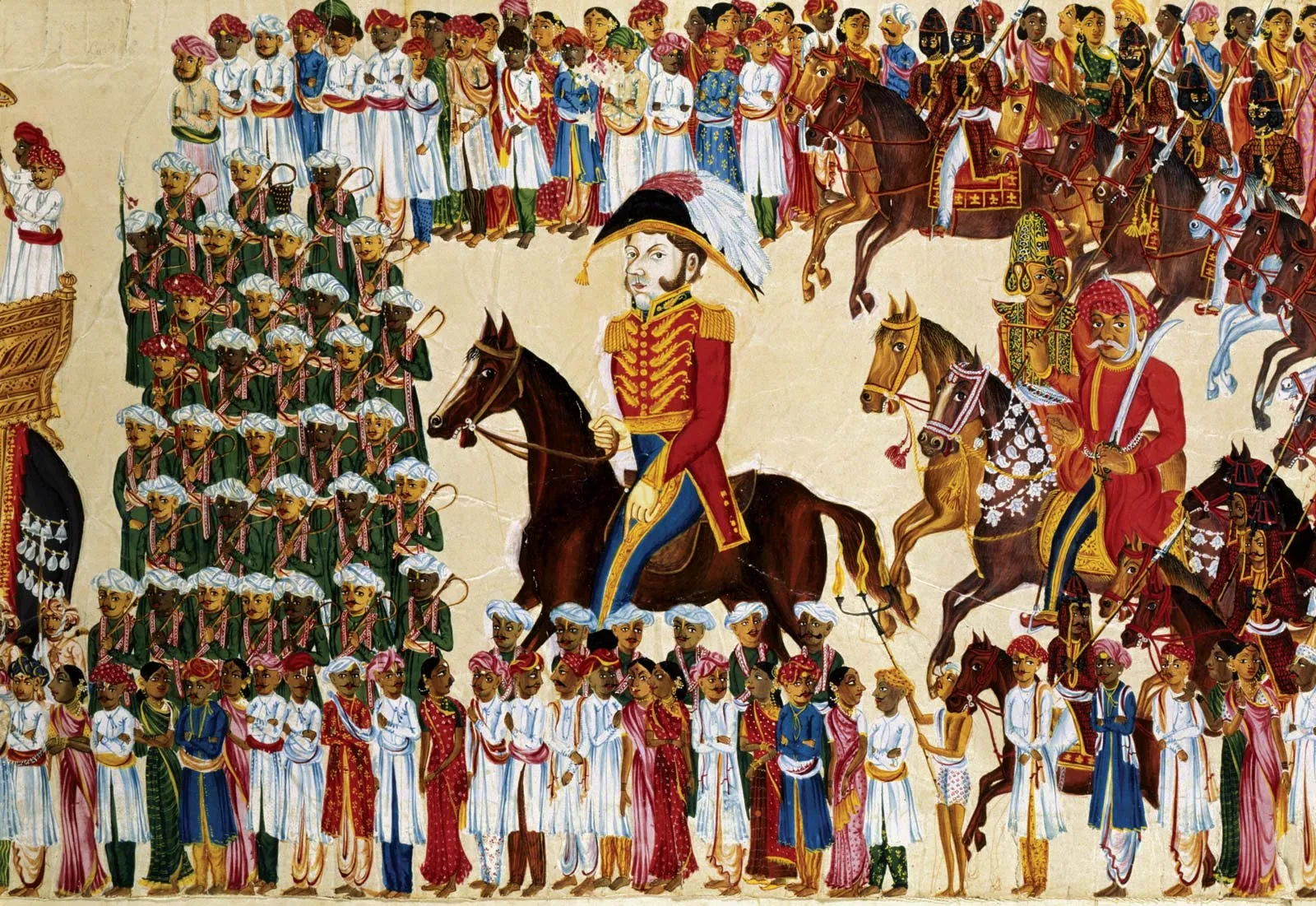
The British East India Company (EIC) stands as one of the most remarkable and controversial entities in global history. Originally established as a modest trading body in the 1600s, it transformed into a sovereign power that governed the Indian subcontinent. This transition from commerce to conquest was solidified in 1765 when the Company secured the Diwani Rights (revenue collection) for Bengal, Bihar, and Odisha. The Company’s reign lasted until the Revolt of 1857, after which the British Crown assumed direct control, ushering in the British Raj.
1 Foundation and Early Trade (1600–1619)
The Company’s journey began with a royal mandate to monopolize trade in the East Indies, eventually focusing its interests on the Indian subcontinent.
- 1600: Royal Charter: Queen Elizabeth I granted a charter to “The Governor and Company of Merchants of London Trading into the East Indies.”
- 1601: First Voyage: Sir James Lancaster led the inaugural expedition aboard the Red Dragon.
- 1612: Battle of Suvali: Captain Thomas Best defeated the Portuguese fleet off the coast of Surat, establishing British naval superiority and impressing the Mughal court.
- 1613: First Permanent Factory: After initial failures by William Hawkins, the EIC received permission from Mughal Emperor Jahangir to establish a permanent factory in Surat.
- 1615–1619: Sir Thomas Roe: Serving as the ambassador of King James I, Roe successfully secured trade concessions for factories in Agra, Ahmedabad, and Bharuch.
2 Territorial Expansion and Strategic Footholds (1632–1717)
As the 17th century progressed, the EIC strategically shifted its focus from mere trade to securing fortified settlements.
Establishment of Presidencies
- Madras (1639): Permission was obtained to build Fort St. George, which became the headquarters for South Indian operations.
- Bombay (1662–1668): Portugal gifted Bombay to King Charles II as a dowry. In 1668, the Crown leased it to the EIC for a nominal sum of £10 per year. It eventually replaced Surat as the Western headquarters.
- Calcutta (1690–1700): Job Charnock established a factory at Sutanuti. By 1698, the EIC held zamindari rights for three villages (Sutanuti, Gobinpur, and Kalikata), leading to the construction of Fort William.
The Magna Carta of the Company (1717)
Emperor Farrukhsiyar issued a Royal Farman (edict) which granted the Company significant privileges:
- Bengal: Free trade in exchange for an annual payment of ₹3,000 and the right to issue Dastaks (trade passes).
- Surat: Exemption from all duties for an annual payment of ₹10,000.
- Currency: EIC coins were permitted to circulate throughout the Mughal Empire.
3 The Era of Conquest: Battles and Treaties (1740–1765)
The mid-18th century saw the EIC engage in military conflicts that fundamentally altered India’s political landscape.
- Carnatic Wars (1740–1763): A series of three wars against the French, culminating in the Battle of Wandiwash (1760), which effectively ended French imperial ambitions in India.
- Battle of Plassey (1757): Robert Clive defeated Nawab Siraj-ud-daulah. This is considered the formal beginning of British political rule in India.
- Battle of Buxar (1764): The EIC defeated the combined forces of Mir Qasim, Shuja-ud-daulah (Awadh), and Shah Alam II (Mughal).
- Treaty of Allahabad (1765): The Company secured Diwani Rights (the right to collect revenue) for Bengal, Bihar, and Odisha, turning the trade entity into a ruling administrative body.
4 Administrative Reforms and The Subsidiary Alliance (1773–1856)
To manage its vast territories, the EIC introduced several legislative acts and administrative codes.
- Regulating Act of 1773: The first step by the British Parliament to regulate EIC affairs.
- Pitt’s India Act (1784): Established a Board of Control to manage political affairs, separating them from commercial activities.
- Cornwallis Code (1793): Introduced by Lord Cornwallis, this code separated revenue administration from the judiciary and established the Civil Services.
- Subsidiary Alliance: A system used by Lord Wellesley to bring Indian states under British protection by forcing them to maintain a British force at their expense.
- Doctrine of Lapse: Lord Dalhousie’s policy of annexing states if a ruler died without a natural heir (e.g., Satara, Jhansi, and Awadh).
5 Social Reforms and Infrastructure (1829–1856)
Under Governors-General like Lord Bentinck and Lord Dalhousie, the EIC introduced Western modernization.
- Abolition of Sati (1829): Championed by Raja Ram Mohan Roy, this regulation banned the practice of Sati across British India.
- English Education (1835): Lord Macaulay’s Minute led to English becoming the medium of instruction for higher education.
- Railways and Telegraph (1853): The first railway line (Bombay to Thane) was opened, and 4,000 miles of telegraph lines were laid.
- Postal System (1854): The modern postal system and uniform postage rates were established under the Post Office Act.
6 Revolt and Dissolution (1857–1874)
The aggressive expansion and disregard for local customs led to the Revolt of 1857 (Sepoy Mutiny), which signaled the end of Company rule.
- 1857 Revolt: A massive uprising by Indian sepoys and rulers against EIC policies. Although the EIC was victorious, the British government realized the Company could no longer govern India.
- Government of India Act 1858: Transferred all powers from the EIC to the British Crown. Lord Canning became the first Viceroy.
- 1874 Dissolution: Following the East India Stock Dividend Redemption Act 1873, the Company was formally dissolved on June 1, 1874.
FAQs
WHO GRANTED THE FIRST ROYAL CHARTER TO THE EAST INDIA COMPANY?
The first Royal Charter was granted by Queen Elizabeth I on December 31, 1600, giving the Company a monopoly on trade with the East Indies.
WHERE WAS THE FIRST PERMANENT FACTORY OF THE BRITISH EAST INDIA COMPANY ESTABLISHED?
The Company established its first permanent factory in Surat in 1613, following permission from the Mughal Emperor Jahangir.
WHAT WERE THE DIWANI RIGHTS AND WHEN WERE THEY GRANTED?
Diwani Rights were the authority to collect taxes and manage civil justice. They were granted to the EIC for Bengal, Bihar, and Odisha in 1765 following the Treaty of Allahabad.
WHICH BATTLE IS CONSIDERED THE STARTING POINT OF BRITISH RULE IN INDIA?
The Battle of Plassey in 1757, where Robert Clive defeated the Nawab of Bengal, Siraj-ud-daulah, is traditionally seen as the beginning of British political dominance.
WHAT WAS THE SUBSIDIARY ALLIANCE SYSTEM?
Introduced by Lord Wellesley, it was a treaty where an Indian ruler accepted British troops within their territory and paid for their maintenance in exchange for protection.
HOW DID BOMBAY COME UNDER THE CONTROL OF THE EAST INDIA COMPANY?
Bombay was given to King Charles II of Britain as a dowry when he married Princess Catherine of Portugal in 1662. The King later leased it to the EIC for £10 per year in 1668.
WHO INTRODUCED THE “DOCTRINE OF LAPSE” AND WHAT WAS ITS IMPACT?
Lord Dalhousie introduced the policy, which allowed the EIC to annex any princely state where the ruler died without a natural male heir. It was a major cause of the 1857 Revolt.
WHAT WAS THE “MAGNA CARTA” OF THE COMPANY IN 1717?
The Farman issued by Emperor Farrukhsiyar is known as the Magna Carta of the Company as it granted them extensive trade privileges and exemptions across Mughal territories.
WHEN WAS THE EAST INDIA COMPANY FORMALLY DISSOLVED?
The Company was formally dissolved on June 1, 1874, under the provisions of the East India Stock Dividend Redemption Act 1873.
WHO WAS THE FIRST GOVERNOR-GENERAL OF BENGAL UNDER THE REGULATING ACT OF 1773?
Warren Hastings was the first Governor-General of Bengal, appointed to oversee the Company’s administration and its new regulatory framework.