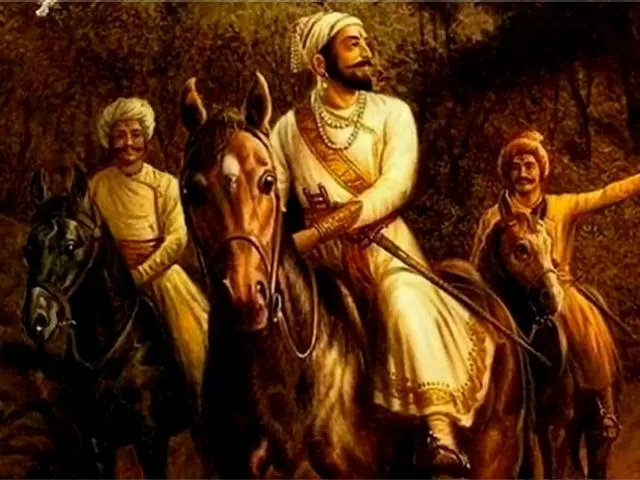
Chhatrapati Shivaji Maharaj (1630–1680) was a visionary leader who carved out an independent Maratha kingdom from the declining Adil Shahi Sultanate of Bijapur, laying the foundation for the Maratha Confederacy. Known for his strategic brilliance, ethical governance, and the revival of indigenous cultural traditions, he is often hailed as the “Father of the Indian Navy” and a pioneer of guerrilla warfare in India.
Early Life and Influences
- Birth: Born on February 19, 1630, at Shivneri Fort to Shahaji Bhonsle (a Maratha general) and Jijabai.
- Mentors: His mother, Jijabai, instilled in him high moral values and a sense of duty toward his culture. His guardian, Dadaji Kondadeo, trained him in military tactics, administration, and revenue systems.
- The Torna Milestone: At the young age of 16, Shivaji captured his first fort, Torna, in 1646, signaling the start of his independent campaign.
Wars and Military Conquests
Shivaji’s military career was defined by his ability to defeat much larger imperial forces using the “Ganimi Kawa” (Guerrilla Warfare) strategy.
1. Conflict with the Bijapur Sultanate
- Battle of Pratapgad (1659): Facing the formidable Bijapuri General Afzal Khan, Shivaji famously killed him during a personal meeting using a ‘Wagh Nakh’ (tiger claws) and decimated the Bijapur army.
- Battle of Pavan Khind (1660): A heroic rearguard action led by Baji Prabhu Deshpande, allowing Shivaji to escape the siege of Panhala and reach the safety of Vishalgad.
2. Conflict with the Mughal Empire
- Shaista Khan Incident (1663): Shivaji led a daring night raid on Shaista Khan’s camp in Pune, injuring the Mughal governor and forcing his retreat.
- Sack of Surat (1664): He raided the wealthy Mughal port of Surat to replenish his treasury and challenge imperial economic might.
- Treaty of Purandar (1665): Besieged by Mirza Raja Jai Singh, Shivaji was forced to sign a treaty, ceding 23 forts and agreeing to visit Aurangzeb’s court in Agra.
- Agra Escape (1666): After being humiliated and placed under house arrest in Agra, Shivaji and his son Sambhaji made a legendary escape hidden in large fruit baskets.
3. Coronation and Later Campaigns
- Coronation (1674): He was formally crowned as Chhatrapati at Raigad Fort by Gaga Bhatt, establishing the Maratha state as a sovereign entity.
- Dakshin Digvijay (1677–78): His final major campaign took him into Southern India (modern-day Karnataka and Tamil Nadu), where he captured Gingee and Vellore.
Administration: The Ashta Pradhan Council
Shivaji established an efficient administrative framework to govern his “Swarajya.” The core of his administration was the Ashta Pradhan (Council of Eight Ministers).
| Position | Title | Responsibility |
| Peshwa | Prime Minister | General administration and welfare. |
| Amatya | Finance Minister | Managing state accounts and income. |
| Sacheev | Secretary | Royal correspondence and edicts. |
| Sumant | Foreign Minister | Diplomacy and foreign affairs. |
| Senapati | Commander-in-Chief | Recruitment and military management. |
| Mantri | Intelligence Minister | Espionage, record-keeping, and security. |
| Panditrao | High Priest | Religious matters and charities. |
| Nyayadhish | Chief Justice | Judicial administration. |
Military and Naval Strategy
1. The Fort Network
Shivaji considered forts to be the “mother of the kingdom.” He controlled nearly 240–280 forts at the time of his death. Each fort was governed by three officers of equal status (Havaldar, Sabnis, and Sarkarkhun) to prevent betrayal.
2. The Maratha Navy
Recognizing the threat of the Siddis, Portuguese, and British, Shivaji built a formidable navy. He constructed sea forts like Sindhudurg and Vijaydurg and commissioned a fleet of indigenous ships (Ghurabs, Gallivats).
3. Land Revenue and Welfare
He abolished the oppressive Jagirdari system and replaced it with a direct land revenue system. He introduced the Chauth (1/4th of revenue) and Sardeshmukhi (an additional 10%) as levies from neighboring territories for protection.
Successors and Legacy
- Sambhaji Maharaj (1681–1689): Continued the struggle against Aurangzeb with immense bravery but was eventually captured and executed.
- Rajaram and Tarabai: Led the Maratha resistance during the 27-year war against the Mughals.
- Shahu Maharaj: His reign saw the rise of the Peshwas, starting with Balaji Vishwanath, who eventually turned the Maratha state into a pan-Indian empire.
Frequently Asked Questions (FAQs)
WHO WAS THE GUARDIAN OF SHIVAJI MAHARAJ?
Dadaji Kondadeo was his guardian and tutor, who trained him in military and administrative skills.
WHY IS SHIVAJI CALLED THE “FATHER OF THE INDIAN NAVY”?
He was one of the first Indian rulers to realize the importance of maritime power, building a fleet and several sea forts to protect the Konkan coast.
WHAT IS THE “ASHTA PRADHAN”?
It was a council of eight ministers established by Shivaji to assist in the administration of the Maratha state.
WHAT WAS SHIVAJI’S GUERRILLA WARFARE TECHNIQUE CALLED?
It was known as “Ganimi Kawa,” which focused on ambushes, speed, and using the rugged terrain to defeat larger armies.
WHAT WERE CHAUTH AND SARDESHMUKHI?
Chauth was a tax of 25% of land revenue collected from non-Maratha territories to protect them from raids, and Sardeshmukhi was an additional 10% tax levied as a claim of over-lordship.
WHICH FORT WAS SHIVAJI’S CAPITAL?
Raigad Fort served as the capital of the Maratha Empire after his coronation in 1674.
WHO DECIPHERED THE ASHOKAN EDICTS?
(Correction: This question relates to Ashoka; James Prinsep deciphered them in 1837. Regarding Shivaji, he replaced Persian with Sanskrit and Marathi for official use).
WHAT WAS THE TREATY OF PURANDAR?
Signed in 1665 with Jai Singh I, Shivaji agreed to cede 23 forts to the Mughals and serve as a vassal.
WHO WAS TANAJI MALUSARE?
A legendary Maratha commander who sacrificed his life to capture the Kondhana (Sinhagad) Fort in 1670.
WHICH LANGUAGE DID SHIVAJI PROMOTE FOR ADMINISTRATION?
He promoted Marathi and Sanskrit, commissioning the Rajvyavahar Kosh to replace Persian administrative terms.