Important Questions for UPSC Prelims, Mains and Interview
|
Context
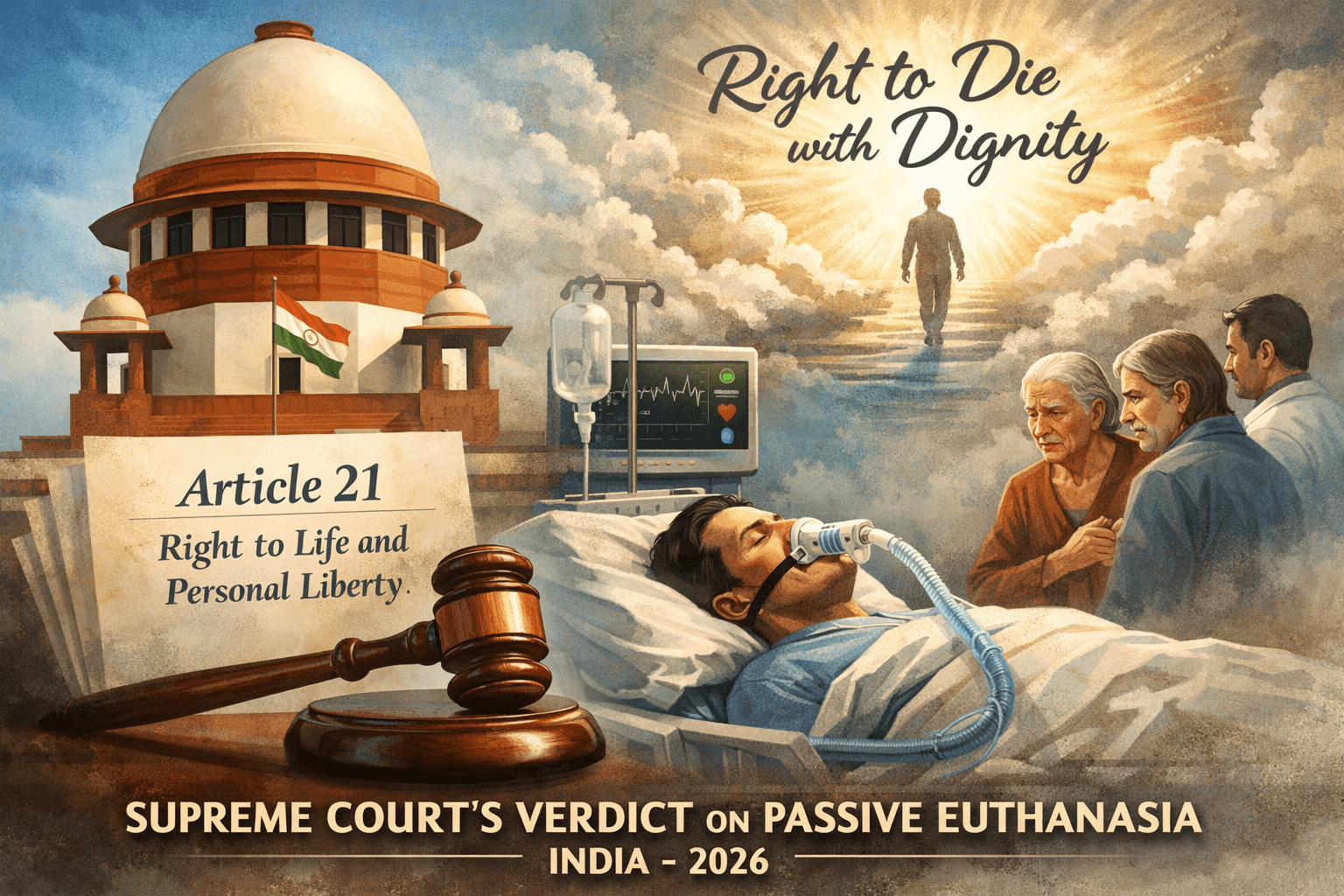
The Supreme Court of India permitted the withdrawal of life-sustaining treatment for Harish Rana, a man who had remained in a persistent vegetative state since 2013 following severe head injuries. This decision marks a significant application of India’s evolving passive euthanasia framework, emphasising dignity and compassionate end-of-life care.
Q1. What is passive euthanasia, and how does it differ from active euthanasia in legal, ethical, and medical terms?
- Passive euthanasia refers to withdrawing or withholding medical treatment that artificially prolongs life. It allows the underlying illness or injury to take its natural course without further medical intervention.
- It may involve withdrawal of ventilator support or stopping artificial nutrition or hydration.
- Active euthanasia, in contrast, involves deliberately causing death through medical means such as lethal injections. In India, active euthanasia is illegal and treated as a criminal offence.
- Passive euthanasia is considered different because it does not intentionally cause death but allows natural death to occur.
Q2. What were the circumstances and judicial reasoning behind the Supreme Court’s decision permitting withdrawal of life-sustaining treatment in the Harish Rana case?
- Harish Rana had remained in a persistent vegetative state since 2013 after a severe head injury.
- His family requested withdrawal of life support, but the Delhi High Court rejected the plea, saying he was not terminally ill.
- The Supreme Court reviewed the case after medical evaluations by expert committees which confirmed his condition was irreversible with no chance of recovery.
- The Court emphasised that the decision was about avoiding artificial prolongation of suffering.
- It directed AIIMS to provide palliative care to ensure comfort & dignity in the final stage of life.
Q3. What is the constitutional basis for passive euthanasia in India, and how has Article 21 been interpreted in relation to the right to die with dignity?
- Article 21 (Right to life and personal liberty) has been interpreted by Supreme Court to include right to live with dignity which also includes respecting patient autonomy & medical realities.
- Patients suffering from irreversible conditions may choose to refuse invasive or futile treatment.
- Passive euthanasia prevents unnecessary prolongation of suffering and thus, is seen as consistent with the constitutional principle of human dignity.
Q4. How has the Indian legal framework on euthanasia evolved through major Supreme Court judgments?
- India currently lacks a dedicated parliamentary law governing euthanasia. The legal framework has largely developed through judicial interpretations and constitutional rulings.
- Early judgments clarified that active euthanasia remains illegal under criminal law.
- Subsequent rulings recognised the possibility of withdrawing life-sustaining treatment in limited situations.
- Courts have introduced procedural safeguards to prevent misuse of euthanasia provisions.
Q5. What were the key principles and safeguards laid down in the Aruna Shanbaug judgment (2011) regarding passive euthanasia?
- The Aruna Shanbaug case (2011) laid the foundation for passive euthanasia in India.
- It recognised that withdrawal of life-support could be allowed under strict supervision.
- Requests for passive euthanasia could be made by family members, doctors or a “next friend” acting in the patient’s best interest.
- The High Court was required to review each case individually.
- Medical evaluation by a committee of expert doctors was mandatory.
- These safeguards aimed to ensure decisions were made carefully and ethically.
Q6. How did the Common Cause judgment (2018) recognise advance directives and expand the concept of dignified end-of-life care?
- In Common Cause v. Union of India (2018), the Court declared that the right to die with dignity is part of Article 21 and introduced the concept of Advance Medical Directives (Living Wills).
- A living will allows individuals to specify in advance whether they want life-support treatment and the conditions under which treatment should be withdrawn.
- It ensures that individuals’ wishes are respected even if they later become incapable of communicating them.
Q7. What procedural reforms were introduced by the Supreme Court in 2023 to simplify the implementation of passive euthanasia?
- The Court simplified rules governing Advance Medical Directives.
- Living wills can now be attested by a notary or gazetted officer.
- Advance directives may be stored in digital health records for easier access.
- Hospitals must form two medical boards to assess the patient’s condition.
- Administrative hurdles such as mandatory magistrate visits were removed.
- These reforms aimed to ensure faster & more practical implementation of end-of-life decisions.
Conclusion
India’s evolving approach to passive euthanasia reflects an effort to reconcile medical ethics, constitutional principles, and human compassion. The Supreme Court’s rulings emphasise that preserving dignity is central to the right to life, especially when recovery is impossible. Developing a clear legal framework for end-of-life care and patient autonomy remains an important step for the future of India’s healthcare system.