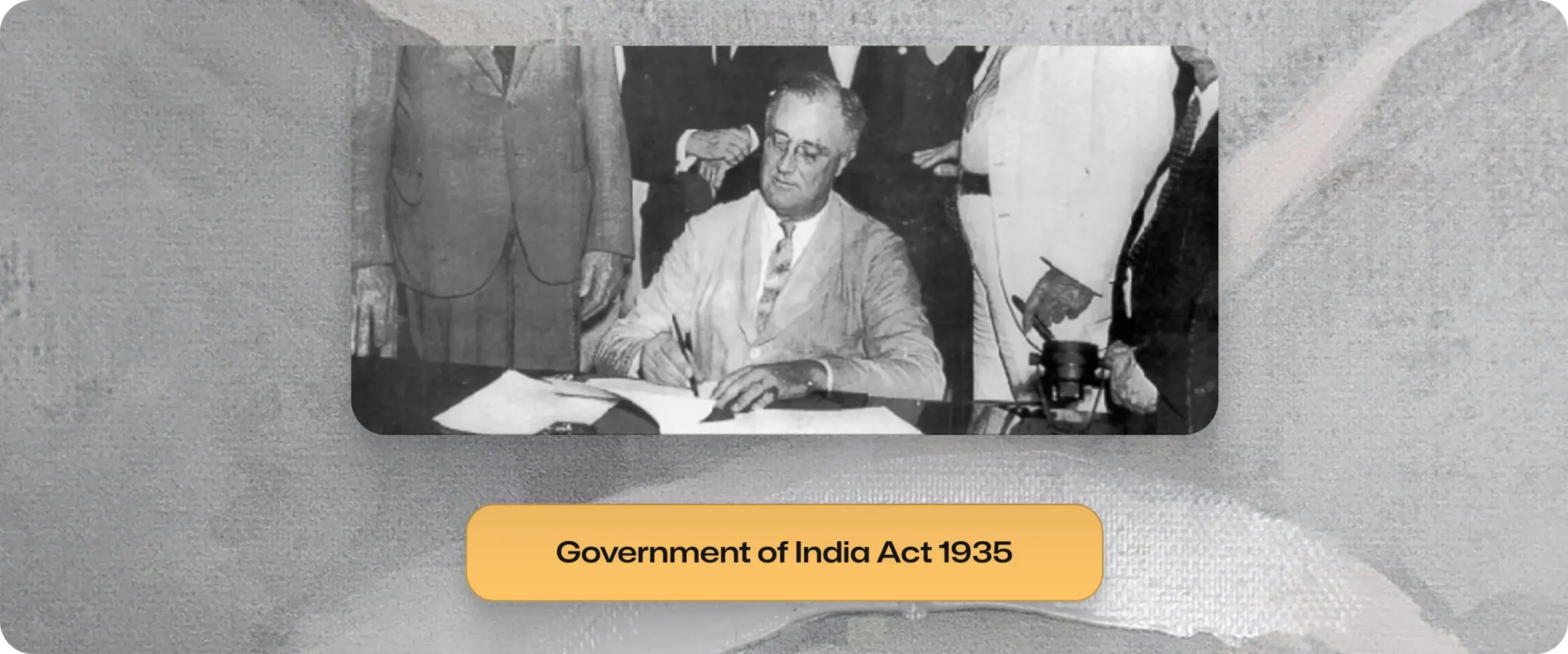
The Government of India Act 1935 was the longest and most detailed piece of legislation enacted by the British Parliament for the governance of British India. Consisting of 321 sections and 10 schedules (often cited with its numerous clauses), it served as a major turning point in India’s constitutional history. While it fell short of the Indian demand for Purna Swaraj (complete independence), it provided the structural blueprint upon which the current Constitution of India was built.
Historical Background: The Path to Reform
The Act was the culmination of a long process of deliberation and political unrest in India.
- Montagu-Chelmsford Reforms (1919) Failure: The earlier reforms introduced “dyarchy,” which proved unsatisfactory and led to increased demands for self-rule.
- Simon Commission (1927): A statutory commission that recommended the abolition of dyarchy and suggested a federal structure, despite being boycotted by Indians.
- Round Table Conferences (1930–1932): Three sessions in London where Indian leaders and British officials discussed future reforms, highlighting the need for provincial autonomy.
- The White Paper (1933): Based on the conferences and the Lothian Committee’s report on the franchise, this document formed the immediate basis for the 1935 Act.
Key Provisions of the Act
The Act introduced several revolutionary concepts to the Indian administrative landscape, many of which remain in practice today.
1. All-India Federation
The Act proposed a federation consisting of British Indian Provinces and Princely States.
- Joining was mandatory for provinces but voluntary for Princely States.
- Result: Because the required number of Princely States never signed the “Instrument of Accession,” the federation part of the Act was never implemented.
2. Provincial Autonomy
- Abolition of Dyarchy: The system of “transferred” and “reserved” subjects in the provinces was abolished.
- Self-Governance: Provinces were granted a separate legal identity and were freed from the direction and control of the Secretary of State and the Governor-General, except in specific “discretionary” matters.
3. Division of Powers
The Act established a clear division of legislative powers between the Centre and the Provinces through three lists:
| List Name | Authority | Subjects |
| Federal List | Central Government | 59 items (Defence, Foreign Affairs, Currency, etc.) |
| Provincial List | Provincial Government | 54 items (Police, Education, Agriculture, etc.) |
| Concurrent List | Both | 36 items (Criminal Law, Marriage, Divorce, etc.) |
Residuary Powers: Unlike the modern Indian Constitution (where they rest with the Parliament), these were vested in the Governor-General.
4. Bicameralism and Franchise
- It introduced bicameralism in 6 out of 11 provinces (Bengal, Bombay, Madras, Bihar, Assam, and the United Provinces).
- Franchise: The electorate was expanded from roughly 3% to 10% of the total population (approximately 30 million people).
5. New Institutions
- Federal Court: Established in 1937 in Delhi (precursor to the Supreme Court of India).
- Reserve Bank of India: To control the currency and credit of the country.
- Public Service Commissions: Provided for the establishment of not only a Federal PSC but also Provincial and Joint PSCs.
Significance and Legacy
The 1935 Act is often described as the “Skeleton of the Indian Constitution.”
- Federal Foundation: It introduced the concept of a federal structure with a distribution of powers that remains the hallmark of Indian polity.
- Training for Democracy: The 1937 provincial elections provided Indian leaders with essential experience in parliamentary governance.
- Administrative Continuity: Most of the administrative details and the “Emergency Provisions” in the modern Constitution are borrowed directly from this Act.
Critical Limitations and Reactions
Despite its scale, the Act was met with significant criticism from Indian nationalists.
- The “Veto” Power: The Governor-General and Governors retained “special responsibilities” and discretionary powers, effectively allowing them to override elected ministers.
- Communal Representation: The Act further entrenched the Communal Award by extending separate electorates to depressed classes, women, and labor.
- Rigidity: The power to amend the Act remained solely with the British Parliament.
- Political Reactions:
- Jawaharlal Nehru called it “a machine with strong brakes and no engine.”
- A. Jinnah described it as “thoroughly rotten, fundamentally bad, and totally unacceptable.”
Frequently Asked Questions (FAQs)
WHICH ACT ABOLISHED DYARCHY IN THE PROVINCES?
The Government of India Act 1935 abolished dyarchy in the provinces and replaced it with Provincial Autonomy.
WHO HELD THE RESIDUARY POWERS UNDER THE 1935 ACT?
In a significant departure from modern practice, the residuary powers were vested in the Governor-General.
HOW MUCH OF THE POPULATION WAS GRANTED VOTING RIGHTS?
The Act extended the franchise to approximately 10% of the total population, totaling about 30 million individuals.
WHICH IMPORTANT FINANCIAL INSTITUTION WAS ESTABLISHED UNDER THIS ACT?
The Reserve Bank of India (RBI) was established to manage the country’s currency and credit.
WHICH PROVINCES WERE GIVEN A BICAMERAL LEGISLATURE?
Bicameralism (two houses) was introduced in Bengal, Bombay, Madras, Bihar, Assam, and the United Provinces.
WHAT WAS THE FEDERAL LIST SUBJECT COUNT?
The Federal List contained 59 subjects, the Provincial List had 54, and the Concurrent List had 36.
WHEN DID THE PROVINCIAL AUTONOMY PROVISIONS COME INTO EFFECT?
The provincial part of the Act came into operation on April 1, 1937.
WHO CALLED THE 1935 ACT A “CHARTER OF SLAVERY”?
Jawaharlal Nehru criticized the Act heavily, describing it as a “new charter of slavery.”
DID THE ALL-INDIA FEDERATION EVER COME INTO EXISTENCE?
No. The All-India Federation never materialized because the Princely States did not join it in sufficient numbers.
WHAT WAS THE “WHITE PAPER” OF 1933?
It was a proposal issued by the British Government containing the constitutional blueprint that eventually became the Government of India Act 1935.