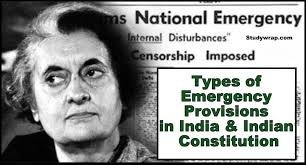
The Emergency Provisions in the Indian Constitution are unique legal mechanisms that empower the Union government to transform India’s federal structure into a unitary one during exceptional crises. These provisions are designed to protect the sovereignty, unity, integrity, and stability of the nation when normal constitutional machinery proves inadequate. Contained in Part XVIII of the Constitution, these powers allow the President of India to act beyond standard constitutional limits to safeguard the state.
Overview of Emergency Provisions
The legal framework for managing emergencies is laid out across nine specific articles, originating from the Weimar Constitution of Germany.
List of Constitutional Articles (Part XVIII)
1 Article 352: Proclamation of Emergency (National Emergency).
2 Article 353: Outlines the effect of a Proclamation of Emergency.
3 Article 354: Application of provisions relating to the distribution of revenues during an emergency.
4 Article 355: Defines the duty of the Union to protect States against external aggression and internal disturbance.
5 Article 356: Provisions in case of failure of constitutional machinery in States (President’s Rule).
6 Article 357: Exercise of legislative powers under a proclamation issued under Article 356.
7 Article 358: Suspension of the provisions of Article 19 (Fundamental Rights) during emergencies.
8 Article 359: Suspension of the enforcement of rights conferred by Part III (Fundamental Rights) during emergencies.
9 Article 360: Provisions relating to a Financial Emergency.
Types of Emergencies in India
The Constitution authorizes three distinct types of emergencies based on the nature of the crisis.
1 National Emergency (Article 352)
A National Emergency is proclaimed when the security of India or any part thereof is threatened by war, external aggression, or armed rebellion.
- Terminology Change: The 44th Constitutional Amendment Act (1978) replaced the term “internal disturbance” with “armed rebellion” to prevent misuse.
- Parliamentary Approval: It must be approved by both Houses within one month by a special majority.
- Impact: The Centre gains power to legislate on State List subjects, and Fundamental Rights under Article 19 are automatically suspended.
- Implementation History: It has been invoked three times: 1962 (Indo-China war), 1971 (Indo-Pak war), and 1975 (internal disturbance).
2 President’s Rule / State Emergency (Article 356)
Commonly known as the failure of constitutional machinery in a state, this is imposed when a state government cannot function according to the Constitution.
- Grounds: Proclaimed based on a report from the Governor or otherwise.
- Approval: Requires parliamentary approval within two months.
- Duration: It can last for six months at a time, up to a maximum of three years.
- Usage: This is the most frequently used provision, invoked more than 115 times across India.
3 Financial Emergency (Article 360)
This can be declared if the financial stability or credit of India is threatened.
- Powers: The President can direct states to observe canons of financial propriety, reduce salaries of government officials (including judges), and reserve money bills for presidential approval.
- Status: This provision has never been invoked in India’s history.
Comparative Table of Emergency Types
| Basis | National Emergency (Art. 352) | President’s Rule (Art. 356) | Financial Emergency (Art. 360) |
| Grounds | War, External Aggression, Armed Rebellion | Failure of Constitutional Machinery | Financial Instability |
| Parliamentary Approval | Within 1 month (Special Majority) | Within 2 months (Special Majority) | Within 2 months (Special Majority) |
| Revocation | President or Lok Sabha resolution | By the President | By the President |
| Judicial Review | Allowed | Allowed | Allowed |
Advantages of Emergency Provisions
1 Rapid Response: Enables the central government to act decisively during war, rebellion, or financial breakdown without procedural delays.
2 National Integrity: Centralizing power temporarily ensures political stability and prevents the country from splintering when state machinery fails.
3 Governance Restoration: Helps restore law and enforcement in regions facing severe internal rebellion or political instability.
4 Fiscal Management: Provides a legal mechanism (Financial Emergency) to prioritize essential expenditures during extreme economic crises.
Criticism and Challenges
1 Threat to Federalism: These provisions can reduce autonomous states to mere administrative units of the Union.
2 Potential for Misuse: History, notably the 1975 Emergency, demonstrates that these powers can be used for political gain and to suppress dissent.
3 Impact on Civil Liberties: The suspension of Fundamental Rights (specifically under Article 19) compromises freedom of expression and personal liberty.
4 Weakened Checks and Balances: Executive dominance during an emergency often limits the scrutiny and accountability usually provided by the Parliament and state assemblies.
Frequently Asked Questions (FAQs)
From which constitution were the Emergency Provisions borrowed?
They were borrowed from the Weimar Constitution of Germany.
What are the three types of emergencies in the Indian Constitution?
The three types are National Emergency (Art. 352), President’s Rule (Art. 356), and Financial Emergency (Art. 360).
Which amendment replaced “internal disturbance” with “armed rebellion”?
The 44th Constitutional Amendment Act of 1978 made this change to prevent arbitrary declarations of National Emergency.
Has a Financial Emergency ever been declared in India?
No, a Financial Emergency under Article 360 has not yet been invoked in India.
How long does a National Emergency stay in force after parliamentary approval?
It continues for six months at a time and can be extended indefinitely with repeated approvals every six months.
Can the President declare an emergency on their own?
The President acts on the written recommendation of the Cabinet (for National Emergency) or based on reports/situation (for President’s Rule).
Which fundamental rights cannot be suspended even during an emergency?
While the provided text mentions Article 19 is suspended, standard constitutional practice (via the 44th Amendment) ensures that Articles 20 and 21 cannot be suspended.
Is the imposition of the President’s Rule subject to judicial review?
Yes, judicial review is allowed for all three types of emergencies to check for mala fide intentions.
How many times has a National Emergency been declared in India?
It has been invoked three times: in 1962, 1971, and 1975.
What is the maximum period for President’s Rule in a state?
The maximum period is three years, subject to periodic approvals and specific conditions like a certification from the Election Commission.