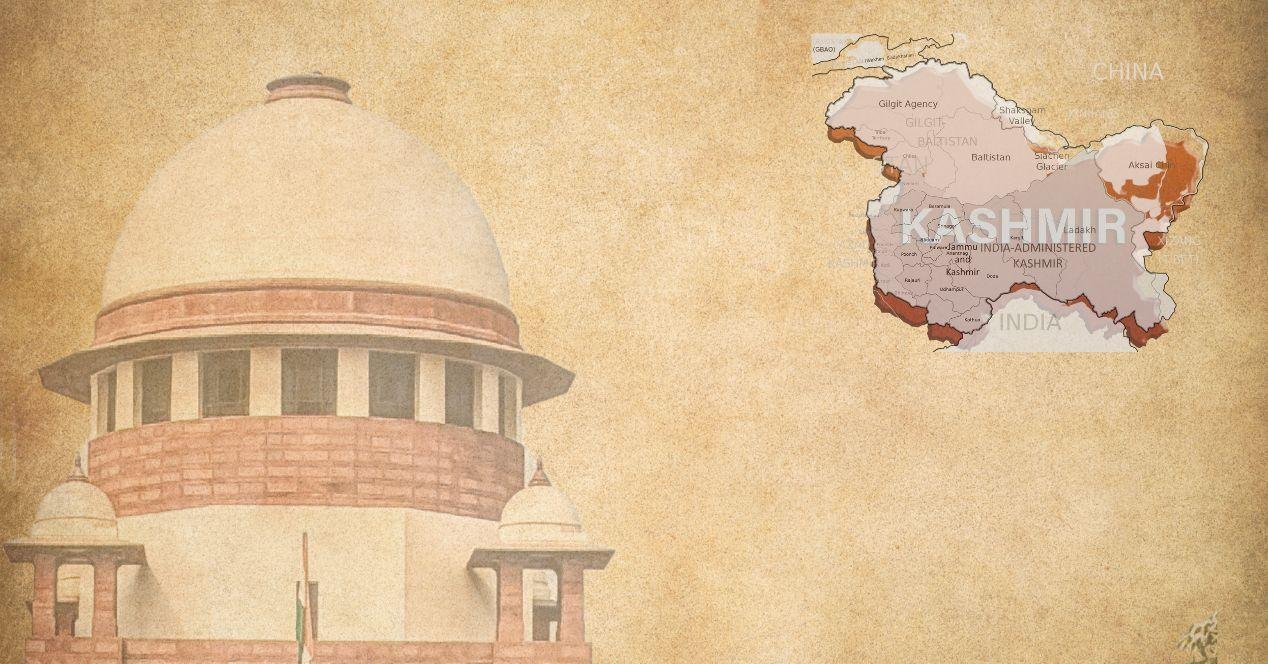
Article 370 was a unique constitutional provision that granted significant autonomy to the state of Jammu and Kashmir (J&K). For nearly seven decades, it defined the legal and administrative relationship between the region and the Indian Union. However, on August 5, 2019, the Government of India made a historic move to abrogate the article, fundamentally altering the region’s status and integrating it fully into the constitutional framework of India.
The abrogation, accompanied by the Jammu and Kashmir Reorganisation Act 2019, led to the bifurcation of the state into two Union Territories: Jammu and Kashmir and Ladakh, marking a decisive shift in India’s internal security and federal landscape.
Historical Background: The Accession of Jammu and Kashmir
The roots of Article 370 lie in the turbulent period of 1947 and the unique geopolitical significance of the princely state of J&K.
- Pre-Independence Status: Ruled by Maharaja Hari Singh, J&K chose to remain independent after the lapse of British paramountcy. Its borders with China, Afghanistan, and Pakistan made it strategically vital.
- Instrument of Accession (1947): Facing an invasion by Pakistani tribal militias, Maharaja Hari Singh signed the Instrument of Accession on October 26, 1947. He agreed to cede control over only three subjects to India: Defense, Foreign Affairs, and Communications.
- Drafting Article 370: To formalize this limited accession, the Indian Constituent Assembly included Article 370, drafted by N. Gopalaswami Ayyangar.
- The “Temporary” Clause: The article was placed under Part XXI of the Constitution, titled “Temporary, Transitional and Special Provisions.” It was intended to be an interim arrangement until a separate Constituent Assembly for J&K could decide on the state’s final relationship with India.
Key Constitutional Provisions of Article 370
Under Article 370, Jammu and Kashmir enjoyed a “special status” that distinguished it from all other Indian states.
- Separate Constitution: J&K had its own constitution (adopted in 1956), flag, and penal code (Ranbir Penal Code).
- Limited Legislative Jurisdiction: The Union Parliament could not make laws for J&K on subjects in the State or Concurrent lists without the state government’s concurrence.
- Presidential Orders: Most provisions of the Indian Constitution were only applicable to J&K through specific Presidential Orders, such as the 1954 Order.
- Article 35A: Derived from Article 370, this provision empowered the J&K legislature to define “permanent residents” and grant them exclusive rights to property ownership and government employment.
Criticisms of Article 370: The Case for Abrogation
Critics argued that the special status served as a structural barrier rather than a benefit.
- Barrier to National Integration: It was viewed as fostering a “sense of separateness” and dual identity that hindered the psychological integration of the region with India.
- Economic Stagnation: Outside investment was restricted because non-residents could not buy land or start businesses easily, resulting in lower industrial growth compared to neighboring states.
- Breeding Ground for Insurgency: Some analysts argued that the lack of central oversight allowed separatist ideologies and terrorism to flourish under the guise of autonomy.
- Governance Gaps: Major central laws—like the RTI Act, Right to Education, and protection for SC/STs—were not automatically applicable, leading to a lack of transparency and social justice.
The Abrogation Process (August 2019)
The government utilized a sophisticated legal mechanism to revoke the special status.
- The Presidential Order (C.O. 272): On August 5, 2019, President Ram Nath Kovind issued an order stating that all provisions of the Indian Constitution would now apply to J&K, effectively superseding the 1954 order.
- Modified Definition: The government amended Article 367 to interpret “Constituent Assembly of J&K” as “Legislative Assembly of J&K.” Since the state was under President’s Rule, the powers of the Assembly were exercised by the Parliament.
- Parliamentary Approval: Resolutions to revoke Article 370 and the Reorganisation Bill were passed by both houses with a two-thirds majority.
- Bifurcation: The Jammu and Kashmir Reorganisation Act, 2019 came into effect on October 31, 2019, creating:
- UT of Jammu and Kashmir: With a Legislative Assembly (similar to Puducherry).
- UT of Ladakh: Without a Legislative Assembly.
Supreme Court Ruling (December 2023)
Following several legal challenges, the Supreme Court of India delivered a landmark unanimous verdict.
- Sovereignty Reaffirmed: The Court held that J&K did not retain any element of sovereignty after the Instrument of Accession.
- Constitutionality Upheld: The Court ruled that the President had the power to abrogate Article 370 and that its “temporary” nature meant it could be revoked.
- Restoration of Statehood: While upholding the creation of the UT of Ladakh, the Court directed the Union Government to restore statehood to J&K and conduct elections by September 2024.
Impact and Outcomes of Abrogation
- Economic Growth: J&K’s GDP reached a growth rate of 8% in 2022-23, outperforming the national average.
- Infrastructure and Tourism: Significant investments in tunnels, railways (Udhampur-Srinagar-Baramulla link), and hotels have led to record-breaking tourist footfalls.
- Security Situation: The government reported a decline in stone-pelting incidents and a more robust crackdown on terror financing networks.
- Legal Uniformity: All central laws, including those for women’s rights and child protection, are now fully applicable in the region.
FAQs: Understanding Article 370
WHAT DOES ARTICLE 370 OF THE INDIAN CONSTITUTION SAY?
It was a “temporary provision” that granted J&K special autonomy, allowing it to have its own constitution and limiting the legislative powers of the Indian Parliament in the state.
WHY WAS ARTICLE 370 REMOVED?
The government cited the need for full national integration, boosting economic development, combating cross-border terrorism, and improving governance as the primary reasons for its removal.
WHAT IS THE DIFFERENCE BETWEEN ARTICLE 370 AND ARTICLE 35A?
Article 370 dealt with the state’s overall special status, while Article 35A (introduced via Presidential Order) defined the rights of “permanent residents” regarding land and jobs.
WHO PROPOSED ARTICLE 370?
It was drafted by Gopalaswami Ayyangar, a former Diwan of J&K and a member of the Indian Constituent Assembly.
WHAT HAPPENED TO LADAKH AFTER THE ABROGATION?
Ladakh was separated from J&K and became a Union Territory without a legislature, fulfilling a long-standing demand of the local population for direct central administration.
HOW DID THE SUPREME COURT VIEW THE REORGANISATION OF J&K?
The Court upheld the abrogation but directed that J&K’s statehood should be restored “at the earliest” and ordered the Election Commission to hold assembly elections.
CAN NON-RESIDENTS NOW BUY LAND IN JAMMU AND KASHMIR?
Yes, with the abrogation of Article 370 and the removal of Article 35A, the restrictions on non-residents purchasing property in the region have been lifted.
WHAT WAS THE ROLE OF THE “INSTRUMENT OF ACCESSION” IN THIS CONTEXT?
It was the legal document signed by Maharaja Hari Singh in 1947 that officially joined J&K to India, forming the legal basis for the subsequent drafting of Article 370.
IS ARTICLE 370 COMPLETELY GONE FROM THE CONSTITUTION?
Legally, the special provisions that gave J&K its autonomy have been “rendered inoperative,” though the Article remains in the text of the Constitution as an “inoperative” provision.
WHICH PART OF THE CONSTITUTION CONTAINED ARTICLE 370?
It was part of Part XXI, which deals with “Temporary, Transitional and Special Provisions.”