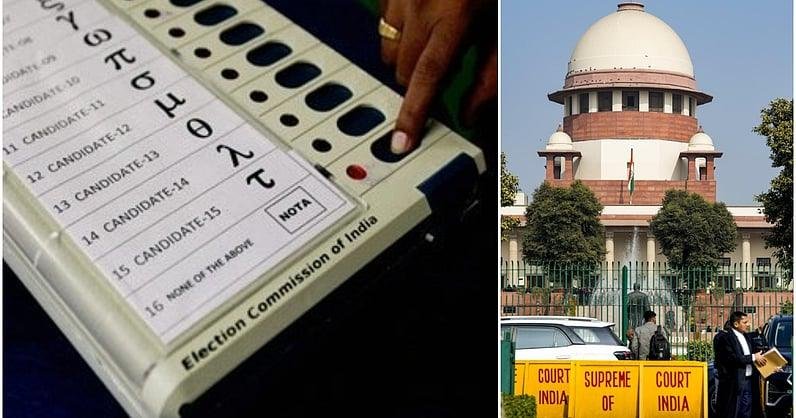
- What is NOTA (None of the Above): It is an option on an Electronic Voting Machine (EVM) which allows voters to participate in elections and reject all contesting candidates. It enables a citizen to vote without selecting any political candidate.
- Origin: In 2013, in the landmark case PUCL vs Union of India, the Supreme Court directed the Election Commission of India to include a NOTA option on Electronic Voting Machines (EVMs).
- First Implementation: It was first used in the 2013 Legislative Assembly elections in Chhattisgarh, Mizoram, Rajasthan, Madhya Pradesh and Delhi.
- Recently, the Supreme Court of India observed that more than a decade after its introduction, the NOTA option has had limited impact on the quality of candidates fielded by political parties.
- Challenges with NOTA and Way Forward
| Challenges | Way Forward |
| No impact on election outcome: Even if NOTA secures the highest votes, the candidate with the next highest votes is declared elected. | Introduce the 50% + 1 rule, where re-election is conducted if NOTA secures majority (51%) of valid votes. |
| No provision in uncontested elections: Voters cannot exercise the NOTA option when a candidate is elected unopposed. | Amend election laws to allow NOTA even in uncontested seats to preserve voter choice. |
| Limited impact on candidate selection: Political parties continue to field candidates based on winnability (than ethical standards), limiting NOTA’s effect on criminalisation of politics. | Bar previously rejected candidates from contesting re-elections if NOTA secures majority, as practiced in Colombia. |
| Weak enforceability at national level: NOTA lacks binding consequences in parliamentary and assembly elections. | Adopt best practices from State Election Commissions like Maharashtra & Haryana, where NOTA is treated as a fictional candidate & re-elections are ordered if it secures majority. |
- While NOTA enhances voter choice and democratic expression, its current design does not influence electoral outcomes. Strengthening its legal consequences could make it a more effective tool for electoral reform and political accountability.
FAQs
Q1. What is NOTA (None of the Above)?
NOTA is an option on Electronic Voting Machines (EVMs) that allows voters to reject all contesting candidates while still participating in the election.
Q2. How did NOTA (None of the Above) originate?
In the landmark PUCL vs Union of India (2013) case, the Supreme Court directed the Election Commission of India to include NOTA on EVMs.
Q3. When was NOTA (None of the Above) first implemented?
It was first used in the 2013 Legislative Assembly elections in Chhattisgarh, Mizoram, Rajasthan, Madhya Pradesh, and Delhi.
Q4. What challenges does NOTA (None of the Above) face?
- No impact on election outcomes (highest NOTA votes don’t cancel results)
- No provision in uncontested elections
- Limited effect on candidate selection and criminalisation of politics
- Weak enforceability at national level
Q5. What reforms are suggested for strengthening NOTA (None of the Above)?
- Introduce a 50% + 1 rule for re-election if NOTA secures majority
- Allow NOTA in uncontested seats
- Bar previously rejected candidates from re-contesting (as in Colombia)
- Adopt best practices from states like Maharashtra & Haryana, where NOTA is treated as a fictional candidate triggering re-election if it wins majority.