To secure a prestigious government job through the UPSC Civil Services Examination (CSE) 2026, you must first clear the mandatory eligibility hurdles. These criteria ensure that every candidate possesses the necessary maturity, education, and physical standards to handle the responsibilities of governance.
1. UPSC Age Limit 2026: Category-Wise Breakdown
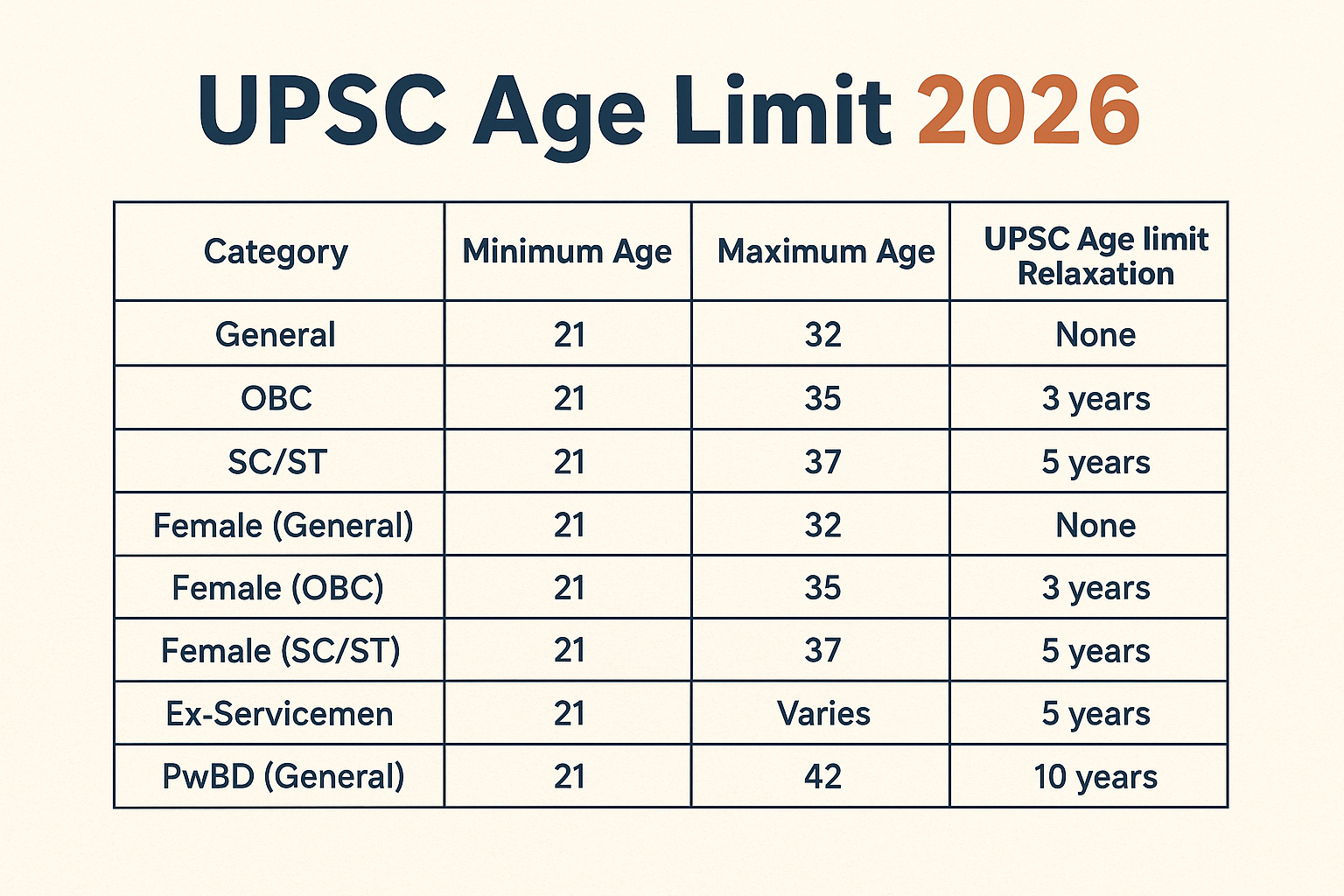
The age of a candidate is calculated as of August 1st, 2026. For the 2026 cycle, general candidates must have been born between August 2, 1994, and August 1, 2005.
| Category | Minimum Age | Maximum Age | Total Attempts |
| General / EWS | 21 Years | 32 Years | 6 |
| OBC (Non-Creamy Layer) | 21 Years | 35 Years | 9 |
| SC / ST | 21 Years | 37 Years | Unlimited (up to age limit) |
| PwBD | 21 Years | 42 Years | 9 (Gen/OBC) |
Special Relaxations for Ex-Servicemen
Ex-servicemen, including Commissioned Officers and ECOs/SSCOs, receive additional benefits based on their service duration and medical status.
● After 5 Years of Service:
● General: 37 Years (+5 years)
● OBC: 40 Years (+8 years)
● SC/ST: 42 Years (+10 years)
● Discharged due to Disability:
● General: 35 Years (+3 years)
● OBC: 38 Years (+6 years)
● SC/ST: 40 Years (+8 years)
How to Calculate Age for 2026?
For the UPSC CSE 2026, you must meet the following birth date criteria:
● Earliest Birth Date: August 2, 1994 (for General category).
● Latest Birth Date: August 1, 2005.
2. Educational Qualifications
The UPSC is inclusive, allowing students from all academic backgrounds to apply.
- Minimum Requirement: You must hold a degree from a government-recognized university.
- Final Year Students: If you are in your final year of graduation, you can still apply for the Prelims. However, you must submit proof of passing before appearing for the Mains (around September 2026).
- Professional Degrees: Technical degrees (B.Tech, MBBS, etc.) are fully recognized. Medical students who have completed their final exams but are still in their internship can apply, provided they submit a completion certificate from their university before the Mains.
3. Nationality Requirements
- For IAS, IPS, and IFS: You must be a Citizen of India.
- For Other Services (IRS, IRTS, etc.): You can be a citizen of India, Nepal, or Bhutan, or a Tibetan refugee who arrived before 1962. Persons of Indian Origin (PIOs) from specific countries who intend to settle in India permanently are also eligible.
4. Physical and Medical Standards
While most administrative roles require you to be “physically fit and mentally stable,” specific services have stricter demands.
- IPS and Railway Services: These require specific measurements for height, weight, and chest expansion. Vision standards (eyesight) are also strictly monitored.
- Medical Examination: Every candidate who clears the Mains and goes to the Interview stage must undergo a medical test at a designated hospital in New Delhi.
5. Important Restrictions
- Already in Service: If you are currently serving as an IAS or IFS officer, you are barred from appearing for the UPSC exam again.
- IPS Restrictions: If you are already an IPS officer, you cannot opt for the IPS again in your preference list.