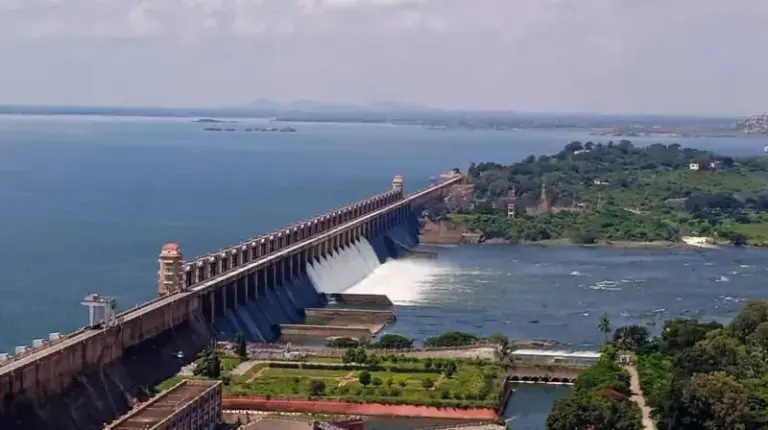
The Tungabhadra Dam, also known as Pampa Sagar, is a major multipurpose reservoir built across the Tungabhadra River in South India. It serves as a critical infrastructure for irrigation, electricity generation, and flood control, supporting the agrarian economies of Karnataka and Andhra Pradesh. Beyond its engineering utility, the dam and the river it harnesses hold immense historical and religious importance, having served as the lifeline for the medieval Vijayanagara Empire.
1. Overview of the Tungabhadra Dam
The Tungabhadra Dam is a testament to post-independence engineering and interstate cooperation.
1 Location: The dam is situated near the town of Hospet in the Vijayanagara district of Karnataka.
2 Construction History: The project began as a joint venture between the erstwhile Hyderabad State and the Madras Presidency. Following India’s administrative reorganization, it became a joint project between Karnataka and Andhra Pradesh, reaching completion in 1953.
3 Technical Specifications:
Storage Capacity: The reservoir can hold 101 TMC (Thousand Million Cubic feet) of water.
Dimensions: The dam stands at a height of approximately 49.5 meters and is equipped with 33 crest gates.
Catchment Area: It drains an expansive area of 28,000 sq. km.
4 Unique Materiality: The Tungabhadra reservoir, alongside the Mullaperiyar Dam in Kerala, holds the distinction of being the only two major reservoirs in India constructed using a specific combination of mud and limestone.
2. The Tungabhadra River System
The Tungabhadra is the largest and most vital tributary of the Krishna River, playing a dominant role in the hydrology of the South Indian peninsula.
Origin and Confluence
1 Source Rivers: It is formed by the union of two separate rivers, the Tunga and the Bhadra. Both originate on the eastern slopes of the Western Ghats in Karnataka.
2 Birth of the River: The Tunga and Bhadra merge at a place called Koodli in the Shimoga district, from where the combined stream is known as the Tungabhadra.
Course and Flow
1 Direction: The river flows in a generally northeast direction across the Deccan Plateau.
2 The Krishna Connection: It travels a total length of 531 km before joining the Krishna River at Sangamaleshwaram in Andhra Pradesh. Krishna eventually empties into the Bay of Bengal.
3 Monsoon Influence: The river’s flow is primarily dictated by the South-West monsoon, which provides heavy rainfall to its Western Ghats catchment area.
Tributaries and Other Dams
1 Key Tributaries: Major feeders include the Varada River and the Hagari (Vedathy) River.
2 Other Infrastructure: Several other dams regulate this river system, including the Tunga Anicut Dam, Bhadra Dam, and Hemavathy Dam.
3. Historical and Cultural Significance
The Tungabhadra is not just a water body but a sacred entity deeply embedded in Indian history and mythology.
1 Ancient Identity: In historical texts, the river was often referred to as the Varada River. In the Ramayana, it is mentioned as Pampa, a name that survives today in the dam’s title, Pampa Sagar.
2 The Vijayanagara Legacy: Between the 14th and 17th centuries, the river was the primary water source for the Vijayanagara Empire. The empire’s capital, Hampi—now a UNESCO World Heritage site—is situated on its banks. The ruins of Hampi still showcase sophisticated ancient water channels and stone aqueducts fed by the river.
FAQs: Tungabhadra Dam and River
WHAT IS THE ALTERNATIVE NAME OF THE TUNGABHADRA DAM?
The Tungabhadra Dam is popularly known as Pampa Sagar, named after the ancient mythological name of the river.
WHICH STATES ARE SERVED BY THE TUNGABHADRA PROJECT?
It is a joint multipurpose project serving the states of Karnataka and Andhra Pradesh.
WHERE DOES THE TUNGA AND BHADRA RIVERS MERGE?
The two rivers merge at Koodli in the Shimoga district of Karnataka to form the Tungabhadra River.
WHAT IS THE HEIGHT AND GATE CAPACITY OF THE DAM?
The dam has a height of 49.5 meters and features 33 crest gates for water management.
WHICH ANCIENT EMPIRE RELIED ON THE TUNGABHADRA RIVER?
The Vijayanagara Empire utilized the river as its primary lifeline, with its capital Hampi located on the river’s banks.
IS THE TUNGABHADRA RIVER A TRIBUTARY OF THE KAVERI?
No, the Tungabhadra is the largest tributary of the Krishna River.
WHAT IS UNIQUE ABOUT THE CONSTRUCTION MATERIAL OF THE DAM?
It is one of only two reservoirs in India (the other being Mullaperiyar) built using a combination of mud and limestone.
WHICH RAIN SYSTEM PRIMARILY FEEDS THE RIVER?
The river is chiefly influenced by the South-West monsoon rains.
WHAT IS THE TOTAL LENGTH OF THE TUNGABHADRA RIVER?
The river has a total length of approximately 531 kilometers.
WHERE DOES THE TUNGABHADRA JOIN THE KRISHNA RIVER?
It joins the Krishna River at Sangamaleshwaram in the state of Andhra Pradesh.