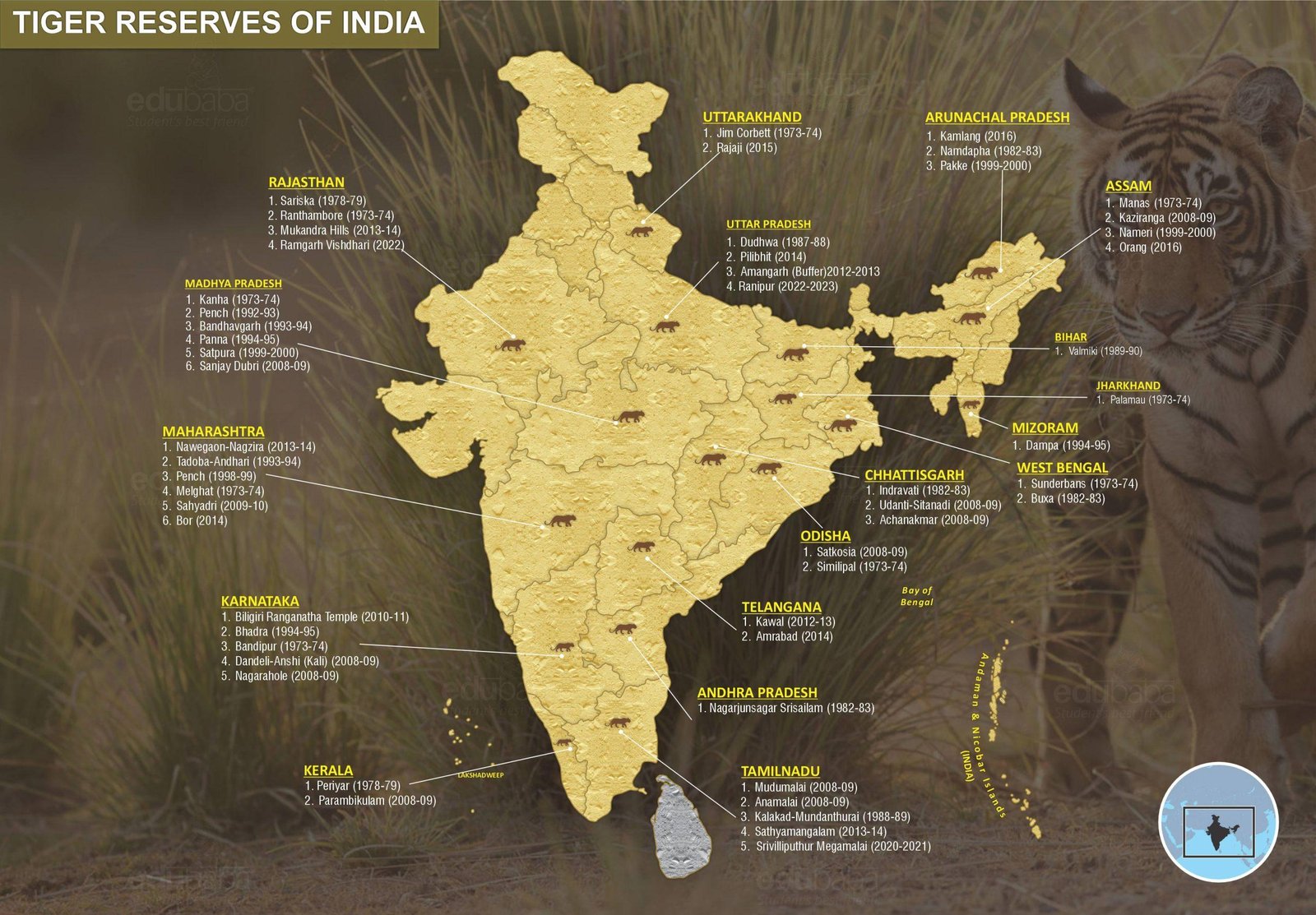
The Bengal Tiger (Panthera tigris tigris) stands as a majestic symbol of India’s natural heritage and was officially declared the National Animal of India in April 1973. This designation coincided with the launch of Project Tiger, a pioneering conservation initiative aimed at protecting this “Endangered” species (as listed in the IUCN Red Data Book) and its critical habitats. What began with nine reserves has now blossomed into a robust network that safeguards 80% of the world’s wild tiger population.
As of 2026, India boasts 58 designated Tiger Reserves, overseen by the National Tiger Conservation Authority (NTCA). These reserves are not merely sanctuaries for tigers but are essential carbon sinks and biodiversity hubs that sustain India’s ecological balance.
Tiger Census 2022: Population Trends and Highlights
India conducts a comprehensive tiger census every four years. The latest Tiger Census Report 2022 revealed a significant growth in the feline population.
- National Statistics: The tiger population increased from 2,967 in 2018 to 3,682 in 2022.
- Top States: Madhya Pradesh leads with 785 tigers, followed by Karnataka (563), Uttarakhand (560), and Maharashtra (444).
- Reserves with Highest Density: Jim Corbett National Park in Uttarakhand hosts the highest number of tigers (260), followed by Bandipur (150) and Nagarhole (141) in Karnataka.
Complete List of Tiger Reserves in India
The following table provides a comprehensive overview of the tiger reserves, their locations, notification years, and total areas. The newest addition is Madhav Tiger Reserve in Madhya Pradesh, notified in 2025.
| Sl No | Tiger Reserve | State | Notification Year | Area (sq km) |
| 1 | Bandipur | Karnataka | 2007 | 1456.30 |
| 2 | Corbett | Uttarakhand | 2010 | 1288.31 |
| 3 | Kanha | Madhya Pradesh | 2007 | 2051.79 |
| 4 | Manas | Assam | 2008 | 2837.10 |
| 5 | Melghat | Maharashtra | 2007 | 2768.52 |
| 6 | Palamau | Jharkhand | 2012 | 1129.93 |
| 7 | Ranthambore | Rajasthan | 2007 | 1411.29 |
| 8 | Simlipal | Odisha | 2007 | 2750.00 |
| 9 | Sunderban | West Bengal | 2007 | 2584.89 |
| 10 | Periyar | Kerala | 2007 | 925.00 |
| 11 | Sariska | Rajasthan | 2007 | 1213.34 |
| 12 | Buxa | West Bengal | 2009 | 757.90 |
| 13 | Indravati | Chhattisgarh | 2009 | 2799.07 |
| 14 | Namdapha | Arunachal Pradesh | 1987 | 2052.82 |
| 15 | Nagarjunsagar Srisailam | Andhra Pradesh | 2007 | 3296.31 |
| 16 | Dudhwa | Uttar Pradesh | 2010 | 2201.77 |
| 17 | Kalakad-Mundanthurai | Tamil Nadu | 2007 | 1601.54 |
| 18 | Valmiki | Bihar | 2012 | 899.38 |
| 19 | Pench | Madhya Pradesh | 2007 | 1179.63 |
| 20 | Tadoba-Andhari | Maharashtra | 2007 | 1727.59 |
| 21 | Bandhavgarh | Madhya Pradesh | 2007 | 1536.93 |
| 22 | Panna | Madhya Pradesh | 2007 | 1598.10 |
| 23 | Dampa | Mizoram | 2007 | 988.00 |
| 24 | Bhadra | Karnataka | 2007 | 1064.29 |
| 25 | Pench (MH) | Maharashtra | 2007 | 741.22 |
| 26 | Pakke | Arunachal Pradesh | 2012 | 1198.45 |
| 27 | Nameri | Assam | 2000 | 464.00 |
| 28 | Satpura | Madhya Pradesh | 2007 | 2133.31 |
| 29 | Anamalai | Tamil Nadu | 2007 | 1479.87 |
| 30 | Udanti-Sitanadi | Chhattisgarh | 2009 | 1842.54 |
| 31 | Satkosia | Odisha | 2007 | 963.87 |
| 32 | Kaziranga | Assam | 2007 | 1173.58 |
| 33 | Achanakmar | Chhattisgarh | 2009 | 914.02 |
| 34 | Kali (Dandeli-Anshi) | Karnataka | 2007 | 1097.51 |
| 35 | Sanjay-Dubri | Madhya Pradesh | 2011 | 1674.50 |
| 36 | Mudumalai | Tamil Nadu | 2007 | 688.59 |
| 37 | Nagarhole | Karnataka | 2007 | 1205.76 |
| 38 | Parambikulam | Kerala | 2009 | 643.66 |
| 39 | Sahyadri | Maharashtra | 2012 | 1165.57 |
| 40 | BRT Temple | Karnataka | 2007 | 574.82 |
| 41 | Kawal | Telangana | 2012 | 2015.44 |
| 42 | Sathyamangalam | Tamil Nadu | 2013 | 1408.40 |
| 43 | Mukundara Hills | Rajasthan | 2013 | 759.99 |
| 44 | Nawegaon-Nagzira | Maharashtra | 2013 | 1894.94 |
| 45 | Amrabad | Telangana | 2015 | 2611.39 |
| 46 | Pilibhit | Uttar Pradesh | 2014 | 730.25 |
| 47 | Bor | Maharashtra | 2014 | 816.27 |
| 48 | Rajaji | Uttarakhand | 2015 | 1075.17 |
| 49 | Orang | Assam | 2016 | 492.46 |
| 50 | Kamlang | Arunachal Pradesh | 2017 | 783.00 |
| 51 | Srivilliputhur Megamalai | Tamil Nadu | 2021 | 1016.57 |
| 52 | Ramgarh Vishdhari | Rajasthan | 2022 | 1501.89 |
| 53 | Ranipur | Uttar Pradesh | 2022 | 529.36 |
| 54 | Veerangana Durgavati | Madhya Pradesh | 2023 | 2339.12 |
| 55 | Dholpur-Karauli | Rajasthan | 2023 | 599.64 |
| 56 | Guru Ghasidas-Tamor Pingla | Chhattisgarh | 2024 | 2829.39 |
| 57 | Ratapani | Madhya Pradesh | 2024 | 1271.47 |
| 58 | Madhav | Madhya Pradesh | 2025 | 1651.39 |
State-Wise Distribution of Tiger Reserves
India’s 58 tiger reserves are spread across 18 states, forming vital wildlife corridors.
- Madhya Pradesh (9 Reserves): The “Tiger State” of India features the highest number of reserves, including Kanha, Pench, and the newly notified Madhav National Park.
- Maharashtra (6 Reserves): Includes Melghat, Tadoba-Andhari, and Bor (the smallest tiger reserve).
- Karnataka (5 Reserves): Home to Bandipur and Nagarhole, which boast high tiger densities.
- Tamil Nadu (5 Reserves): Includes Mudumalai and the recently added Srivilliputhur Megamalai.
- Rajasthan (5 Reserves): Features Ranthambore and the newer Dholpur-Karauli reserve.
Top 10 Largest Tiger Reserves in India
These vast landscapes are critical for maintaining healthy tiger genetics and preventing human-animal conflict.
- Nagarjunsagar-Srisailam (Andhra Pradesh): The Largest Tiger Reserve in India, spanning 3,296.31 sq. km. It is characterized by the Nallamala Hills and the Srisailam reservoir.
- Manas (Assam): A Himalayan reserve that is also a UNESCO World Heritage Site and home to the one-horned rhino.
- Guru Ghasidas – Tamor Pingla (Chhattisgarh): One of the newest large reserves, crucial for connectivity in Central India.
- Melghat (Maharashtra): Situated in the Satpura range, acting as a vital catchment for five major rivers.
- Similipal (Odisha): Famous for its dense sal forests and “black tigers” (melanistic tigers).
- Amrabad (Telangana): Known for the coexistence of the Chenchu tribe with the wildlife in the Nallamala Hills.
- Sundarbans (West Bengal): The world’s largest mangrove forest where tigers have adapted to a saline-aquatic lifestyle.
- Dudhwa (Uttar Pradesh): Located on the Indo-Nepal border, it is unique for hosting both tigers and rhinos.
- Satpura (Madhya Pradesh): A rugged landscape south of the Narmada River with deep valleys and sandstone peaks.
- Namdapha (Arunachal Pradesh): The only reserve in the world hosting the Tiger, Leopard, Snow Leopard, and Clouded Leopard.
FAQs: Tiger Reserves in India
WHICH IS THE LARGEST TIGER RESERVE IN INDIA?
The Nagarjunsagar-Srisailam Tiger Reserve in Andhra Pradesh is the largest, covering approximately 3,296.31 sq. km.
WHICH STATE HAS THE HIGHEST NUMBER OF TIGER RESERVES?
Madhya Pradesh holds the record with 9 tiger reserves, the latest being Madhav Tiger Reserve in 2025.
WHAT IS THE LATEST ADDITION TO THE TIGER RESERVES LIST?
Madhav National Park in Madhya Pradesh was notified as a Tiger Reserve in 2025.
WHICH RESERVE HAS THE HIGHEST TIGER POPULATION?
Jim Corbett National Park in Uttarakhand has the highest individual tiger count, with 260 tigers as per the 2022 census.
WHEN WAS PROJECT TIGER LAUNCHED?
Project Tiger was launched in April 1973 from the Jim Corbett National Park.
WHO IS THE ADMINISTRATIVE AUTHORITY FOR TIGER RESERVES?
The National Tiger Conservation Authority (NTCA), a statutory body under the Ministry of Environment, Forest and Climate Change, administers them.
WHICH TIGER RESERVE IS FAMOUS FOR SWIMMING TIGERS?
The Sundarbans Tiger Reserve in West Bengal is world-famous for its mangrove-dwelling tigers that swim in saline waters.
ARE THERE ANY TIGER RESERVES IN THE HIMALAYAS?
Yes, reserves like Corbett, Rajaji, Namdapha, and Manas are located in the Himalayan foothills or ranges.
WHICH IS THE ONLY RESERVE WITH ALL FOUR BIG CATS?
Namdapha Tiger Reserve in Arunachal Pradesh is the only one in the world to host the Tiger, Leopard, Snow Leopard, and Clouded Leopard.
WHAT IS THE CURRENT TIGER POPULATION IN INDIA?
According to the 2022 Census, India has 3,682 tigers, which is a significant increase from 2,967 in 2018.