The President of India is the First Citizen of the country and the Supreme Commander of the Indian Armed Forces. Under Article 52 of the Constitution, the office is established as a symbol of the nation’s unity, integrity, and solidarity. While the President is the Constitutional Head of State, India follows a parliamentary system where the real executive power is vested in the Prime Minister and the Council of Ministers.
Comprehensive List of the Presidents of India (1950–2026)
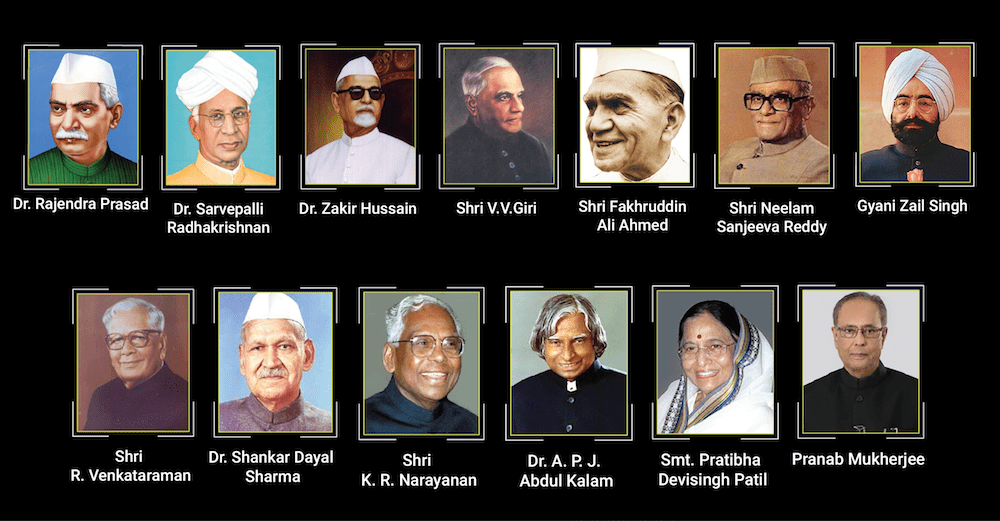
Since the adoption of the Republic in 1950, India has been led by distinguished scholars, scientists, lawyers, and social reformers. Below is the exhaustive list of those who have occupied the Rashtrapati Bhavan.
Table of Indian Presidents and Their Tenures
| No. | Name | Tenure | Key Profile & Milestone |
| 1 | Dr. Rajendra Prasad | 1950 – 1962 | First President; only one to serve two full terms. |
| 2 | Dr. S. Radhakrishnan | 1962 – 1967 | Renowned philosopher; his birthday is Teacher’s Day. |
| 3 | Dr. Zakir Husain | 1967 – 1969 | First Muslim President; died in office. |
| — | V.V. Giri (Acting) | 1969 | Acting President following Dr. Husain’s demise. |
| — | M. Hidayatullah (Acting) | 1969 | Only Chief Justice of India to serve as Acting President. |
| 4 | V.V. Giri | 1969 – 1974 | Only the President was elected as an Independent candidate. |
| 5 | Fakhruddin Ali Ahmed | 1974 – 1977 | Signed the 1975 Emergency; died in office. |
| — | B.D. Jatti (Acting) | 1977 | Acting President following Ahmed’s death. |
| 6 | Neelam Sanjiva Reddy | 1977 – 1982 | Only the President elected unopposed; youngest at the time. |
| 7 | Giani Zail Singh | 1982 – 1987 | First Sikh President; exercised the Pocket Veto. |
| 8 | R. Venkataraman | 1987 – 1992 | Former Defence Minister and legal luminary. |
| 9 | Dr. Shankar Dayal Sharma | 1992 – 1997 | Known for his academic and legal contributions. |
| 10 | K.R. Narayanan | 1997 – 2002 | First Dalit President; first to vote in a general election. |
| 11 | Dr. A.P.J. Abdul Kalam | 2002 – 2007 | “Missile Man of India”; first scientist President. |
| 12 | Pratibha Patil | 2007 – 2012 | First Woman President of India. |
| 13 | Pranab Mukherjee | 2012 – 2017 | Known as the “Man for all Seasons” in Indian politics. |
| 14 | Ram Nath Kovind | 2017 – 2022 | Former Governor of Bihar; focused on social justice. |
| 15 | Droupadi Murmu | 2022 – Present | First Tribal President; youngest President of India. |
Constitutional Framework: Eligibility and Election
The Constitution provides strict criteria for anyone aspiring to the office of the President, ensuring the dignity and neutrality of the position.
Eligibility Criteria (Article 58)
- Citizenship: Must be a citizen of India.
- Age: Must have completed 35 years of age.
- Qualifications: Must be qualified for election as a member of the Lok Sabha.
- Office of Profit: Must not hold any office of profit under the Union, State, or local authorities (exceptions include sitting President, VP, Governors, or Ministers).
The Electoral College (Article 54)
The President is not directly elected by the people but through an indirect election by an Electoral College consisting of:
- Elected members of both Houses of Parliament (LS & RS).
- Elected members of the Legislative Assemblies of the States.
- Elected members of the Legislative Assemblies of Delhi and Puducherry (added via the 70th Amendment).
Powers and Functions of the President
The President wields a variety of powers, though most are exercised on the “aid and advice” of the Council of Ministers (Article 74).
- Executive Powers: All executive actions of the Government of India are formally taken in the President’s name. They appoint the PM, Ministers, Governors, and the Attorney General.
- Legislative Powers: The President summons and prorogues Parliament and can dissolve the Lok Sabha. No bill becomes an Act without the President’s assent.
- Military Powers: As the Supreme Commander, they appoint the Chiefs of the Army, Navy, and Air Force.
- Judicial Powers: Includes the power to grant pardons, reprieves, or remissions of punishment (Pardoning Power – Article 72).
- Emergency Powers: The President can declare three types of emergencies: National ( 352), President’s Rule (Art. 356), and Financial (Art. 360).
Historical Milestones and Records
- Longest Tenure: Rajendra Prasad (12 years).
- Acting Presidents: India has seen three Acting Presidents: V. Giri, M. Hidayatullah, and B.D. Jatti.
- Pocket Veto: Giani Zail Singh famously used the “Pocket Veto” on the Indian Post Office (Amendment) Bill in 1986.
- Scientific Excellence: A.P.J. Abdul Kalam was the first bachelor and the first professional scientist to occupy the office.
- First Woman Sukhoi Pilot: Pratibha Patil made history by flying a Sukhoi-30 MKI fighter jet while in office.
FAQs: Presidents of India
Who was the first President of India?
Dr. Rajendra Prasad was the first President, serving from 1950 to 1962.
Is the President elected directly by the citizens?
No, the President is elected indirectly by an Electoral College consisting of elected MPs and MLAs.
What happens if the President dies in office?
The Vice President serves as the Acting President. If the VP’s office is also vacant, the Chief Justice of India takes over.
Who is the current President of India?
Smt. Droupadi Murmu, who assumed office on July 21, 2022.
Can a President be removed from office?
Yes, through a process called Impeachment for “violation of the Constitution” under Article 61.
Who was the only President to be elected unopposed?
Neelam Sanjiva Reddy was elected unopposed in 1977.
Does the President have the power to veto a bill?
Yes, the President can exercise Absolute, Suspensive, or Pocket Vetoes, though they must sign a bill if it is passed again by Parliament after a return.
What is the tenure of the President?
The tenure is 5 years, and there is no limit on how many times a person can be re-elected.
Who was the first woman President of India?
Pratibha Patil, who served as the 12th President from 2007 to 2012.
What is the minimum age to become the President?
A candidate must be at least 35 years old.