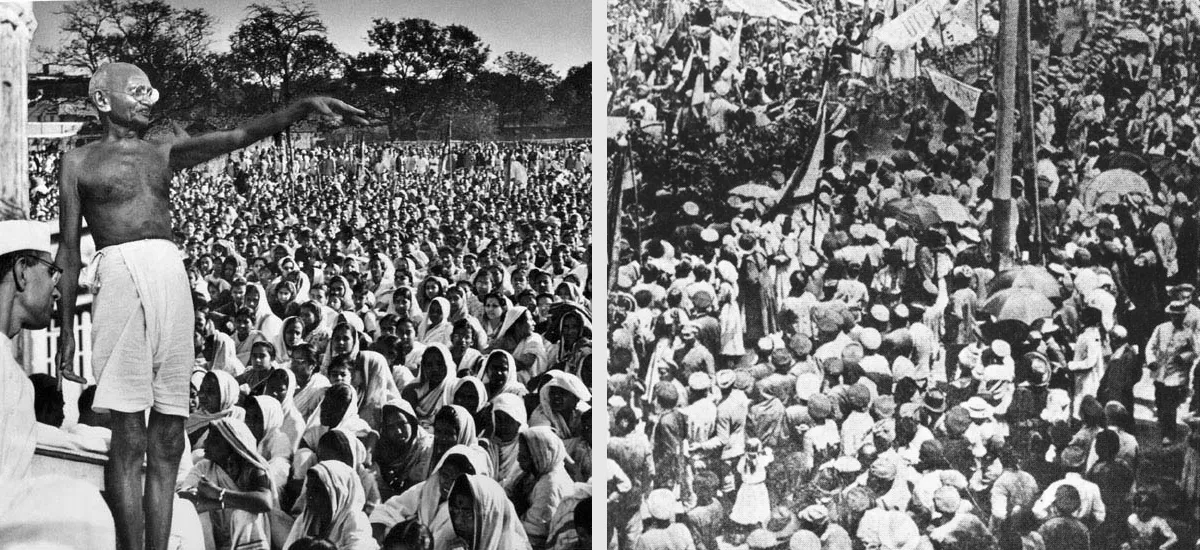
The Non-Cooperation Movement (NCM) stands as a watershed moment in the Indian freedom struggle. Launched in 1920 by Mahatma Gandhi, it marked the transition from elite-led constitutional agitation to mass-based politics. For the first time, the Indian populace—ranging from urban professionals to rural peasants—united under a singular banner to peacefully resist British hegemony through the systematic boycott of colonial institutions.
Historical Context: The origin of Dissent
The movement did not emerge in a vacuum but was the result of a “culmination of grievances” against British policies following World War I.
Immediate Causes
- The Rowlatt Act (1919): Officially known as the Anarchical and Revolutionary Crimes Act, it allowed the British government to imprison nationalists without trial. Gandhi termed it the “Black Act” and responded with the Rowlatt Satyagraha.
- Jallianwala Bagh Massacre (April 13, 1919): The brutal firing on a peaceful crowd in Amritsar by General Dyer shocked the nation’s conscience and shattered any remaining faith in British “justice.”
- The Khilafat Issue: Indian Muslims were deeply agitated by the harsh treatment of the Ottoman Caliph (Khalifa) by the British after WWI. Gandhi saw this as a “golden opportunity” to cement Hindu-Muslim unity.
- Economic Distress: Post-war inflation, heavy taxation, and forced recruitment during the war years had impoverished the Indian masses, creating fertile ground for a revolt.
- Disappointment with Reforms: The Montagu-Chelmsford Reforms (Government of India Act 1919) failed to provide meaningful self-governance, leading many to label them “disappointing and unsatisfactory.”
The NCM Timeline: From Approval to Withdrawal
The movement followed a structured political trajectory through the Indian National Congress (INC).
- September 1920 (Calcutta Special Session): The INC approved the NCM program until “Punjab and Khilafat wrongs” were redressed and Swaraj (self-rule) was attained.
- December 1920 (Nagpur Session): The program was formally endorsed. Crucially, the Congress creed was changed from “constitutional means” to “peaceful and legitimate means,” signaling a shift toward mass extra-constitutional struggle.
- 1921: The movement reached its peak with widespread boycotts and the establishment of national institutions.
- February 11, 1922: Gandhi unilaterally called off the movement following the Chauri Chaura incident, where a violent mob set fire to a police station, killing 22 policemen.
Features and Programs of the Movement
Gandhi planned the NCM in stages, moving from symbolic surrenders to active economic and institutional boycotts.
Key Components of the Program
- Surrender of Titles: Nationalist leaders and citizens returned honorary titles and medals (e.g., Gandhi returned the Kaiser-i-Hind medal).
- Educational Boycott: Students left government-controlled schools and colleges. This led to the birth of National Institutions like Jamia Millia Islamia, Kashi Vidyapeeth, and Bihar Vidyapeeth.
- Legal Boycott: Lawyers like Motilal Nehru, C.R. Das, and C. Rajagopalachari gave up their lucrative practices. Private Panchayat Courts were set up to settle disputes.
- Economic Boycott: The most visible aspect was the Boycott of Foreign Goods, especially British cloth. Public bonfires of foreign clothes became common, and the Charkha (spinning wheel) became a symbol of self-reliance (Swadeshi).
- Social Reform: The movement included the abolition of untouchability, the promotion of Hindu-Muslim unity, and a campaign against liquor and toddy shops.
- Tilak Swaraj Fund: Aimed at collecting ₹1 crore to finance the movement, it was oversubscribed, proving the massive public support.
Regional Spread: A Pan-Indian Phenomenon
The NCM manifested differently across India, shaped by local grievances:
| Region | Key Leaders | Nature of Protest |
| Bengal | J.M. Sengupta, Birendranath Sasmal | Strikes in tea plantations and railways; anti-union board agitations. |
| United Province | Baba Ram Chandra, Madari Pasi | Agrarian riots and the Eka Movement; Kisan Sabha activism. |
| Punjab | Akali Leaders | The Akali Movement for Gurudwara reform became a subset of NCM. |
| Andhra | Alluri Sitaram Raju | Tribal defiance of forest laws and “no-tax” campaigns in Chirala-Perala. |
| Malabar (Kerala) | Mopillah Peasants | Intense anti-landlord (Jemni) and anti-British struggle (Mopillah Revolt). |
| Gujarat | Vallabhbhai Patel | Massive mobilization of peasants against the colonial government. |
Significance and Limitations
Major Achievements
- Mass Mobilization: It transformed the national movement from an intellectual debate into a People’s Struggle, bringing women and peasants into the fold.
- Anti-Imperialist Consciousness: It eroded the “myth of British invincibility” and fostered a sense of national pride.
- Secular Unity: It achieved an unprecedented level of Hindu-Muslim cooperation through the alliance with the Khilafat committee.
Limitations
- Religious Convergence: The merger with the Khilafat issue, which was based on religious identity, arguably brought communal elements into secular politics in the long run.
- Sudden Withdrawal: The decision to stop the movement after Chauri Chaura disillusioned many younger leaders (like Subhash Chandra Bose and Jawaharlal Nehru) who felt the nation was on the verge of victory.
- Class Dynamics: The leadership was careful not to turn the struggle into a “class revolution” against Indian Zamindars, which limited the radicalization of the peasant struggle.
FAQs: Non-Cooperation Movement
Who launched the Non-Cooperation Movement and when?
It was launched by Mahatma Gandhi in 1920.
What were the “Three Evils” the movement sought to address?
It aimed to correct the Punjab wrongs (Jallianwala Bagh), the Khilafat wrongs, and attain Swaraj.
Why was the movement called off in 1922?
It was withdrawn due to the Chauri Chaura incident in Gorakhpur, where a peaceful protest turned violent, violating Gandhi’s core principle of non-violence.
What role did the Khilafat Movement play?
The Khilafat movement acted as a parallel struggle by Indian Muslims; Gandhi merged it with the NCM to ensure pan-Indian Hindu-Muslim unity against the British.
Which educational institutions were founded during NCM?
Prominent national institutions included Jamia Millia Islamia (Aligarh/Delhi), Kashi Vidyapeeth (Varanasi), and Gujarat Vidyapeeth.
What was the “Tilak Swaraj Fund”?
A fund started in memory of Bal Gangadhar Tilak to collect ₹1 crore to support NCM activities and promote the Charkha.
Who were the “No-Changers”?
After the NCM was called off, a group of leaders (like Rajendra Prasad and Vallabhbhai Patel) who wanted to continue constructive work and opposed entering legislative councils were called “No-Changers.”
What was the impact on British trade?
The boycott of foreign cloth led to a drastic fall in British imports, while Indian textile mills and handlooms saw a significant boost.
Was the movement strictly non-violent?
While Gandhi insisted on non-violence (Ahimsa), localized violence occurred, such as the Mopillah Revolt in Kerala and the Chauri Chaura incident.
How did the NCM change the Indian National Congress?
It turned the Congress into a mass-based revolutionary organization with a hierarchy reaching down to the village level.