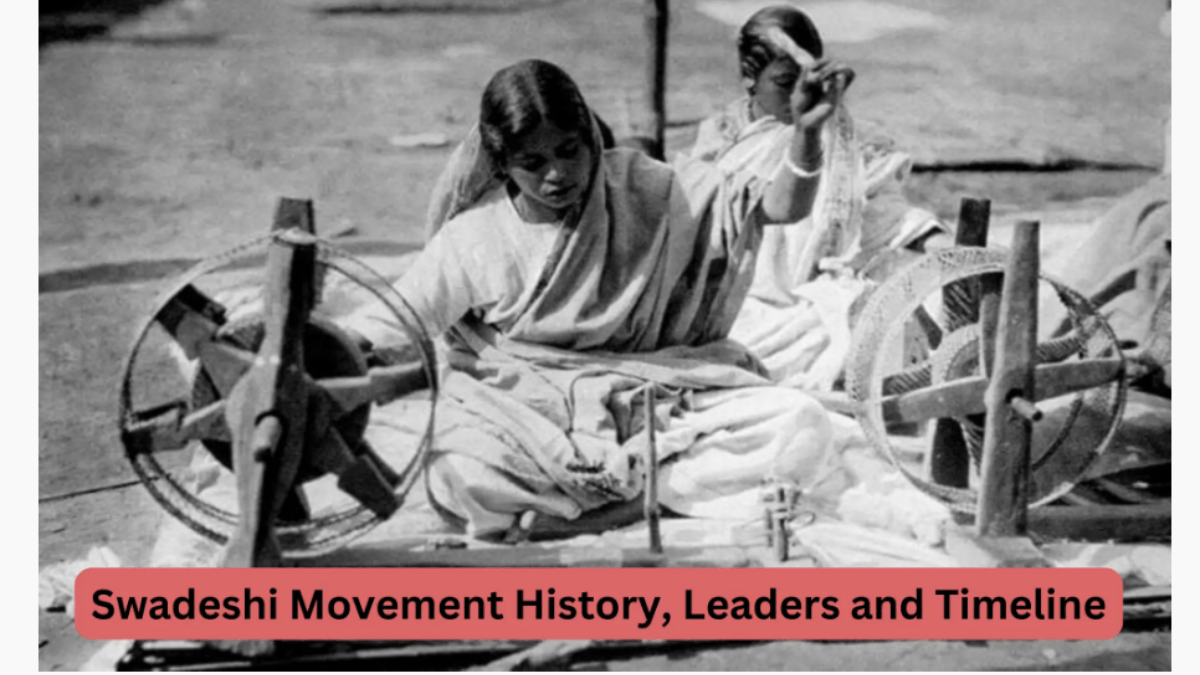
The Swadeshi Movement, launched in the early 20th century, stands as a momentous chapter in India’s relentless struggle for independence. Officially erupting in 1905 as a direct response to the Partition of Bengal, the movement served as a catalyst for a new era of Indian nationalism. It was the first time that the strategies of Boycott and Self-Reliance (Swadeshi) were used systematically to challenge British imperial dominance.
This period marked a pivotal juncture where the Indian populace moved away from mere petitions to active resistance, nurturing a resolute spirit of national identity and economic independence.
1. Background: The Partition of Bengal (1905)
The Swadeshi movement was deeply rooted in the British policy of “Divide and Rule,” orchestrated primarily by Lord Curzon.
The Administrative Plea vs. Political Reality
1 Administrative Reason: The British claimed Bengal was too large (comprising 78 million people) to be efficiently administered by a single provincial government.
2 Political Motive: The real intent was to suppress the rising tide of nationalism. By separating the predominantly Muslim eastern areas from the Hindu-majority western areas, Curzon aimed to shatter the unity of the Bengali-speaking educated middle class.
3 The Implementation: In July 1905, the government announced the formation of “Eastern Bengal and Assam.” Despite massive local opposition, the partition was implemented on 16th October 1905.
2. The Genesis of Boycott and Swadeshi
Protests began as early as 1903 but reached a fever pitch in 1905. The movement transitioned from constitutional agitation to a mass economic struggle.
- Early Protests: Initially, the Moderates used press campaigns, public meetings, and petitions. When these failed, the “Boycott” of British goods was proposed in Krishnakumar Mitra’s journal, Sanjivani, in July 1905.
- The Town Hall Meeting: On 7 August 1905, a massive meeting at Calcutta’s Town Hall formally proclaimed the Boycott of British goods.
- Day of Mourning: On 16th October 1905, people observed Arandhan (not lighting the hearth) and tied Rakhi on each other’s wrists as a symbol of unbreakable unity between the two halves of Bengal.
- Different Approaches: Moderates vs. Extremists
The movement saw a clear ideological divide within the Indian National Congress, leading to a shift in political strategy.
The Moderate Approach
1 Leaders: Surendranath Banerjee, Krishnakumar Mitra, and Narendra Kumar Sen.
2 Strategy: They relied on “Constructive Swadeshi”—self-help through indigenous enterprises and national education.
3 Educational Reform: In response to the Carlyle Circular (which threatened students with expulsion), leaders established the National Council of Education (1906) and the Bengal National College, with Aurobindo Ghosh as its first principal.
The Extremist (Radical) Approach
1 Leaders: The famous trio Lal-Bal-Pal (Lala Lajpat Rai, Bal Gangadhar Tilak, and Bipin Chandra Pal) along with Aurobindo Ghosh.
2 Strategy: They demanded Swaraj (complete independence) and advocated for “Passive Resistance.”
3 Expansion: They wanted to extend the boycott beyond goods to government schools, courts, and titles, moving the movement toward civil disobedience.
4. The Role of Samitis and Volunteer Corps
The movement was sustained at the grassroots level by various volunteer organizations known as Samitis.
- Swadesh Bandhab Samiti: Led by Ashwini Kumar Dutt in Barisal, it achieved remarkable success in mobilizing the rural masses.
- Other Notable Samitis: The Dawn Society, Anushilan Samiti, and the Anti-Circular Society.
- Functions: These bodies engaged in social work during famines, provided physical training, and promoted Swadeshi products through magic lantern lectures and traditional folk theater (Jatra).
5. Economic and Social Impacts of Swadeshi
The movement was not just political; it was a crusade for economic self-sufficiency.
1 Revival of Industries: Exclusive Indian ventures emerged, such as Bengal Chemicals (started by P.C. Ray), Laxmi Cotton Mills, and various soap and match factories.
2 Shift in Consumption: People committed to using only Indian-made cloth (Khadi) and sugar, even if it was coarser or more expensive.
3 Cultural Upsurge: Patriotic songs by Rabindranath Tagore (such as Amar Sonar Bangla) and Rajanikanta Sen became the anthems of the masses.
4 Mass Participation: For the first time, women joined processions, and students became the backbone of the movement through picketing.
6. The Communal Tangle and Reversal
- Rise of Communalism: To counter the movement, the British encouraged pro-partition sentiments among Muslim aristocrats. This led to the formation of the All India Muslim League in 1906 in Dacca, led by Nawab Salimullah.
- Annulment: Faced with relentless agitation, the British government finally annulled the Partition of Bengal in 1911 during the visit of King George V. However, the capital was shifted from Calcutta to Delhi in the same year.
7. Evaluation: Significance for the Freedom Struggle
The Swadeshi movement was a “leap forward” for Indian politics:
- End of Petitions: It proved that “petitioning and praying” was ineffective, establishing Passive Resistance as a viable tool.
- Goal of Swaraj: It set the ultimate goal of the Indian people as complete independence.
- All-India Impact: While centered in Bengal, it resonated in Maharashtra (Tilak), Punjab (Lajpat Rai), and Andhra (where it was called the Vandemataram Movement).
Frequently Asked Questions (FAQs)
WHO STARTED THE SWADESHI MOVEMENT IN 1905?
The movement was a spontaneous reaction to the Partition of Bengal, led initially by Moderates like Surendranath Banerjee and later energized by Extremists like Tilak, Bipin Chandra Pal, and Lajpat Rai.
WHAT WAS THE MAIN OBJECTIVE OF THE SWADESHI MOVEMENT?
The primary objective was to reverse the partition of Bengal and achieve Swaraj (self-rule) by boycotting British goods and promoting indigenous Indian industries.
WHAT WAS THE CARLYLE CIRCULAR?
Issued in 1905, it was a government order that threatened to withdraw grants and affiliations from educational institutions whose students participated in the anti-partition political agitations.
WHO FOUNDED THE BENGAL CHEMICALS AND PHARMACEUTICAL WORKS?
It was founded by the famous scientist Acharya Prafulla Chandra Ray (P.C. Ray) during the Swadeshi movement to promote Indian industrial self-reliance.
HOW DID THE SWADESHI MOVEMENT AFFECT THE HANDLOOM SECTOR?
The movement led to a massive revival of the domestic cottage and handloom industries as people boycotted Manchester cloth and shifted to locally woven Indian textiles.
WHAT IS THE VANDEMATARAM MOVEMENT?
This was the name given to the Swadeshi movement in the deltaic Andhra region, where it was led by figures like Mutnuri Krishna Rao.
WHO WAS THE FIRST PRINCIPAL OF BENGAL NATIONAL COLLEGE?
Aurobindo Ghosh resigned from his post in Baroda to become the first principal of the Bengal National College in 1906.
WHAT WAS THE “ARANDHAN” OBSERVED IN BENGAL?
Proposed by Ramendra Sunder Trivedi, Arandhan was the ritual of not cooking food on the day Bengal was partitioned (16 Oct 1905) as a mark of mourning and protest.
WHAT ROLE DID RABINDRANATH TAGORE PLAY IN THE MOVEMENT?
Tagore composed several patriotic songs, suggested the Raksha Bandhan festival to promote Hindu-Muslim unity, and advocated for “Atmashakti” or self-reliance.
WHEN WAS THE PARTITION OF BENGAL FINALLY REVERSED?
The partition was annulled in 1911 by Lord Hardinge, primarily due to the sustained pressure of the Swadeshi and Boycott movements.