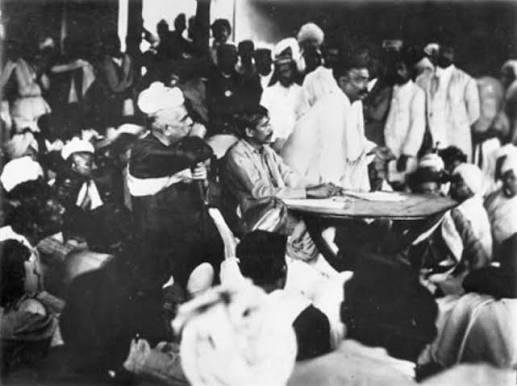
The Surat Split (1907) marked a turning point in the Indian national movement. It was the first organisational division within the Indian National Congress (INC) and reflected deep ideological differences over the strategy for achieving Swaraj. The growing nationalist response to the Partition of Bengal (1905), disagreements over leadership, and contrasting political approaches culminated in the split at the Surat Session (1907). Although the division temporarily weakened the Congress, it also paved the way for a more assertive and mass-based phase of India’s freedom struggle.
Historical Background
- By the beginning of the twentieth century, the Indian national movement had entered a new phase characterised by rising political awareness and stronger opposition to British colonial rule.
- The Partition of Bengal (1905) triggered widespread public resentment and gave momentum to the Swadeshi Movement, which promoted the use of indigenous goods and the boycott of foreign products.
- Within the Indian National Congress, differences gradually emerged regarding the methods of securing political rights and the future direction of the national movement.
- These differences reached their peak during the Surat Session of the INC in 1907, held on the banks of the Tapti River, where the Congress split into Moderates and Extremists.
- The session ended in disorder and was suspended without completing its proceedings, making the split a defining event in the history of the Indian freedom movement.
Factors Responsible for the Surat Split
- Ideological Differences
- The principal cause of the split was the contrasting political philosophy of the two factions.
- The Moderates, led by Gopal Krishna Gokhale, believed that constitutional methods such as petitions, resolutions, debates, and negotiations would gradually secure political reforms.
- The Extremists, led by Bal Gangadhar Tilak, Lala Lajpat Rai, and Bipin Chandra Pal, argued that political rights could only be achieved through mass participation and sustained public pressure.
- They advocated a four-fold programme comprising:
-
- Swaraj (Self-rule)
- Swadeshi (Promotion of indigenous goods)
- Boycott (Rejection of foreign goods and institutions)
- National Education (Development of an indigenous education system)
- Partition of Bengal and the Swadeshi Movement
- The Partition of Bengal (1905) became the immediate political issue that widened differences within the Congress.
- Nationalists viewed the partition as an attempt to weaken Indian unity through a divisive administrative policy.
- Although both factions opposed the partition, they differed significantly in their methods of protest.
- The Moderates favoured constitutional agitation and a limited boycott of foreign goods.
- The Extremists sought to transform the Swadeshi Movement into a nationwide campaign for Swaraj through mass mobilisation and economic self-reliance.
- Leadership Dispute
- Differences over the Congress leadership further intensified internal tensions.
- At the Calcutta Session (1906), Dadabhai Naoroji was elected Congress President, temporarily preserving unity within the organisation.
- At the Surat Session (1907), the Moderates nominated Rash Behari Ghosh as President, while the Extremists sought the election of a leader committed to their programme of Swaraj, Swadeshi, Boycott, and National Education.
- The venue of the session was shifted from Nagpur to Surat, a move widely regarded as favouring the Moderate leadership.
- Sharp disagreements over the presidential election and the Congress agenda disrupted the proceedings and ultimately led to the formal split.
- Growing Mutual Distrust
- The widening ideological divide gradually eroded cooperation between the two groups.
- The Moderates believed that confrontational methods would invite severe British repression and weaken the national movement.
- The Extremists argued that constitutional politics alone could not secure self-rule and criticised the Moderates for placing excessive faith in British goodwill.
- British Repressive Policies
- The British Government adopted increasingly repressive measures to curb nationalist activities.
- Surveillance, arrests of nationalist leaders, and restrictions on political activities strengthened the Extremists’ belief that constitutional methods alone were inadequate.
- The Moderates, however, continued to favour constitutional agitation to avoid further administrative repression.
Impact of the Surat Split
- Temporary Weakening of the Indian National Congress
- The Surat Split weakened the unity and organisational strength of the Indian National Congress (INC).
- The separation of the Moderates and Extremists reduced the Congress’s ability to present a united front against British rule.
- For several years, the Congress remained largely under Moderate leadership, leading to a decline in its political influence and public appeal.
- Intensification of British Repression
- The British Government exploited the division within the Congress by pursuing its policy of “Divide and Rule.”
- It intensified surveillance, censorship, arrests, and prosecutions to suppress nationalist activities.
- The imprisonment of Bal Gangadhar Tilak in 1908 became a symbol of the government’s determination to curb assertive nationalism and discourage political mobilisation.
- Rise of Assertive Nationalism
- Despite the organisational setback, the split accelerated the growth of assertive nationalism in India.
- The Extremists continued to propagate the ideals of Swaraj, Swadeshi, Boycott, and National Education beyond the Congress.
- Their emphasis on mass mobilisation broadened the social base of the nationalist movement and inspired greater public participation in the struggle for self-rule.
- These ideas later became central to the nationwide movements led by Mahatma Gandhi.
- Decline of Moderate Dominance
- After the split, the Moderates retained control of the Congress but struggled to sustain the momentum of the national movement.
- Their reliance on constitutional methods attracted diminishing public support during a period of growing political consciousness.
- The limitations of moderate politics gradually became evident, strengthening the demand for broader public participation in the freedom struggle.
- Foundation for Future Unity
- The experience of the split highlighted the importance of organisational unity in the national movement.
- The limitations exposed by the division convinced both factions that cooperation was essential for effectively challenging British rule.
- This realisation laid the foundation for the eventual reunification of the Congress.
Reunion at the Lucknow Session (1916)
- The Moderates and Extremists reunited at the Lucknow Session of the Indian National Congress in 1916, ending nearly a decade of organisational division.
- The session also witnessed the Lucknow Pact (1916) between the Indian National Congress and the All India Muslim League, marking an important phase of political cooperation.
- The reunion restored organisational unity and enabled the Congress to re-emerge as the principal platform of the Indian national movement.
- It also strengthened the organisational base of the national movement and prepared the ground for broader mass campaigns in the years that followed.
Significance of the Surat Split
- The Surat Split marked the first organisational division within the Indian National Congress, exposing fundamental differences over the strategy for achieving Swaraj.
- It reflected the evolution of the Indian national movement from constitutional agitation by a limited elite to assertive and mass-based nationalism.
- The split popularised the principles of Swaraj, Swadeshi, Boycott, and National Education, which later became enduring pillars of India’s freedom struggle.
- It highlighted the need to combine constitutional politics with wider public mobilisation for building an effective national movement.
- The ideological debates that emerged from the split prepared the ground for the Gandhian phase of the national movement, which combined mass participation with disciplined political organisation.
Conclusion
The Surat Split (1907) was a defining event in the evolution of India’s freedom struggle. Although it temporarily weakened the Indian National Congress through organisational division, it also transformed the character of the national movement by bringing debates on leadership, political strategy, and mass participation to the forefront.
The reunion at the Lucknow Session (1916) restored unity within the Congress, while the lessons of the split contributed to the emergence of a stronger and more inclusive national movement. Thus, despite being a temporary organisational setback, the Surat Split proved to be an important milestone in the evolution of India’s national movement by redefining its leadership, methods, and long-term political direction.
Frequently Asked Questions (FAQs)
What was the Surat Split?
The Surat Split (1907) was the first organisational division within the Indian National Congress, resulting in the separation of the Moderates and Extremists because of differences over leadership, political strategy, and methods of achieving Swaraj.
Why did the Surat Split take place?
The split resulted from ideological differences, disagreements over the Swadeshi Movement, the presidential election at the Surat Session (1907), and growing mistrust between the Moderate and Extremist factions.
Who were the main leaders of the Moderates and Extremists?
The Moderates were led by Gopal Krishna Gokhale, Dadabhai Naoroji, and Pherozeshah Mehta, while the Extremists were led by Bal Gangadhar Tilak, Lala Lajpat Rai, and Bipin Chandra Pal.
What was the immediate trigger for the Surat Split?
The immediate trigger was the dispute over the election of the Congress President at the Surat Session (1907), which reflected deeper disagreements regarding the leadership, programme, and methods of the Indian National Congress.
When did the Moderates and Extremists reunite?
The two groups reunited at the Lucknow Session of the Indian National Congress in 1916, restoring organisational unity after nearly a decade of separation.
Why is the Surat Split considered a landmark in Indian history?
The Surat Split marked a turning point in the Indian national movement by exposing ideological differences within the Congress, encouraging the growth of assertive nationalism, and laying the foundation for the mass movements that shaped the later phase of India’s freedom struggle.