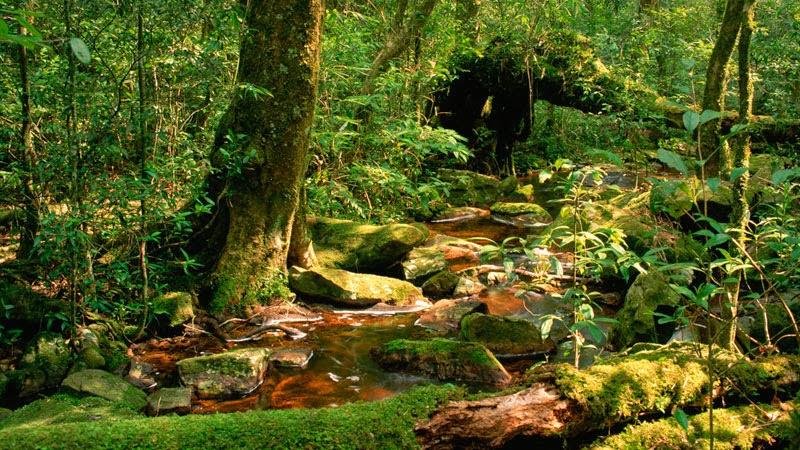
Natural vegetation refers to a plant community that has grown naturally without human aid and has been left undisturbed by humans for a long time. India, being one of the world’s 12 mega-biodiversity countries, possesses a vast array of natural vegetation ranging from the exotic rainforests of the Andaman Islands to the sparse scrub of the Thar Desert. With over 6% of the world’s flowering species, India ranks tenth globally in plant diversity. This richness is a direct result of the country’s varied relief, soil types, and climatic gradients.
Major Types of Natural Vegetation in India
India’s vegetation is broadly classified into five major groups based on climate, soil, and altitude.
Tropical Evergreen and Semi-Evergreen Forests
These forests are found in regions of heavy rainfall and high humidity.
- Tropical Evergreen: Located on the western slopes of the Western Ghats, NE Indian hills, and the Andaman & Nicobar Islands.
- Climate: Annual rainfall >250 cm; temperature 25°C–27°C.
- Features: Multi-layered (stratified) structure with trees reaching 60 meters. No definite leaf-shedding time.
- Species: Rosewood, Mahogany, Aini, Ebony.
- Semi-Evergreen: Found in the relatively drier patches of the same regions. They are transitional between evergreen and deciduous.
- Species: White Cedar, Hollock, Kail.
Tropical Deciduous Forests
Commonly known as Monsoon Forests, these are the most widespread forests in India.
- Tropical Moist Deciduous: Found in NE states, Himalayan foothills, and eastern slopes of Western Ghats (Rainfall: 100–200 cm).
- Species: Teak, Sal, Shisham, Sandalwood.
- Tropical Dry Deciduous: Found in the rainier parts of the Peninsula and the plains of UP and Bihar (Rainfall: 70–100 cm). They transition into thorn forests in drier areas.
- Species: Tendu, Palas, Amaltas, Bel, Khair.
3 Tropical Thorn Forests
These occur in areas receiving less than 50 cm of rainfall.
- Location: Semi-arid areas of SW Punjab, Haryana, Rajasthan, Gujarat, and parts of MP and UP.
- Features: Plants remain leafless for most of the year; characterized by tussocky grass and scrub.
- Species: Babool, Ber, Wild Date Palm, Khejri, Neem.
4 Montane (Mountain) Forests
Vegetation in mountainous regions changes rapidly with increasing altitude.
- Northern Mountain Forests: 1,000–2,000m: Wet temperate forests (Oak, Chestnut).
- 1,500–1,750m: Pine forests (Chir Pine).
- 2,225–3,048m: Blue Pine and Spruce. Deodar (construction grade wood) is prominent in the Western Himalayas.
- High Altitude: Silver firs, Junipers, and Rhododendrons.
- Southern Mountain Forests: Found in the Nilgiris, Anaimalai, and Palani hills. The temperate forests here are called Sholas.
- Species: Magnolia, Laurel, Cinchona.
5 Littoral and Swamp Forests (Wetlands)
India has a rich repository of wetlands, including the specialized Mangrove forests.
- Mangroves: Grow along coasts in salt marshes and estuaries. India hosts 2.5% of the world’s mangroves, primarily in the Sundarbans and Andaman Islands.
- Features: Salt-tolerant species that provide critical habitats for the Royal Bengal Tiger and diverse birdlife.
Factors Influencing Vegetation Diversity
The distribution and type of plants in India are governed by four primary factors:
| Factor | Influence on Vegetation |
| Rainfall | High rainfall (>200cm) leads to Evergreen cover; low rainfall (<50cm) leads to Thorn/Scrub. |
| Temperature | In the Himalayas, temperature drops with altitude, causing a shift from tropical to Tundra vegetation. |
| Topography | The windward side of the Western Ghats is lush green, while the leeward (rain-shadow) side is dry. |
| Soil Type | Alluvial soils support dense deciduous forests; sandy desert soils support drought-resistant species. |
Strategic Importance of Natural Vegetation
- Biodiversity Support: Provides breeding grounds for endemic species. The Sundarbans and the Western Ghats are global hotspots.
- Climate Regulation: Acts as a carbon sink, sequestering CO2 and regulating regional rainfall cycles.
- Soil and Water Management: Root systems anchor the soil, preventing erosion. Forests in the Brahmaputra basin help in groundwater recharge and flood mitigation.
- Economic Resources: Supplies high-value timber (Teak, Sal), medicinal plants for Ayurveda, and industrial raw materials like bamboo and cane.
- Cultural Value: Sacred Groves (e.g., in Meghalaya) protect rare species through traditional community-led conservation.
FAQs
WHICH FOREST TYPE IS THE MOST WIDESPREAD IN INDIA?
The Tropical Deciduous Forests (specifically the Dry Deciduous sub-type) are the most extensive forest cover in India.
WHAT ARE “SHOLAS”?
Sholas are the unique temperate mountain forests found in the higher reaches of the Nilgiris, Anaimalai, and Palani hills in Southern India.
WHY ARE MANGROVE FORESTS FOUND ONLY IN COASTAL AREAS?
Mangroves are composed of halophytes (salt-tolerant plants) that require tidal influence and saline water found in estuaries and deltas to thrive.
WHICH TREE IS KNOWN AS THE “FLAME OF THE FOREST”?
The Palas (Butea monosperma) is commonly referred to as the “Flame of the Forest” due to its bright orange-red flowers.
WHAT IS THE MAIN DIFFERENCE BETWEEN EVERGREEN AND SEMI-EVERGREEN FORESTS?
Evergreen forests receive >250cm of rain and stay green year-round; Semi-Evergreen forests receive slightly less rain (200-250cm) and contain a mix of evergreen and deciduous species.
WHERE IS THE DEODAR TREE COMMONLY FOUND?
Deodar is an endemic species found in the Western Himalayas, primarily at altitudes between 1,500 and 2,500 meters.
WHICH REGION IN INDIA IS FAMOUS FOR THE SUNDARI TREE?
The Sundarbans in West Bengal is named after the Sundari tree (Heritiera fomes), which is the dominant mangrove species there.
HOW DOES ALTITUDE AFFECT HIMALAYAN VEGETATION?
As altitude increases, the temperature decreases, causing a transition from Tropical Deciduous at the foothills to Temperate Broadleaf, then Coniferous, and finally Alpine Tundra (mosses/lichens).
WHICH STATE HAS THE HIGHEST CONCENTRATION OF TROPICAL THORN FORESTS?
Rajasthan has the highest concentration due to its arid climate and minimal rainfall.
WHAT IS “JHUM CULTIVATION” AND HOW DOES IT AFFECT VEGETATION?
Jhum (shifting) cultivation involves clearing forest patches for agriculture. It often leads to habitat fragmentation and degradation of natural vegetation in Northeast India.