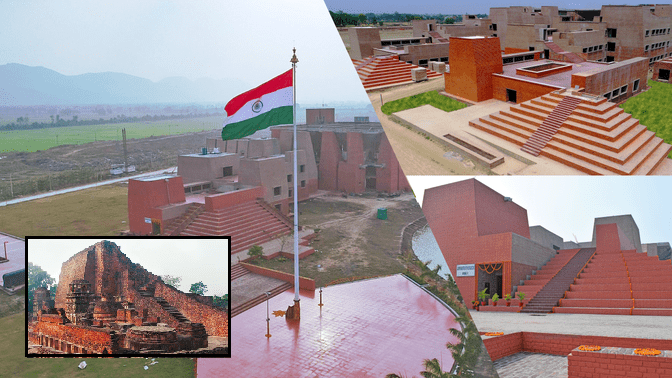
Nalanda University, established in the 5th century CE in the ancient kingdom of Magadha (modern-day Bihar), holds the prestigious distinction of being the world’s first residential university. A beacon of intellectual excellence for centuries, it served as a global hub that attracted scholars and students from across India, China, Tibet, Persia, and various other regions of Asia. Today, the site stands as a testament to India’s profound cultural legacy and its historical role as a leader in global education.
The Historical Journey of Nalanda Mahavihara
The history of Nalanda is a saga of academic brilliance, royal patronage, and eventual tragedy, spanning nearly eight centuries before its modern-day rediscovery.
1 Foundations and Royal Patronage
1 Gupta Dynasty Origins: The university was founded in 427 CE by Kumargupta I of the Gupta dynasty. Located near present-day Rajgir, Bihar, it quickly evolved into a premier center for Buddhist studies.
2 The Pala Contribution: The Pala rulers, who were devout Buddhists, continued to support the institution. Historical inscriptions record that Dharmapala and Devapala gifted entire villages to provide for the monastery’s upkeep.
3 Regional and International Support: Nalanda received significant royal patronage from Harshavardana (606-648 CE) and Bhaskaravarma, the 7th-century king of Assam. Beyond the subcontinent, it also received grants and support from several foreign rulers.
2 Accounts of Global Scholars
During its zenith in the 7th century CE, Nalanda was visited by renowned Chinese scholars Xuan Zang and I-Qing. Their detailed documentation of the university’s curriculum, discipline, and architecture remains the most vital primary source for understanding the institution’s historical grandeur.
3 Destruction and Rediscovery
1 The 1193 Catastrophe: The university met a tragic end in 1193 CE when it was destroyed by Muhammad bin Bakhtiyar Khilji.
2 19th Century Rediscovery: The site was first rediscovered in 1812 by the Scottish surveyor Francis Buchanan-Hamilton. While he documented the presence of ruins and Buddhist imagery, he did not immediately identify them as Nalanda. 3 Formal Identification: In 1861, Sir Alexander Cunningham officially identified the ruins as the ancient Nalanda University, bringing its historical importance back to global attention.
Architectural Features and Academic Excellence
Nalanda was a rare combination of outstanding achievements in site planning, art, and administrative organization.
1 The University Complex and Artistry
1 Surviving Structures: While the original complex was vast, the current remains consist of 11 viharas (monasteries) and 14 temples, accompanied by smaller shrines and votive structures.
2 Axial Planning: The site exhibits sophisticated axial planning, with a layout carefully arranged along a north-south axis.
3 Iconographic Art: The stone, metal, and stucco artworks found at the site retain features that document the evolution of Buddhist belief systems, specifically the transition from Mahayana to Vajrayana Buddhism.
2 Academic Infrastructure
1 The Nine-Story Library: A legendary repository of knowledge, the library was nine stories high. Monks meticulously copied books and documents to ensure that scholars could maintain their own specialized collections.
2 Residential Capacity: As the first residential university, it housed approximately 10,000 students and provided accommodation for 2,000 professors during its peak.
3 Diverse Curriculum: The education system was holistic and interdisciplinary, offering subjects such as philosophy, mathematics, astronomy, medicine, and logic.
3 Eminent Scholars and Luminaries
1 Aryabhata: The famous mathematician and astronomer is believed to have led the university in the 6th century CE.
2 Spiritual and Intellectual Giants: Notable scholars who studied or taught here include Nagarjuna, Dharmapala, Dharmakirti, Dinnaga, and Silabhadra.
3 Global Influence: Naropa, a Nalanda luminary, was instrumental in bringing Buddhism to Tibet alongside Shantarakshita and Padmasambhava.
Universal Significance and Modern Revival
Nalanda’s influence extends far beyond its physical ruins, impacting contemporary educational models and international diplomacy.
1 Recognition as a Global Heritage Site
In 2016, UNESCO designated “The Excavated Remains at Nalanda” as a World Heritage Site, acknowledging its role in the shared heritage of Asia. It is recognized as a foundation for subsequent Mahaviharas across the region.
2 The Medieval School of Discussion and Logic
Nalanda scholars pioneered the art and science of debate, transforming it into a critical tool for higher learning. This systematic approach to logic and knowledge production remains evident in contemporary monasteries in Sri Lanka, Tibet, and Nepal.
3 Nalanda University in the 21st Century
1 Revival Act: To resurrect this historic institution, the Indian government passed the Nalanda University Act in 2010.
2 International Collaboration: The modern university is a flagship project of the Ministry of External Affairs and a key outcome of the East Asia Summit.
Institute of National Importance (INI): Designated as an INI, the new Nalanda University aims to promote international research and learning while reviving India’s rich cultural legacy.
Frequently Asked Questions (FAQs)
WHO WAS THE FOUNDER OF THE ANCIENT NALANDA UNIVERSITY?
The ancient Nalanda University was founded in 427 CE by Kumargupta I of the Gupta dynasty.
WHERE IS NALANDA UNIVERSITY LOCATED?
The ruins of the ancient university are located in Rajgir, Bihar, near the modern-day city of Patna.
WHICH FOREIGN INVADER DESTROYED NALANDA UNIVERSITY?
Nalanda was destroyed at the end of the 12th century, specifically in 1193 CE, by Muhammad bin Bakhtiyar Khilji.
WHAT WAS UNIQUE ABOUT NALANDA’S RESIDENTIAL FACILITIES?
It is recognized as the world’s first residential university, once housing 10,000 students and 2,000 professors in dedicated dormitories.
WHICH CHINESE SCHOLARS DOCUMENTED THE LIFE AT NALANDA?
Famous Chinese travelers and scholars Xuan Zang and I-Qing visited in the 7th century CE and provided detailed accounts of the institution.
WHEN DID NALANDA RECEIVE UNESCO WORLD HERITAGE STATUS?
UNESCO designated “The Excavated Remains at Nalanda” as a World Heritage Site in 2016.
WHO WAS THE MATHEMATICIAN BELIEVED TO HAVE LED NALANDA IN THE 6TH CENTURY?
The legendary mathematician and astronomer Aryabhata is thought to have served as the head of the university during the 6th century CE.
WHAT SUBJECTS WERE TAUGHT IN THE NALANDA CURRICULUM?
The university offered a holistic curriculum including philosophy, mathematics, astronomy, medicine, and logic.
WHAT IS THE NINE-STORY STRUCTURE FAMOUSLY ASSOCIATED WITH NALANDA? Nalanda was famous for its massive nine-story library, where monks meticulously preserved and copied sacred and academic texts.
HOW IS THE MODERN NALANDA UNIVERSITY CONNECTED TO THE ANCIENT ONE? The modern university was established by the Nalanda University Act of 2010 as an international center for learning to revive the historic legacy of the original institution.