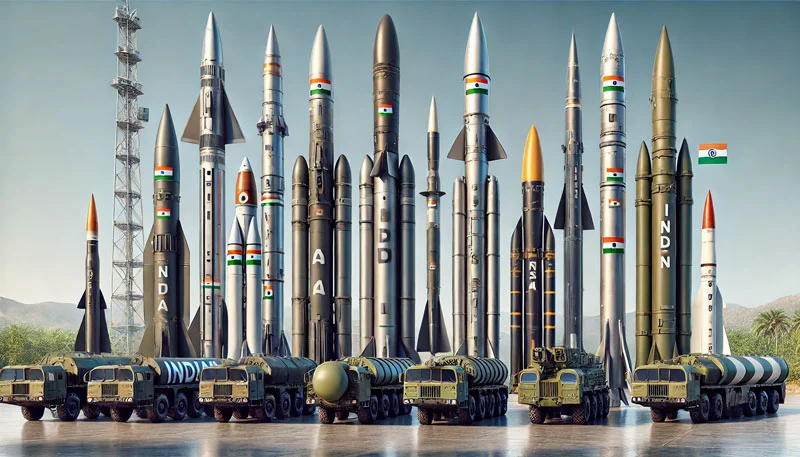
The development of indigenous missile systems stands as one of India’s greatest scientific and strategic achievements since independence. Primarily driven by the Integrated Guided Missile Development Program (IGMDP), India has transformed from a nation dependent on imports to a global leader in missile technology. These systems are not merely weapons; they are instruments of strategic stability in the Asia-Pacific region, ensuring a balance of power through credible deterrence and advanced tactical capabilities.
1 What is a Missile? Understanding the Core Components
A missile is a self-propelled, guided airborne ranged weapon. Unlike a rocket, which follows a fixed path, a missile is equipped with a sophisticated guidance system that allows it to adjust its trajectory mid-flight to hit a specific target.
Every modern missile system consists of five essential components:
- Guidance System: The “brain” that directs the missile to its destination.
- Targeting System: Identifies and locks onto the specific objective.
- Flight System: Aerodynamic surfaces like fins or wings that control movement.
- Engine/Propulsion: Provides the thrust for flight (jet engine or rocket motor).
- Warhead: The explosive or strategic payload designed to neutralize the target.
2 Hallmark Features of India’s Missile Systems
India’s missile arsenal is characterized by precision, speed, and lethality. The following features define the country’s modern strike capabilities:
- Pinpoint Accuracy: Using advanced Inertial Navigation Systems (INS), satellite guidance, and radar seekers, missiles like BrahMos and Agni-V can hit targets with high circular error probability (CEP) precision, minimizing collateral damage.
- Quick Reaction Capability: The transition toward solid-fuel technology allows for rapid deployment. Strategic missiles can now be launched in under 15 minutes using specialized Transport-Erector-Launcher (TEL)
- High Lethality: Indigenous propulsion systems enable heavy warheads to be carried over extended ranges. The BrahMos, for instance, utilizes its supersonic kinetic energy to be one of the deadliest cruise missiles in the world.
3 The Evolution of India’s Missile Programs
India’s journey began with the vision of Dr. A.P.J. Abdul Kalam and the establishment of the DRDO.
Key Developmental Milestones
| Program / Initiative | Period | Key Features & Outcomes |
| IGMDP | 1983–2008 | Developed the “PATNA” series: Prithvi, Akash, Trishul, Nag, and Agni (1-3). |
| BrahMos Aerospace | 1998–Present | A landmark joint venture with Russia to create the world’s fastest supersonic cruise missile. |
| Ballistic Missile Defence (BMD) | 1999–Present | A two-tiered shield: Prithvi Air Defence (PAD) for exo-atmospheric and Advanced Air Defence (AAD) for endo-atmospheric interception. |
| Independent Projects | 2008–Present | Focus on Agni-V (ICBM), K-Series (SLBMs), and Hypersonic Technology (HSTDV). |
4 Classification of Missiles: Speed, Trajectory, and Launch Mode
4.1 Based on Speed (The Mach Scale)
Missiles are categorized by their speed relative to the speed of sound (Mach 1):
- Subsonic: Slower than sound (e.g., Nirbhay, U.S. Tomahawk).
- Supersonic: Mach 1 to Mach 5 (e.g., BrahMos—reaches nearly Mach 3).
- Hypersonic: Faster than Mach 5 (e.g., Shaurya, Sagarika, and the Russian Zircon).
4.2 Based on Trajectory
- Ballistic Missiles: These follow a high, arched path (lofted trajectory). After the initial boost, they fall toward the target under the influence of gravity.
- Examples: Agni and Prithvi
- Cruise Missiles: These stay within the Earth’s atmosphere and fly at a constant speed and low altitude to avoid radar detection.
- Examples: BrahMos (Supersonic) and Nirbhay (Subsonic).
- Hypersonic Glide Vehicles (HGV): These are launched via a rocket but glide back to Earth at hypersonic speeds, making them nearly impossible to intercept.
4.3 Based on Launch Mode
| Launch Mode | Description | Example |
| Surface-to-Surface | Land-based launch against ground targets. | Agni, Prithvi |
| Surface-to-Air | Land-based interceptors for aerial threats. | Akash, MRSAM |
| Air-to-Air | Launched from jets against enemy aircraft. | Astra |
| Submarine-Launched | Fired from submerged nuclear submarines. | K-15 Sagarika |
5 Strategic vs. Tactical Missiles
The Strategic Deterrent (Nuclear Triad)
Strategic missiles are designed for long-range deterrence. They form the core of India’s Nuclear Triad (the ability to launch nuclear weapons from land, air, and sea).
- Intercontinental Ballistic Missile (ICBM): Agni-V is India’s first ICBM, with a range of 5,000–8,000 km. It features MIRV (Multiple Independently Targetable Re-entry Vehicle) technology, allowing one missile to strike several targets simultaneously.
- Submarine-Launched Ballistic Missiles (SLBM): The K-series (K-15, K-4) ensures Second-Strike Capability, allowing India to retaliate even if its land-based assets are destroyed.
The Tactical Battlefield Edge
Tactical missiles are used in direct combat to neutralize specific enemy assets.
- Prithvi Series: Short-range missiles (Prithvi-I, II, III) for battlefield roles near borders.
- BrahMos: The “Fire-and-Forget” supersonic missile used by all three services. Its BrahMos-II variant (hypersonic) is currently under development.
6 Propulsion and Guidance Systems
Propulsion Types
- Solid Propulsion: Simple and reliable; uses HTPB fuel. (e.g., Agni-Prime, Nag).
- Liquid Propulsion: Highly efficient and throttleable. (e.g., Prithvi).
- Cryogenic: Uses liquid oxygen and hydrogen for massive thrust in long-range missiles like Agni-V.
- Ramjet/Scramjet: Air-breathing engines for high-speed cruise missiles like BrahMos.
Guidance Technologies
- Inertial Guidance: Uses onboard sensors for autonomous flight (Agni).
- Terrain Mapping: Matches radar data with maps for low-altitude flight (Prithvi).
- Laser Homing: Follows a laser beam to the target (Helina anti-tank missile).
- Radar/GPS: Active seekers that lock onto targets (BrahMos).
7 Challenges in Defence Indigenisation
Despite successes, several hurdles remain in India’s path to 100% self-reliance:
- Critical Components: India still imports high-tech parts like RF seekers and advanced sensors.
- Project Delays: Several programs have faced developmental lags, affecting the immediate operational readiness of the forces.
- Technology Transfer: Global powers are often reluctant to share “hot engine” or high-end guidance technology.
- Funding: The capital-intensive nature of these projects requires sustained funding and private sector participation (PPP models).
FAQs
WHAT IS THE FULL FORM OF IGMDP IN THE CONTEXT OF INDIAN MISSILES?
It stands for the Integrated Guided Missile Development Program, which was the foundational project for India’s indigenous missile capabilities.
WHICH MISSILE IS KNOWN AS INDIA’S FIRST INTERCONTINENTAL BALLISTIC MISSILE?
Agni-V is India’s first ICBM, capable of hitting targets at distances ranging from 5,000 to 8,000 kilometers.
WHAT IS THE DIFFERENCE BETWEEN A BALLISTIC MISSILE AND A CRUISE MISSILE?
A ballistic missile follows an arched, gravity-driven trajectory out of the atmosphere, while a cruise missile stays within the atmosphere and flies like an airplane at a constant altitude.
WHICH IS THE FASTEST SUPERSONIC CRUISE MISSILE IN THE WORLD?
The BrahMos missile, a joint venture between India and Russia, is recognized as the world’s fastest supersonic cruise missile.
WHAT IS MIRV TECHNOLOGY IN THE AGNI-V MISSILE?
Multiple Independently Targetable Re-entry Vehicle (MIRV) technology allows a single missile to carry several nuclear warheads, each capable of hitting a different target.
WHICH MISSILE COMPLETES INDIA’S NUCLEAR TRIAD?
The K-series of Submarine-Launched Ballistic Missiles (SLBMs), specifically the K-15 Sagarika, completes India’s nuclear triad.
WHAT IS THE PURPOSE OF THE BALLISTIC MISSILE DEFENCE (BMD) PROGRAM?
The BMD program is designed to create a multi-layered shield to intercept and destroy incoming enemy ballistic missiles both inside (endo) and outside (exo) the Earth’s atmosphere.
WHICH ENGINE TECHNOLOGY IS USED FOR HYPERSONIC MISSILES?
Hypersonic missiles typically use Scramjet (Supersonic Combustion Ramjet) engines to achieve speeds greater than Mach 5.
WHAT IS THE SIGNIFICANCE OF SOLID PROPULSION OVER LIQUID PROPULSION?
Solid propulsion is more reliable for quick-reaction launches because it requires less preparation time and can be stored easily in canisters.
WHO IS REFERRED TO AS THE “MISSILE MAN OF INDIA”?
Dr. A.P.J. Abdul Kalam is known as the “Missile Man of India” for his pivotal role in the success of the IGMDP and India’s space programs.