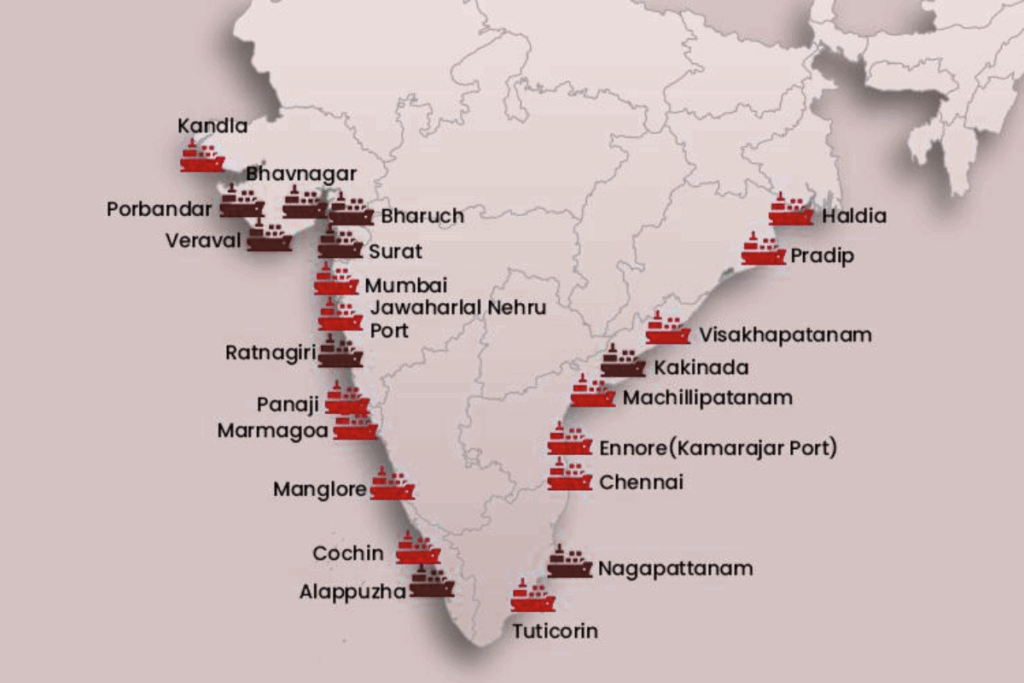
India’s strategic positioning in the Indian Ocean, coupled with an extensive 7,517 km coastline, has established the nation as a global maritime powerhouse. Currently, India hosts 13 major ports (including the newly approved Vadhavan Port) and over 200 non-major (minor) ports. These maritime gateways are the lifeblood of the Indian economy, handling approximately 95% of trade by volume and 70% by value.
Under the Maritime India Vision 2030, the government aims to boost cargo capacity to 2,200 MMTPA, leveraging initiatives like the Sagarmala Project to enhance port-led development and global competitiveness.
Overview of India’s Port Infrastructure
The governance of India’s ports is divided based on their scale and strategic importance.
1 Major Ports: Managed by the Union Ministry of Ports, Shipping, and Waterways, these handle the bulk of international traffic.
2 Minor Ports: Governed by respective State Maritime Boards. Out of 200+ minor ports, approximately 65 actively handle cargo.
3 Recent Developments: In June 2024, the Government approved Vadhavan Port in Maharashtra as the 13th major port. Conversely, Port Blair (Andaman & Nicobar) had its major port status removed in 2017 due to insufficient container traffic.
Major Ports on the Western Coast of India
The Western Coast ports primarily handle trade with the Middle East, Europe, and Africa. They are known for deep-water natural harbours and high container throughput.
1. Deendayal Port (Kandla), Gujarat
Status: India’s largest port by cargo volume, handling 132.3 MMT in 2023–24.
Key Features: A natural harbour in Kandla Creek. It is a major hub for bulk liquid and dry cargo, including petroleum and salt.
Future Outlook: Integral to the IMEEC (India-Middle East-Europe Economic Corridor) and INSTC.
2. Mumbai Port Trust, Maharashtra
1 History: Established in 1873, it is one of India’s oldest and most historic natural deep-water harbours.
2 Trade: A key gateway for western India, exporting machinery, chemicals, and textiles while importing crude oil.
3. Jawaharlal Nehru Port Trust (JNPT), Maharashtra
1 Capacity: India’s largest container port, managing over 55% of the country’s total container traffic.
2 Objective: A high-tech facility aimed at strengthening local production and reducing trade dependency on China.
4. Vadhavan Port, Maharashtra (Under Construction)
1 Vision: Notified as the 13th major port in 2024.
2 Features: An artificial harbour designed to accommodate massive vessels like Panamax and Capesize ships.
5. Port of Mormugao, Goa
1 Specialization: Originally developed for iron ore exports.
2 Updates: Opening an International Cruise Terminal by 2025; first Indian port on the Environmental Ship Index (ESI).
6. New Mangalore Port, Karnataka
1 Depth: Features the deepest inner harbour on the West Coast.
2 Exports: Key for iron ore concentrates, coffee, and cashew nuts.
7. Kochi (Cochin) Port, Kerala
1 Strategic Value: Located on the cross-roads of the Indian Ocean and Laccadive Sea.
2 Infrastructure: Home to India’s largest International Container Transshipment Terminal (ICTT) at Vallarpadam.
Major Ports on the Eastern Coast of India
The Eastern Coast ports facilitate trade with ASEAN countries, East Asia, and Russia.
1. V.O. Chidambaranar Port (Tuticorin), Tamil Nadu
1 Significance: The second-largest port in Tamil Nadu and a major container hub.
2 Exports: Known for textiles, seafood, and granite.
2. Chennai Port, Tamil Nadu
1 Scale: The second-largest container port in India.
2 Corridors: Essential for the Chennai-Vladivostok Maritime Corridor (CVMC), reducing travel time to Russia to 24 days.
3. Kamarajar Port (Ennore), Tamil Nadu
1 Unique Status: India’s first corporatised major port, functioning outside traditional tariff regulations.
2 Trade: Initially focused on thermal coal; now a major automobile export hub.
4. Visakhapatnam Port, Andhra Pradesh
1 Record: Surpassed previous cargo handling records in 2024.
2 Geopolitical Role: Strengthens ties via Chabahar (Iran) and Sittwe (Myanmar) to counterbalance regional influences.
5. Paradip Port, Odisha
1 Volume: In FY 2023-24, it became India’s largest major port by cargo throughput, surpassing Deendayal Port.
2 Type: A deep-water port specializing in iron ore and thermal coal.
6. Syama Prasad Mookerjee Port (Kolkata), West Bengal
1 Nature: India’s only major riverine port, situated 203 km from the sea.
2 Twin Docks: Kolkata Dock System (KDS) and the deep-water Haldia Dock Complex (HDC).
Significance and Challenges of India’s Maritime Sector
Major Significance
1 Economic Engine: Handled 795 million tonnes of cargo in 2022-23; capacity increased by 87% since 2014.
2 Strategic Links: Critical for connectivity between Asia, Europe, and Africa.
3 Green Transition: Transitioning to eco-friendly measures, including electric vehicles and digital logistics.
Critical Challenges
1 Dredging Limits: Many ports cannot handle “Ultra Large Container Vessels” due to depth constraints.
2 Logistics Gaps: Poor last-mile connectivity between road/rail networks and the port gates.
3 Efficiency: Longer ship turnaround times compared to global benchmarks like Singapore or Dubai.
FAQs: Major Ports in India
WHICH IS THE OLDEST PORT IN INDIA?
The Syama Prasad Mookerjee Port (Kolkata), established in 1870, is the oldest operating port in India.
WHICH PORT HAS AN ARTIFICIAL HARBOUR IN INDIA?
Chennai Port and Kamarajar (Ennore) Port are notable artificial harbours on the East Coast.
WHICH PORT IS KNOWN AS THE PEARL OF INDIA?
Tuticorin Port (V.O. Chidambaranar) is often referred to as the Pearl City/Pearl Port due to its historic pearl fishery.
WHICH PORT IS KNOWN AS DIAMOND HARBOR?
The shipping point at Kolkata Port, specifically the section of the Hooghly River near the sea, is known as Diamond Harbor.
WHICH IS THE DEEPEST PORT IN INDIA?
Visakhapatnam Port and Paradip Port are among the deepest ports; however, the upcoming Vadhavan Port is designed to handle the largest global vessels.
WHICH PORT IS INDIA’S LARGEST CONTAINER PORT?
JNPT (Jawaharlal Nehru Port Trust) in Navi Mumbai handles over 55% of India’s container traffic.
WHICH IS THE ONLY RIVERINE MAJOR PORT IN INDIA?
The Syama Prasad Mookerjee Port (Kolkata) is the only major riverine port.
WHAT IS THE SAGARMALA PROJECT?
It is a government initiative for port-led development, aimed at modernizing ports, improving connectivity, and supporting coastal communities.
WHICH PORT SURPASSED KANDLA TO BECOME THE LARGEST BY THROUGHPUT IN 2024?
Paradip Port in Odisha surpassed Deendayal (Kandla) Port in FY 2023-24.
WHAT IS THE STATUS OF PORT BLAIR?
Port Blair is currently a minor port; its “major port” status was revoked by the government in 2017.