The French Revolution was a watershed event in modern history that began in 1789 and ended in the late 1790s with the ascent of Napoleon Bonaparte. During this period, French citizens razed and redesigned their country’s political landscape, uprooting centuries-old institutions such as absolute monarchy and the feudal system.
The upheaval was caused by widespread discontent with the French monarchy and the poor economic policies of King Louis XVI. Although it degenerated into a bloodbath during the Reign of Terror, the French Revolution helped shape modern nations by introducing the world to the inherent power of the people and the principles of Liberty, Equality, and Fraternity.
France on the Eve of Revolution: Social and Political Structure
Before 1789, France was governed by the “Old Regime,” a rigid social hierarchy that divided the population into three distinct “Estates.”
The Three Estates
- First Estate (Clergy): Included high-ranking religious officials. They owned 10% of the land, collected tithes, and were exempt from taxes.
- Second Estate (Nobility): Comprised aristocrats who held top positions in the government and military. They held feudal rights over peasants and were also tax-exempt.
- Third Estate (Commoners): Accounted for 98% of the population, including the bourgeoisie (lawyers, doctors), urban workers, and peasants. They bore the entire tax burden of the state.
The Political and Economic Climate
- Absolute Monarchy: King Louis XVI ruled with divine right, possessing unchecked authority.
- Financial Ruin: France was nearly bankrupt due to the extravagant lifestyle of the Versailles court and the cost of helping in the American Revolutionary War.
- Famine: Bad harvests in the late 1780s led to soaring bread prices, pushing the urban poor toward starvation.
Primary Causes of the French Revolution
The revolution was not the result of a single event but a combination of systemic failures.
- Economic Inequality: The tax-exempt status of the wealthy few left the impoverished masses to fund a failing state.
- Influence of Enlightenment Thinkers: Philosophers like Voltaire (Freedom of Speech), Rousseau (The Social Contract), and Montesquieu (Separation of Powers) challenged the “divine right” of kings.
- Weak Leadership: Louis XVI was indecisive, and his wife, Marie Antoinette, was despised for her perceived indifference and foreign (Austrian) roots.
- The American Precedent: The success of the American colonies in overthrowing British rule proved that Enlightenment ideals could be translated into a functional government.
The Outbreak: 1789
The revolution was triggered when Louis XVI attempted to impose new taxes on the Third Estate.
The Estates-General and the Tennis Court Oath
On May 5, 1789, Louis XVI convened the Estates-General. When the King refused to grant the Third Estate equal voting power, they broke away to form the National Assembly.
- Tennis Court Oath (June 20, 1789): After being locked out of their hall, representatives met at a nearby indoor tennis court and swore not to leave until they had drafted a constitution for France.
The Storming of the Bastille
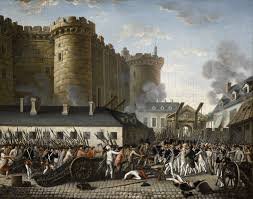
On July 14, 1789, fearing the King was gathering troops to disperse them, a mob in Paris stormed the Bastille, a medieval fortress and prison symbolizing royal tyranny. This event marked the beginning of the armed revolution.
Major Phases of the Revolution
1. Constitutional Monarchy (1789–1792)
The National Assembly abolished the feudal system and issued the Declaration of the Rights of Man and the Citizen.
- Legislative Structure: The Constitution of 1791 established a system with Active Citizens (men over 25 who paid taxes) having voting rights and Passive Citizens having none.
2. The Radical Republic and Reign of Terror (1792–1794)
Revolutionary wars against Austria and Prussia radicalized the movement. The Jacobins, led by Maximilien Robespierre, seized control.
- Execution of the King: Louis XVI and Marie Antoinette were executed by guillotine in 1793.
- The Terror: Robespierre executed thousands of “enemies of the revolution,” eventually leading to his own execution in July 1794.
3. The Directory and Rise of Napoleon (1795–1799)
Following Robespierre’s fall, a five-member Directory was formed. However, political instability and corruption led to a coup d’état by Napoleon Bonaparte in 1799, effectively ending the revolution.
Impact and Legacy of the French Revolution
The French Revolution changed the course of global history through several key outcomes:
- End of Feudalism: It dismantled the medieval social structure across much of Western Europe.
- Birth of Secularism: The Church’s power was curtailed, and the state became a secular entity.
- Nationalism: It inspired the concept of “The Nation” as a collective identity of the people rather than the property of a king.
- Rights and Equality: The focus shifted toward meritocracy rather than birthright.
American Revolution vs. French Revolution
| Aspect | American Revolution | French Revolution |
| Primary Goal | Independence from foreign rule. | Internal social and political overhaul. |
| Ideological Focus | Natural rights and limited government. | General will and social justice. |
| Violence Level | Military conflict between armies. | Massive internal civil violence (The Terror). |
| Outcome | Stable Federal Republic. | Cycle of Republic, Terror, and Empire. |
FAQs: The French Revolution
WHAT WAS THE “OLD REGIME” IN FRANCE?
It was the social and political system of France before the 1789 revolution, divided into three estates with the monarchy at the top.
WHY IS JULY 14 CELEBRATED IN FRANCE?
It marks the Storming of the Bastille, the symbolic start of the French Revolution and the struggle against tyranny.
WHO WERE THE JACOBINS?
They were a radical political club during the revolution, led by Robespierre, who advocated for the execution of the king and the establishment of a republic.
WHAT WAS THE “TENNIS COURT OATH”?
An agreement by the Third Estate in 1789 to not disband until they had written a new constitution for France.
WHO WAS MARIE ANTOINETTE?
The Queen of France during the revolution, she was executed for treason and became a symbol of royal extravagance.
WHAT IS THE SIGNIFICANCE OF THE “DECLARATION OF THE RIGHTS OF MAN”?
It established the fundamental principle that all men are born free and equal in rights, serving as a preamble to the 1791 Constitution.
HOW DID THE REVOLUTION IMPACT SLAVERY?
The National Convention abolished slavery in 1794, though it was briefly restored by Napoleon before being permanently abolished later.
WHAT WAS THE GUILLOTINE?
A machine used for “humane” executions by beheading, which became a primary tool during the Reign of Terror.
WHO WAS MAXIMILIEN ROBESPIERRE?
A leader of the Jacobins and the architect of the Reign of Terror, who was eventually executed by his own device.
HOW DID THE FRENCH REVOLUTION END?
It ended in 1799 when Napoleon Bonaparte staged a coup d’état and declared himself the First Consul of France.