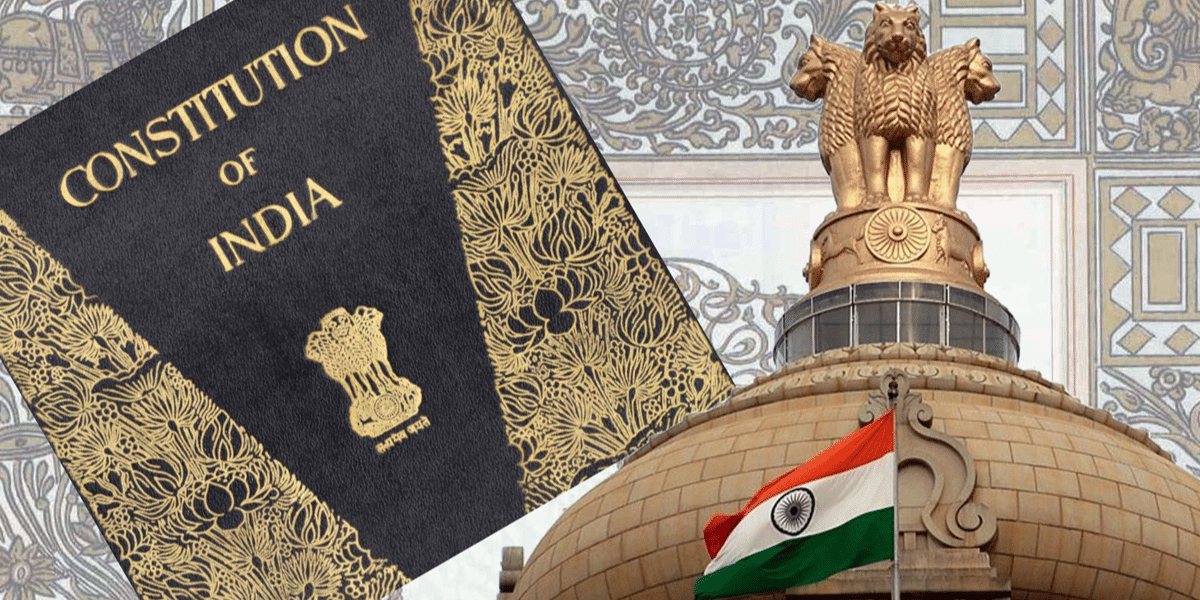
The Constitution of India is the world’s lengthiest written constitution and the supreme law of the land. Adopted on November 26, 1949, and coming into effect on January 26, 1950, it establishes a robust framework that defines the powers of the government while safeguarding the rights of its citizens.
To ensure organized governance, this massive document is structured into distinct Parts, which act as thematic chapters covering everything from basic human rights to complex administrative relations between the Centre and the States.
The Evolution of the Constitutional Structure
The Indian Constitution is a living document, meaning it evolves through amendments to meet the changing needs of society. This evolution is reflected in the growth of its components:
| Feature | Original (1950) | Present (2026) |
| Total Parts | 22 | 25 |
| Articles | 395 | 448 |
| Schedules | 8 | 12 |
How the Parts Expanded
While the numbering of the original Parts remains (stopping at XXII), new Parts have been inserted using alphabetical suffixes (e.g., Part IV-A). This prevents the disruption of the original sequence. Notable additions include:
- Part IX-A (Municipalities): Added by the 74th Amendment Act, 1992, to formalize urban local self-government.
- Part IX-B (Co-operative Societies): Inserted via the 97th Amendment Act, 2011, to promote democratic functioning of co-operatives.
- Part XIV-A (Tribunals): Introduced by the 42nd Amendment Act, 1976, for administrative and specialized dispute resolution.
- Part IV-A (Fundamental Duties): Added by the 42nd Amendment Act, 1976, on the recommendation of the Swaran Singh Committee.
List of the 25 Parts of the Indian Constitution
The following table provides a precise breakdown of every Part, the Articles it encompasses, and its core theme.
| Part | Articles | Subject / Theme | Significance & Key Details |
| I | 1 – 4 | The Union & its Territory | Defines India as a ‘Union of States’; covers reorganization of states and boundaries. |
| II | 5 – 11 | Citizenship | Provisions for who became a citizen at commencement and Parliament’s power to regulate citizenship. |
| III | 12 – 35 | Fundamental Rights | The “Magna Carta” of India; guarantees civil liberties like equality and freedom. |
| IV | 36 – 51 | DPSP | Directive Principles; non-justiciable guidelines for creating a social welfare state. |
| IV-A | 51A | Fundamental Duties | Lists 11 ethical obligations of citizens toward the nation. |
| V | 52 – 151 | The Union | Detailed structure of the Executive (President, PM), Parliament, and Supreme Court. |
| VI | 152 – 237 | The States | Governance structure of States, including Governors, CMs, and High Courts. |
| VII | 238 | [Repealed] | Dealt with Part B states; removed by the 7th Amendment (1956). |
| VIII | 239 – 242 | Union Territories | Specific administration rules for UTs under the President. |
| IX | 243 – 243O | The Panchayats | Rural local self-government; introduced by the 73rd Amendment. |
| IX-A | 243P–243ZG | The Municipalities | Urban local bodies; provides for their structure and powers. |
| IX-B | 243ZH–243ZT | Co-operative Societies | Constitutional status for managing and regulating co-operatives. |
| X | 244 – 244A | Scheduled & Tribal Areas | Special administration for 5th and 6th Schedule areas. |
| XI | 245 – 263 | Centre-State Relations | Legislative and administrative coordination between Union and States. |
| XII | 264 – 300A | Finance & Property | Covers taxes, borrowing, and the Right to Property (Article 300A). |
| XIII | 301 – 307 | Trade & Commerce | Freedom of trade within the territory of India. |
| XIV | 308 – 323 | Public Services | Recruitment and conditions for Civil Services (UPSC and State PSCs). |
| XIV-A | 323A – 323B | Tribunals | Quasi-judicial bodies for administrative or specific tax/labor issues. |
| XV | 324 – 329A | Elections | Empowers the Election Commission of India to conduct free and fair polls. |
| XVI | 330 – 342 | Special Provisions | Safeguards for SCs, STs, and historically marginalized classes. |
| XVII | 343 – 351 | Official Languages | Details regarding Hindi in Devanagari script and regional languages. |
| XVIII | 352 – 360 | Emergency Provisions | National, President’s Rule, and Financial Emergency protocols. |
| XIX | 361 – 367 | Miscellaneous | Immunities for President/Governors and general interpretations. |
| XX | 368 | Amendment Power | The formal procedure to amend the Constitution. |
| XXI | 369 – 392 | Temporary Provisions | Special status/provisions for certain states (e.g., historical Article 370). |
| XXII | 393 – 395 | Short Title/Repeals | Commencement date and the authoritative text in Hindi. |
Top 10 FAQs: Parts of the Indian Constitution
How many Parts were there in the original Indian Constitution?
Originally, the Constitution had 22 Parts. Through various amendments, this has increased to 25 Parts currently.
Which Part of the Constitution is known as the ‘Magna Carta’ of India?
Part III, which covers Fundamental Rights (Articles 12 to 35), is often referred to as the Magna Carta of the Indian Constitution.
Which Part was removed from the Indian Constitution?
Part VII (dealing with States in Part B of the First Schedule) was repealed by the 7th Constitutional Amendment Act, 1956.
What is Part IV-A of the Indian Constitution?
Part IV-A contains the Fundamental Duties (Article 51A). It was not in the original draft but was added in 1976 during the Emergency.
Which Parts deal with Local Self-Government?
Part IX (The Panchayats) and Part IX-A (The Municipalities) are dedicated to rural and urban local self-government, respectively.
What are the Emergency Provisions in the Constitution?
Found in Part XVIII (Articles 352–360), these allow the government to handle exceptional situations like war, internal armed rebellion, or financial instability.
Which Part allows the Parliament to amend the Constitution?
Part XX (Article 368) outlines the power and procedure for the Parliament to amend the Constitution while maintaining its “basic structure.”
What does Part II of the Constitution cover?
Part II (Articles 5–11) deals with Citizenship, defining who was a citizen at the time of independence and authorizing Parliament to make laws regarding the same.
Why are some Parts numbered with ‘A’ or ‘B’ (like IX-A)?
Alphabetic suffixes are used to insert new sections without changing the original numbering of subsequent Parts, ensuring structural continuity.
Which Part covers the relation between the Union and the States?
Part XI (Articles 245–263) details the legislative and administrative relations, ensuring a federal balance of power.