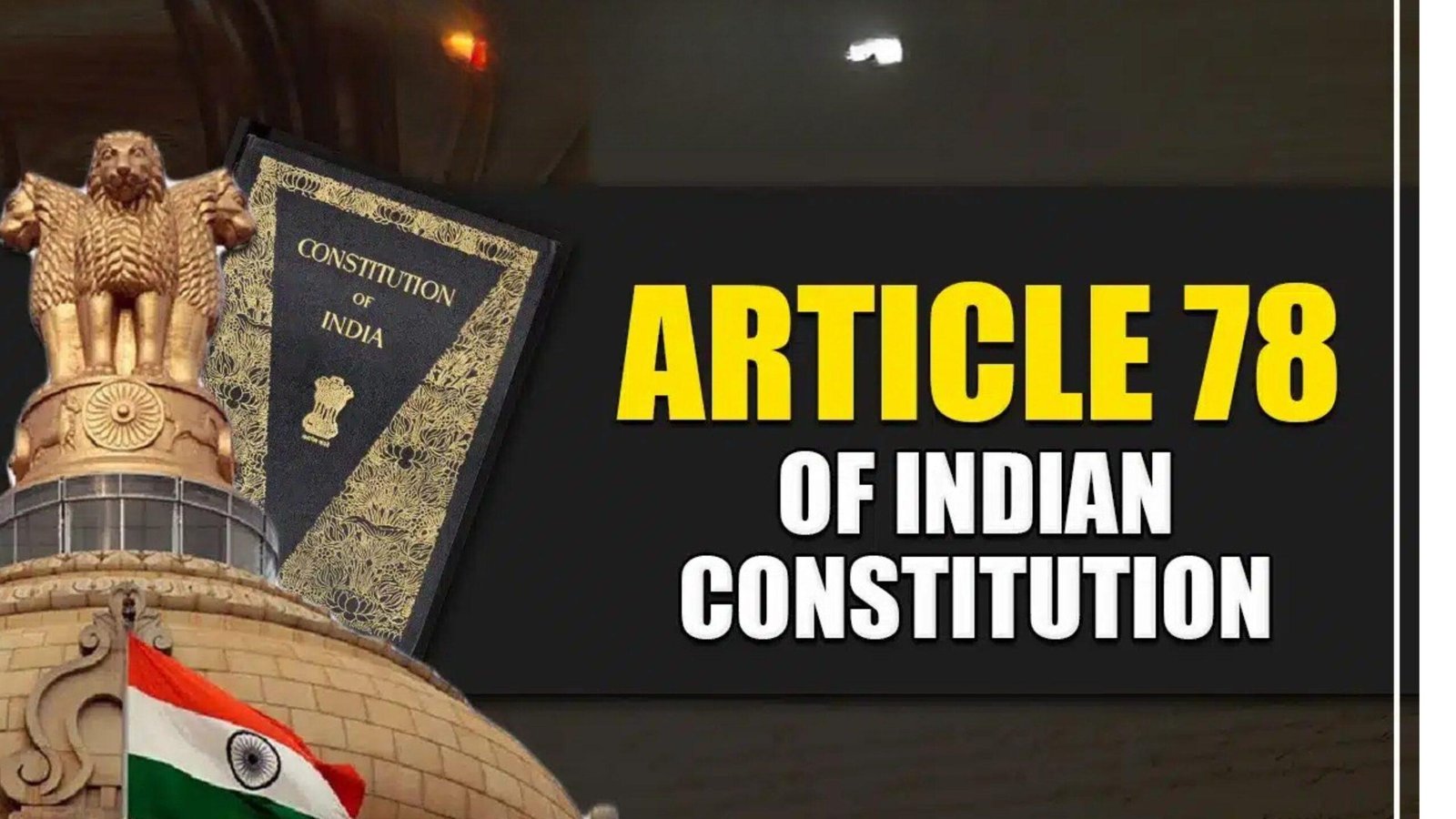
Article 78 of the Indian Constitution is a fundamental provision that defines the functional relationship between the President of India (the nominal head) and the Prime Minister (the real executive). It establishes the Prime Minister as the primary “channel of communication” between the Council of Ministers and the President. While the President is the constitutional head of the Union, Article 78 ensures they are kept informed and involved in the governance of the country, upholding the principles of accountability in a parliamentary democracy.
Provisions of Article 78: The Prime Minister’s Duties
The Prime Minister holds a unique constitutional position that mandates the regular flow of information from the government to the Head of State. Under Article 78, these duties are categorized into three distinct clauses:
1 Article 78(a) – Communication of Cabinet Decisions: It is the mandatory duty of the Prime Minister to communicate to the President all decisions of the Council of Ministers relating to the administration of the affairs of the Union and proposals for legislation.
2 Article 78(b) – Furnishing Requested Information: The Prime Minister is duty-bound to provide the President with such information relating to administrative affairs or legislative proposals as the President may call for.
3 Article 78(c) – Submission for Collective Consideration: If the President so requires, the Prime Minister must submit for the consideration of the Council of Ministers any matter on which a decision has been taken by an individual Minister but has not yet been considered by the Council as a whole.
The Prime Minister as a Link Between President and Cabinet
The Prime Minister acts as a vital bridge, ensuring that the two highest offices of the land work in harmony.
1 De Facto Executive Authority: Although all executive actions are taken in the name of the President, the Prime Minister exercises the actual (de facto) power. Article 78 ensures the President is not a mere figurehead but is actively aware of the government’s trajectory.
2 The “Aid and Advice” Mechanism: While Article 74 mandates that the President act on the “aid and advice” of the Cabinet, Article 78 provides the mechanism through which the President can seek clarity or prompt a review of specific government decisions.
3 Cabinet Solidarity: Clause (c) of Article 78 is particularly significant as it reinforces the principle of Collective Responsibility. It prevents individual ministers from taking unilateral actions without the consensus of the entire Council.
Constitutional Context: Selection and Authority
The Prime Minister’s office is governed by both written articles and long-standing parliamentary conventions:
1 Appointment (Article 75): The Constitution states that the Prime Minister shall be appointed by the President. By convention, this appointment is reserved for the leader of the majority party or coalition in the Lok Sabha.
2 Inter-relationship with other Articles: Article 78 must be read in conjunction with Article 74 (Council of Ministers) and Article 75 (Collective Responsibility). Together, these form the core of the executive structure of the Indian Union.
3 Constitutional Discretion: Although the President must follow advice, Article 78 gives them the right to be “consulted, to encourage, and to warn,” a phrase originally coined by Walter Bagehot to describe the powers of a constitutional monarch.
Significance for Governance and Accountability
1 Transparency: It ensures that the highest office of the State is never kept in the dark regarding the Cabinet’s legislative agenda.
2 Checks and Balances: By allowing the President to ask for information or a Cabinet review, Article 78 acts as a subtle check on the potential arbitrariness of the executive branch.
3 Smooth Transition of Power: During periods of political flux or when new legislation is proposed, the PM’s adherence to Article 78 ensures institutional stability.
FAQs: Article 78 of the Indian Constitution
WHAT IS THE MAIN PURPOSE OF ARTICLE 78?
It defines the constitutional duties of the Prime Minister toward the President, primarily focusing on the communication of administrative decisions and legislative proposals.
IS THE PRIME MINISTER LEGALLY BOUND TO INFORM THE PRESIDENT UNDER ARTICLE 78?
Yes, Article 78 uses the word “duty,” making it a constitutional obligation for the Prime Minister to keep the President informed.
CAN THE PRESIDENT REJECT A CABINET DECISION UNDER ARTICLE 78?
No, the President cannot reject a decision. However, under Article 78(c), the President can ask the Prime Minister to place an individual minister’s decision before the whole Council for collective consideration.
WHAT IS THE DIFFERENCE BETWEEN ARTICLE 74 AND ARTICLE 78?
Article 74 deals with the Council of Ministers providing “aid and advice” to the President, while Article 78 outlines the specific duty of the PM to keep the President informed.
WHO ACTS AS THE CHANNEL OF COMMUNICATION BETWEEN THE CABINET AND THE PRESIDENT?
The Prime Minister is the sole designated channel of communication between the Council of Ministers and the President of India.
CAN THE PRESIDENT CALL FOR INFORMATION ON UNION AFFAIRS INDEPENDENTLY?
Yes, under Article 78(b), the President has the constitutional right to call for any information regarding administrative affairs or legislative proposals from the Prime Minister.
WHAT DOES ARTICLE 78(C) ENSURE?
It ensures the principle of Collective Responsibility by allowing the President to refer a decision made by a single minister back to the entire Council of Ministers for deliberation.
IS THE ADVICE GIVEN BY THE PRIME MINISTER SUBJECT TO JUDICIAL REVIEW?
Generally, the advice tendered by Ministers to the President (Article 74) is protected from judicial inquiry, but the actual actions or orders resulting from that advice can be challenged in court.
WHAT ROLE DOES ARTICLE 78 PLAY DURING A NATIONAL EMERGENCY?
During emergencies, the duty of the PM to keep the President updated becomes even more critical to ensure that the constitutional head is aware of the rapid changes in administration.
DOES ARTICLE 78 APPLY TO STATE GOVERNORS AND CHIEF MINISTERS?
A similar provision exists at the state level under Article 167, which defines the duties of the Chief Minister in relation to the Governor.