Context
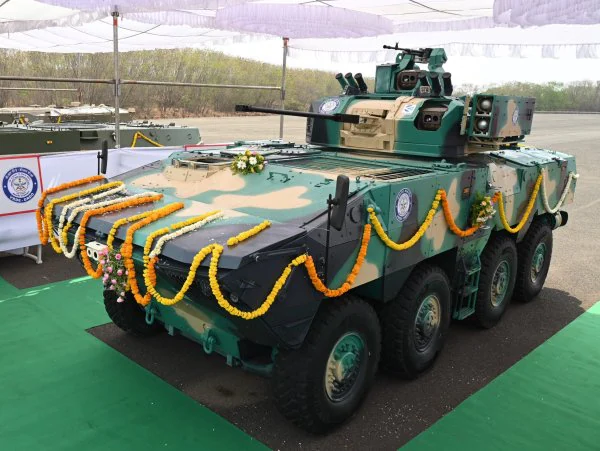
The Defence Research and Development Organisation (DRDO) has initiated the Vikram VT 21 programme as part of India’s efforts to modernise its armoured fighting vehicle fleet. It is conceptualised as an Advanced Armoured Platform aimed at meeting the requirement of a Futuristic Infantry Combat Vehicle (FICV) for the Indian Army, primarily to replace the ageing BMP-2 infantry vehicles.
Key Features of Vikram VT 21
- Dual Platform Design
The project includes two configurations:
- Wheeled variant: Suitable for high-speed movement on roads and semi-urban terrain with lower maintenance needs.
- Tracked variant: Designed for rough, off-road, and battlefield conditions, offering better stability and mobility over difficult terrain.
- Firepower and Combat Capability
- Equipped with a 30 mm unmanned turret for enhanced offensive capability and crew safety.
- Integrated 7.62 mm machine gun for close-range engagement.
- Capability to fire third-generation Anti-Tank Guided Missiles (ATGMs), improving precision strike ability against armoured threats.
- Mobility and Engine Performance
- Powered by a high-output engine with automatic transmission.
- Designed for high power-to-weight ratio, enabling speed, agility, and terrain adaptability.
- Amphibious capability allows crossing of water obstacles using hydro-propulsion systems.
- Protection and Survivability
- Offers STANAG Level 4/5 protection standards against bullets, blasts, and shell fragments.
- Modular armour system allows upgrades and mission-specific configurations.
Way Forward:
- Increase indigenous content through sustained DRDO–industry collaboration.
- Streamline procurement, testing, and approval processes.
- Encourage private sector participation and competitive bidding
- Focus on standardisation and network-centric design integration
- Conduct extensive field trials across varied geographies
Conclusion
The Vikram VT 21 represents a significant step towards modernising India’s infantry combat capabilities. If successfully developed and inducted, it will not only replace obsolete platforms but also enhance India’s operational readiness, technological edge, and defence indigenisation goals in line with contemporary warfare requirements.