Context
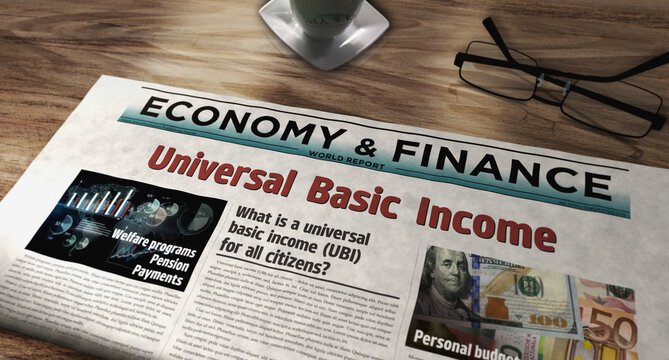
India’s rising inequality, job losses due to automation, and increasing insecurity in the gig economy have renewed interest in Universal Basic Income (UBI). Economists argue that UBI can help ensure basic income security, support demand, and strengthen India’s welfare system.
What is Universal Basic Income?
- Universal Basic Income (UBI) means a fixed amount of money given regularly to every citizen by the government, without any conditions.
- It is universal (for all), unconditional (no eligibility test), and aims to ensure that every person has a minimum level of income to meet basic needs like food, shelter, and healthcare.
What is the Mechanism of UBI? (How it works)
- Coverage: Every adult citizen receives a fixed cash transfer directly from the government.
- Frequency: The money is given at regular intervals, usually monthly.
- Transfer System: The payment is sent directly into bank accounts through the Direct Benefit Transfer (DBT) system using Aadhaar and Jan Dhan
- Amount: The amount can be linked to the poverty line and increased with inflation.
- Funding: The money can come from reducing wasteful subsidies, higher taxes on the rich, or new social funds.
- Implementation: It can start with vulnerable groups (like women, elderly, and disabled) and later expand to all citizens.
- Monitoring: The government should monitor the programme digitally to avoid duplication or fraud.
Why UBI Should Be Adopted in India (Benefits)
- Reduces Poverty and Inequality: India’s top 1% owns 40% of wealth. A small guaranteed income helps reduce this gap and provides minimum financial security to all.
- Supports People Affected by Job Loss and Automation: As technology replaces many jobs, UBI can act as a safety net for workers while they learn new skills.
- Simplifies Welfare Delivery:
- Current schemes are complex and exclude many poor people.
- UBI is simple – one direct transfer for everyone.
- Recognises Unpaid Work: It values unpaid household and caregiving work, especially done by women.
- Protects Dignity: It removes the stigma of being called “poor” or “beneficiary.” Everyone gets support as a right.
- Encourages Good Governance: When citizens are not dependent on freebies, they can vote based on performance, not short-term promises.
- Positive Results in Trials:
- India: SEWA experiment (2011-13) in Madhya Pradesh improved nutrition, school attendance, and income.
- Other countries: Finland, Kenya, and Iran saw better mental health and food security.
- Strong Digital Infrastructure: Aadhaar, Jan Dhan, and DBT make it easier for India to deliver cash transfers directly.
Recent Data and Global Trends
- India’s inequality: Gini index (wealth inequality) = 75 in 2023 (very high).
- Growth without equality: GDP growth of 8.4% (2023-24) has not improved basic welfare; India ranks 126 out of 137 in the World Happiness Report 2023.
- Global Examples: Finland, Kenya, and Iran tested UBI and saw positive results without reducing work participation.
- Automation: McKinsey Global Institute says up to 800 million jobs could be lost globally by 2030 due to automation.
Challenges and Way Forward
| Challenges | Way Forward |
| High cost: A basic UBI could cost about 5% of India’s GDP. | Start with small, targeted groups like women and elderly; fund it by reducing wasteful subsidies and increasing taxes on the wealthy. |
| Universal benefit to rich and poor alike: This may reduce the redistributive impact. | Roll out in phases – begin with low-income groups, then expand. |
| Fear of inflation: More money may increase prices. | Combine UBI with better supply of essential goods to avoid shortages. |
| Digital exclusion: Many rural and tribal areas lack access to banks or the internet. | Improve financial access, mobile banking, and digital literacy before full rollout. |
| Political resistance: Existing welfare schemes create vested interests. | Build public consensus and show pilot success stories to gain support. |
| Not a solution for all problems: UBI cannot replace education, health, or job programmes. | Continue essential schemes like PDS and MGNREGA along with UBI. |
Conclusion
Universal Basic Income is not a cure for all economic problems, but it can provide a strong foundation of financial security for every citizen. It can help India reduce inequality, support workers in the age of automation, and ensure that no one is left behind.
| Ensure IAS Mains Question
Q. “Universal Basic Income can strengthen India’s social security system and reduce inequality.” Discuss its potential and challenges. (250 words) |
| Ensure IAS Prelims Question
Q. Which of the following statements is true about Universal Basic Income (UBI)? a) It is given only to poor households. b) It is a conditional cash transfer linked to employment. c) It is an unconditional and universal cash payment to all citizens. d) It replaces all welfare schemes. Answer: c) It is an unconditional and universal cash payment to all citizens. Explanation: Universal Basic Income (UBI) is a system of unconditional and universal cash payments given regularly to all citizens, regardless of income or employment. It ensures basic income security and reduces inequality. Unlike targeted or conditional welfare schemes, UBI promotes simplicity, dignity, and economic stability for everyone. |