Important Questions for UPSC Prelims, Mains and Interview
|
Context
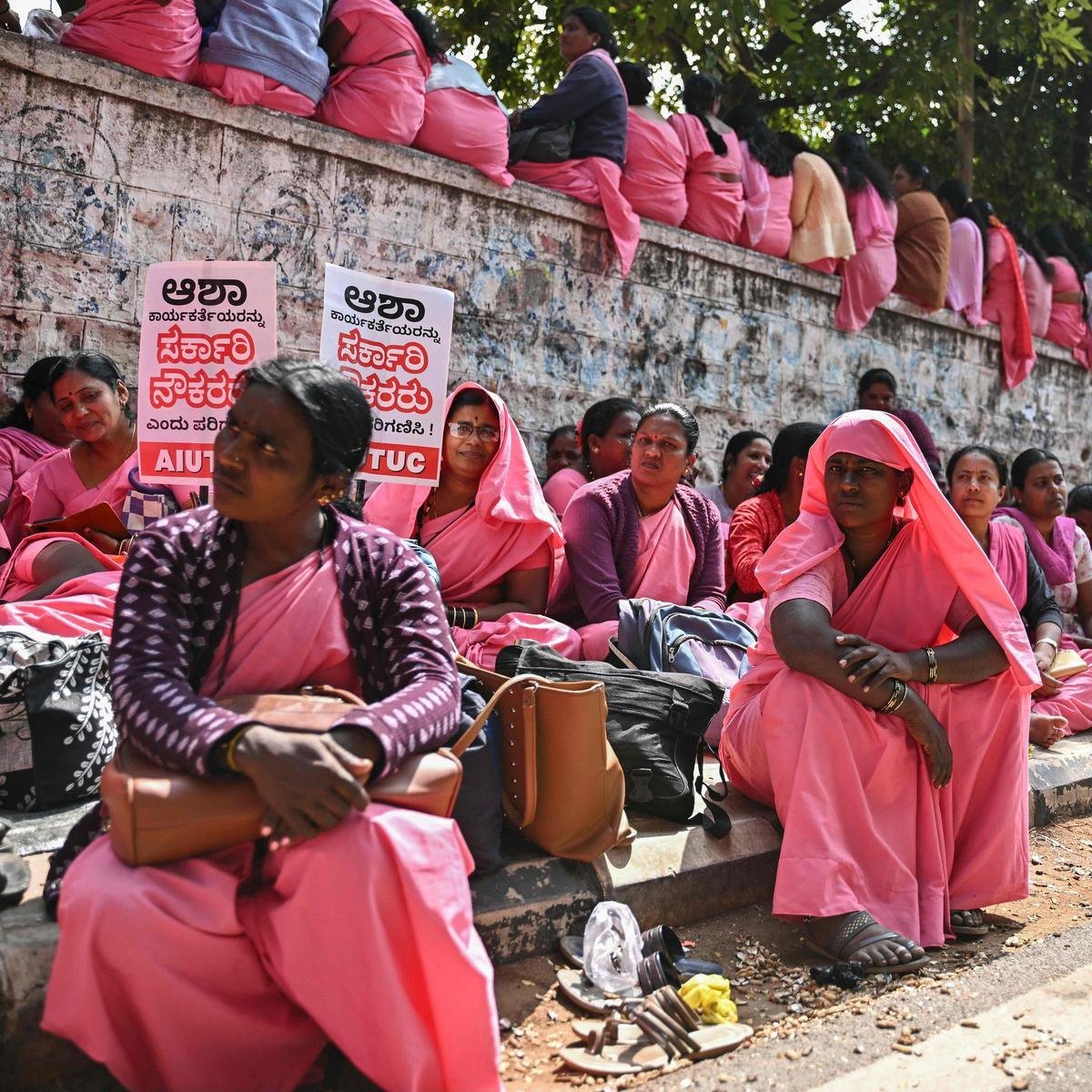
The Union Budget 2026–27 proposes to train 1.5 lakh caregivers under the National Skills Qualification Framework (NSQF) to strengthen India’s care economy. However, millions of existing care workers—such as ASHA workers, Anganwadi workers, and mid-day meal workers—continue to be treated as “volunteers” rather than formal employees, raising concerns about labour rights and recognition.
Q1. Why has the issue of recognising “volunteer” care work gained importance in India’s welfare and labour policy framework?
- India’s demand for healthcare, childcare, and elderly care services is rising rapidly.
- The government is expanding care sector via training programmes for professional caregivers.
- However, millions of existing workers already perform essential welfare services across country.
- These workers play a critical role in delivering government programmes such as nutrition programmes and maternal & child services.
- Despite their responsibilities, many are classified as “volunteers” & receive only honorariums instead of wages.
- This classification excludes them from formal labour protections and social security benefits.
- Recognising their contribution is essential for strengthening India’s welfare delivery system.
Q2. Who are the major women care workers in India’s welfare system, and what roles do they perform in delivering public services?
- India’s care workforce is largely composed of women engaged in community-based welfare services.
- ASHA workers act as frontline health workers supporting maternal and child healthcare.
- Anganwadi workers and helpers provide nutrition services and early childhood care under the Integrated Child Development Services (ICDS).
- Mid-day meal workers prepare and distribute meals in schools to support child nutrition and education.
- These workers serve as community-level links between government programmes & beneficiaries. Their responsibilities often include health awareness campaigns and monitoring child growth and nutrition.
- Collectively, they form the backbone of India’s public health and nutrition systems.
Q3. Why are many care workers in India classified as “volunteers” rather than formal employees, and what challenges does this classification create?
- Government historically classified these workers as honorary community volunteers rather than employees. This classification allows programmes to operate with lower financial costs because as volunteers, they are usually paid small honorariums instead of formal salaries.
- They often lack basic labour protections such as paid leaves and maternity benefits.
- Most workers also do not receive formal employment contracts or job security.
- Limited access to social security schemes leaves them financially vulnerable.
- As a result, millions of women workers remain in informal & insecure employment conditions.
Q4. How does the structure of India’s care economy reflect gender inequalities in unpaid and undervalued labour?
- Care work in India is strongly shaped by traditional gender roles and social expectations.
- Women are disproportionately responsible for household caregiving & community welfare activities. According to time-use data, women spend significantly more time on caregiving activities than men.
- Because caregiving is often seen as a natural extension of women’s domestic responsibilities, it is undervalued economically.
- Many welfare programmes rely on women’s unpaid or poorly paid labour. This creates a cycle where care work is under-recognised as skilled labour and undercompensated financially.
- Such gendered labour patterns reinforce economic inequality and limited employment security for women.
Q5. What contradictions arise between government efforts to expand the care economy and the treatment of the existing care workforce?
- Recent policies aim to train new caregivers to meet rising care needs.
- At the same time, millions of existing care workers remain outside formal labour framework. Many of them already perform complex tasks requiring training & community knowledge.
- Despite their experience, they are often excluded from professional recognition and career pathways. Training programmes primarily focus on new entrants rather than upgrading the skills of existing workers.
- This creates a policy contradiction where the state seeks to expand the care sector, yet undervalues the current workforce sustaining it.
- Addressing this contradiction is essential for building a credible and inclusive care economy.
Q6. How can legal and institutional reforms help transition care workers from honorarium-based roles to formal employment?
- Courts have increasingly recognised the need to reconsider the status of long-term contractual workers. The Supreme Court has indicated that essential and continuous work cannot remain temporary indefinitely.
- Governments could create frameworks to convert long-term care workers into formal employees. Transition mechanisms may include standardised wage structures and formal employment contracts.
- Extending skill certification under NSQF programmes to existing workers would recognise their experience.
- Legal recognition would also enable access to labour protections and social security schemes.
- Institutional reforms could strengthen professional identity and stability in the care workforce.
Q7. What policy measures can help build a fair and sustainable care economy in India?
- Governments should recognise care work as skilled labour rather than voluntary service.
- Introducing fair wages and standardized honorarium structures can improve financial security.
- Social protection measures should include health insurance, pensions, and maternity benefits.
- Training programmes should focus not only on new workers but also on upskilling existing care workers.
- Policy frameworks should incorporate international standards such as the ILO’s 5R framework for decent care work.
- Workers should be given representation in policy discussions affecting the care sector.
- Increased public investment is necessary to strengthen healthcare, childcare, and elderly care infrastructure.
- Building a strong care economy can also generate large-scale employment opportunities for women.
Conclusion
India’s care economy relies heavily on millions of women who deliver essential welfare services but remain classified as “volunteers.” Recognising care work as skilled labour and providing fair wages, legal protections, and social security is crucial for building a sustainable and equitable care system. Strengthening this workforce will not only improve welfare delivery but also contribute to gender equality and inclusive economic development.