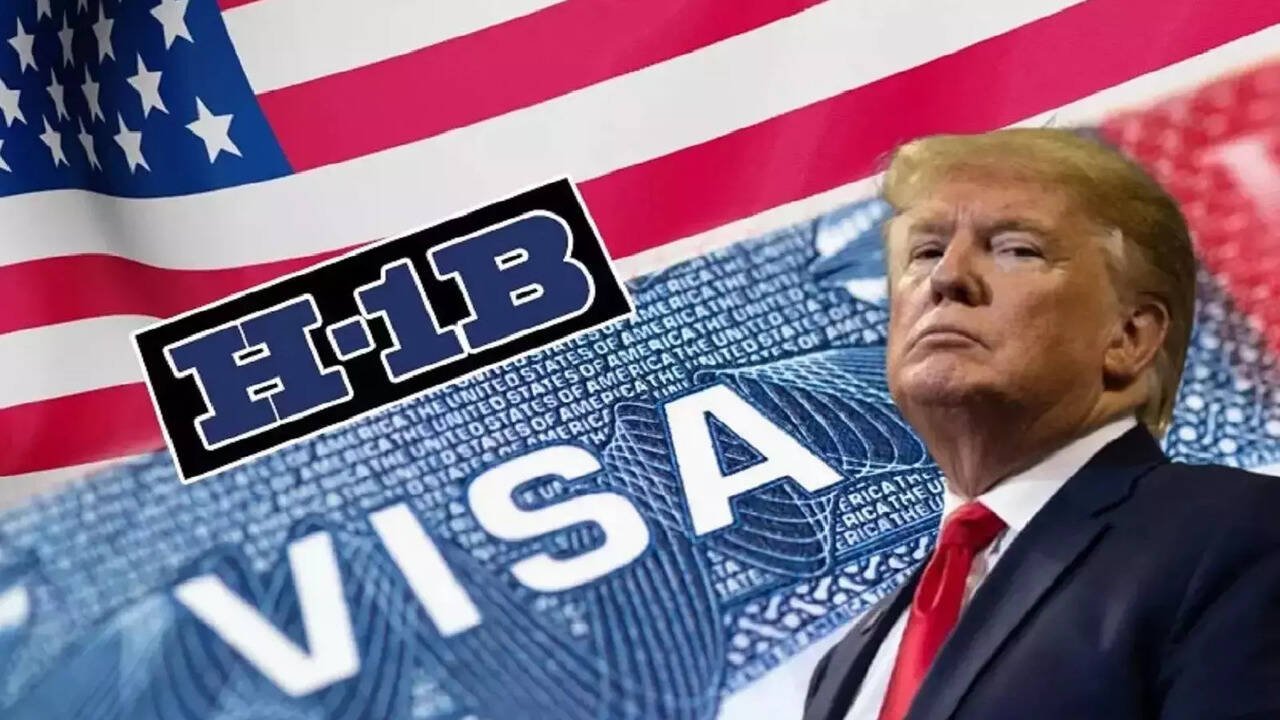
Why in the News?
- S. President Donald Trump announced a $100,000 fee for new H-1B visa applicants, causing widespread concern among Indian IT professionals.
- The move has potential humanitarian, diplomatic, and economic consequences, affecting families, the S. tech industry, and global talent mobility.
- India’s Ministry of External Affairs (MEA) highlighted the importance of skilled talent mobility for both S. and Indian economic growth.
Key Highlights
- Introduction to H-1B Visa
- The H-1B visa is a non-immigrant visa that allows S. companies to hire highly skilled foreign workers in sectors like technology, engineering, and finance.
- Since 2004, the visa has been capped at 85,000 per year, distributed via a lottery system when applications exceed the quota.
- Indian nationals represent approximately 71% of H-1B visa recipients, highlighting India’s dominant presence in the global tech workforce.
- Trump’s Proclamation and Initial Reactions
- President Donald Trump signed a proclamation increasing the H-1B application fee to $100,000 for new applicants.
- The decision raised concerns over humanitarian consequences for families of visa applicants and economic disruption for U.S. tech companies.
- Data suggested that nearly 60% of H-1B recipients earn below $100,000, implying that companies may find hiring foreign workers financially unviable under the new fee structure.
- Industry and Diplomatic Response
- Major tech companies such as Microsoft, Amazon, and JPMorgan responded by instructing their H-1B employees currently outside the U.S. to return before the fee implementation deadline, creating a rush for last-minute flights.
- India’s MEA issued a cautionary note about the humanitarian impact and highlighted the importance of technology collaboration and talent mobility between India and the U.S.
- Clarification on Fee Implementation
- S. Commerce Secretary Howard Lutnick initially suggested that the $100,000 fee would be annual, escalating concerns.
- Shortly after, White House Press Secretary Karoline Leavitt clarified that the fee is a one-time payment, applicable only to new H-1B visa applications in the next lottery cycle.
- Existing H-1B visa holders and those renewing their visas are not affected by this proclamation.
- Immediate Effects on Applicants
- The announcement triggered panic among H-1B visa holders, leading to last-minute bookings for flights to the U.S.
- The Indian government instructed its missions and embassies worldwide to provide assistance to citizens attempting to return to the U.S. before the deadline.
- Long-Term Implications
- The policy underscores the risks of over-reliance on the U.S. job market for Indian tech workers.
- It presents an opportunity for India to strengthen domestic infrastructure, boost AI and technology capabilities, and diversify its markets to Europe, Asia, and other regions.
- Prolonged restrictive policies may also result in a talent shortage in the U.S., affecting innovation, research, and economic growth.
Key Terms
- H-1B Visa: A U.S. non-immigrant visa allowing companies to hire highly skilled foreign professionals in fields like IT, engineering, and finance.
- Visa Lottery System: A randomized selection process for issuing visas when the number of applicants exceeds the annual quota.
- Talent Mobility: The movement of skilled professionals across countries, facilitating knowledge transfer and innovation.
- Protectionism: Policies that prioritize domestic workforce over foreign talent by imposing restrictions like higher fees or quotas.
- Artificial Intelligence (AI) Capability: The ability of a country to develop, deploy, and scale AI technologies, enhancing economic and technological competitiveness.
- Humanitarian Consequences: Impacts on families and individuals resulting from sudden policy changes, affecting livelihoods and personal well-being.
- Non-immigrant Visa: A nonimmigrant visa allows foreign nationals to enter the U.S. for temporary purposes, such as tourism, business, study, or temporary work, with the intent to leave the U.S. after their approved stay is completed. These visas are distinct from immigrant visas, which are for individuals seeking to live permanently in the United States.
Implications
- For Indian Workers: The steep fee could discourage new applications, limiting career opportunities in the U.S.
- For U.S. Tech Firms: Recruitment of highly skilled foreign talent becomes cost-prohibitive, potentially affecting innovation and competitiveness.
- For India: A wake-up call to boost domestic tech ecosystem, develop AI capabilities, and reduce over-dependence on foreign markets.
- For Bilateral Relations: Adds strain to Indo-U.S. ties but limits India’s ability to influence U.S. policy.
- For Global Talent Mobility: Reflects a trend of protectionism, with countries restricting skilled migration to prioritize domestic workforce.
Challenges & Way Forward
| Challenges | Way Forward |
| Exorbitant H-1B visa fees making U.S. opportunities unaffordable | Invest in domestic tech hubs, offer incentives for high-value innovation, and support startups |
| Over-reliance on U.S. market for employment | Diversify international markets, targeting Europe, Asia, Russia, and emerging economies |
| Humanitarian concerns for families of visa applicants | Strengthen diplomatic channels and provide guidance to affected citizens through embassies and missions |
| Uncertainty in U.S. immigration policies | Formulate long-term national strategies to reduce dependency on foreign visa systems |
| Potential U.S. talent shortage due to restrictive policies | Promote bilateral R&D collaborations to maintain innovation flows and exchange of knowledge |
Conclusion
The $100,000 H-1B visa fee reflects a protectionist approach in U.S. immigration policy. While it poses immediate challenges for Indian IT professionals and multinational companies, it also provides an opportunity for India to strengthen its domestic technology ecosystem, explore global markets, and reduce dependence on foreign employment. Over time, such restrictive measures may backfire on the U.S. by limiting access to skilled talent.
| EnsureIAS Mains Question
Q. “India’s dependence on foreign employment markets poses long-term structural risks.” Critically examine in the context of the H-1B fee hike. (250 Words) |
| EnsureIAS Prelims Question
Q. Consider the following statements regarding the H-1B visa in the United States: 1. It is a non-immigrant visa that allows U.S. companies to employ highly skilled foreign workers in specialized occupations such as IT, engineering, and finance. 2. The number of H-1B visas issued annually has been capped at 85,000 since 2004, and they are allocated through a lottery system when applications exceed this limit. 3. H-1B visa holders can freely work in any country of their choice once they obtain the visa. Which of the statements given above is/are correct? a) 1 and 2 only Answer: a) 1 and 2 only Explanation: Statement 1 is correct: H-1B is a non-immigrant visa for highly skilled workers. Statement 2 is correct: The annual quota of 85,000 visas has been in effect since 2004, and visas are allocated via a lottery if applications exceed this number. Statement 3 is incorrect: H-1B visa holders are authorized to work only in the United States for the sponsoring employer, not in any country of their choice. |
|
Also Read |
|
| UPSC Foundation Course | UPSC Daily Current Affairs |
| UPSC Monthly Magazine | CSAT Foundation Course |
| Free MCQs for UPSC Prelims | UPSC Test Series |
| ENSURE IAS NOTES | Our Booklist |