Context
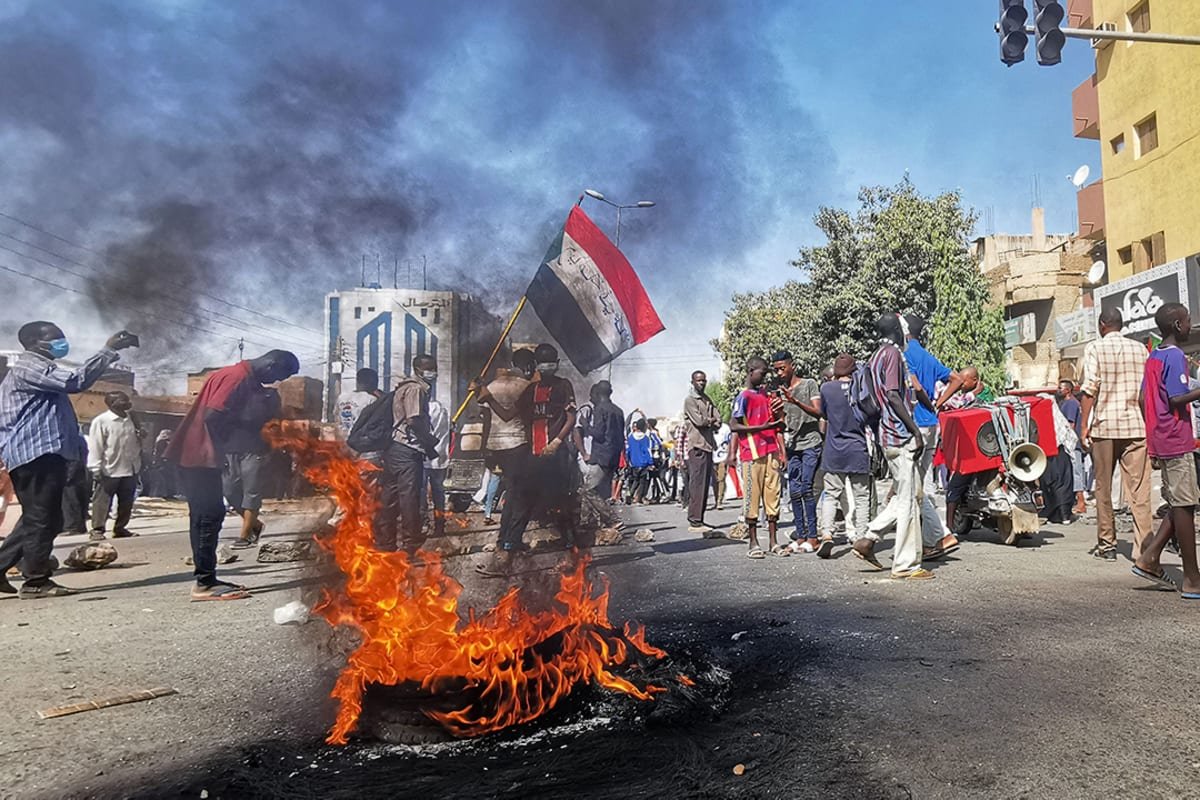
Sudan’s civil war between the Sudanese Armed Forces (SAF) and the Rapid Support Forces (RSF), ongoing since April 15, 2023, has caused a dramatic economic collapse, rapid territorial shifts, record displacement, and worsening famine conditions. Recent intensification in Kordofan and the fall of El Fasher have marked a major turning point.
What is the Conflict?
- The conflict is a nationwide civil war rooted in a power struggle between the SAF, led by General Abdel Fattah al-Burhan, and the RSF, led by Mohamed Hamdan Dagalo (Hemedti).
- The SAF and RSF had jointly removed President Omar al-Bashir in 2019 and carried out a coup in 2021.
- Tensions escalated over plans to integrate the RSF into the national army.
- Both leaders sought to retain power, wealth, and influence.
- The war has divided Sudan into zones of control:
- SAF: East and central Sudan (including Port Sudan and areas of Khartoum)
- RSF: Most of Darfur and large parts of Kordofan
- The humanitarian and economic impact has become one of the worst globally.
Why Has the Crisis Escalated?
- Power Struggle: Competing ambitions of Burhan and Hemedti over military control and resource networks.
- Territorial Contestation: RSF seeks dominance in Darfur and Kordofan, while SAF attempts to secure central-western routes.
- Collapse of Integration Talks: Incorporating the RSF into the national army threatened Hemedti’s autonomy and wealth.
- Weak Governance Structures: Decades of instability since Bashir’s fall left institutions fragile.
- Regional Fragmentation: The war’s expansion created de facto parallel administrations.
How the Conflict Has Unfolded?
- Major Military Shifts
- RSF offensive across Kordofan intensified.
- Drone strike on Kalogi killed dozens, including children; a kindergarten and hospital were hit.
- RSF consolidates western Sudan and advances into oil-rich regions.
- Fall of El Fasher
- El Fasher is the capital city of North Darfur in western Sudan. It was the last major stronghold of the Sudanese Armed Forces (SAF) in the Darfur region until it fell to the Rapid Support Forces (RSF) after an 18-month siege.
- RSF used sand berms to encircle the city and cut civilian movement.
- ACLED recorded nearly 400 civilian-targeting incidents in the region between April 2023 and October 2025; over 55% occurred in 2025.
- More than 1,400 people were killed.
- Humanitarian Breakdown
- Over 50,000 reported deaths.
- 8 million people displaced as of September 2025—the largest and fastest-growing displacement crisis globally.
- Economic Collapse
- GDP contraction of 29% in 2023–24, the steepest decline in decades.
- Food prices skyrocketed:
- Sorghum in Kadugli increased more than tenfold to over $40 per 3 kg.
- Millet in El Fasher exceeded $500 for 3.5 kg.
- Famine Expansion
- Sudan entered famine conditions for the first time in September 2025.
- Minimal food security fell from 47% (2022) to 24% (2025).
- Crisis-level food insecurity rose from 13% to 31%.
- One percent of the population is now at the highest level of food insecurity.
Implications
- Economic Freefall: A 29% GDP contraction indicates systemic collapse, making recovery increasingly difficult.
- Humanitarian Emergency: Mass displacement, rising deaths, and famine risk destabilize the entire region.
- Territorial Fragmentation: RSF gains suggest a possible split, enabling a parallel administration in western Sudan.
- Regional Security Risks: Spillover into South Sudan, Chad, and the Sahel could trigger wider instability.
- Weakening of State Authority: With major regions under RSF control, central governance is eroding rapidly.
Challenges & Way Forward
| Challenges | Way Forward |
| Severe territorial fragmentation with RSF controlling large western regions | Intensify regional diplomatic engagement for ceasefire and negotiated territorial arrangements |
| Record displacement and famine risk | Scale up UN and African Union-led humanitarian corridors and food security interventions |
| Sharp economic contraction and market collapse | Establish emergency financial support mechanisms and stabilisation funds |
| Civilian targeting and human rights violations | Strengthen international monitoring and accountability frameworks |
| Military stalemate and absence of political roadmap | Promote inclusive peace talks involving SAF, RSF, civilian groups, and regional actors |
Conclusion
Sudan’s civil war has triggered a multidimensional catastrophe marked by territorial disintegration, economic collapse, and unprecedented humanitarian suffering. A forward-looking resolution requires coordinated regional diplomacy, robust humanitarian intervention, and a structured political process capable of restoring national coherence.
| EnsureIAS Mains Question
Q. Examine the economic, territorial, and humanitarian consequences of the 2023–25 Sudan civil war. Discuss how the conflict’s escalation in Darfur and Kordofan has reshaped Sudan’s political geography and food security landscape. (250 Words) |
| EnsureIAS Prelims Question
Q. Consider the following statements about the Sudan conflict: 1. The SAF controls most of Darfur, while the RSF controls eastern Sudan including Port Sudan. 2. Sudan’s GDP contracted by nearly 29% in 2023–24. 3. Sudan recorded the largest and fastest-growing displacement crisis globally by 2025. Which of the above statements is/are correct? Answer: b) 2 and 3 only Explanation: Statement 1 is incorrect: The RSF controls most of Darfur and large parts of Kordofan. The SAF controls eastern and central regions including Port Sudan. Statement 2 is correct: Sudan’s GDP shrank by 29% in 2023–24, the sharpest contraction in recent years. Statement 3 is correct: With 9.8 million displaced by 2025, Sudan has the world’s largest and fastest-growing displacement crisis. |