Context
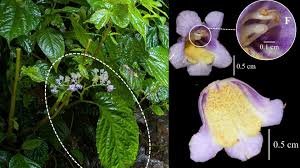
A new plant species, Stauranthera aureoglossa, has been discovered by botanists in the Himalayan region, noted for its unique “golden tongue” feature.
About Stauranthera aureoglossa
- This species was identified in the mid-elevation evergreen forests of Arunachal Pradesh, specifically in the Kamle and Upper Subansiri districts.
- It is a perennial herb that grows on moist rocks and soil near streams and rivulets, indicating its dependence on fragile streamside ecosystems.
- The plant is distinguished by its bell-shaped bluish-purple flowers, setting it apart from closely related species.
- Unlike similar plants, it does not have a tubular spur at the base of the flower, which is usually a common feature.
- Instead, it has a raised, textured yellow patch inside the lower petal, resembling a tongue-like structure, which inspired the name “aureoglossa” (golden tongue).
- Its leaves are typically diamond-shaped or spear-shaped, adding to its distinct botanical characteristics.
- Due to threats like logging, landslides, and road construction, its habitat is under pressure, and it has been provisionally classified as an endangered species.