Important questions for UPSC Pre/ Mains/ Interview:
|
Context
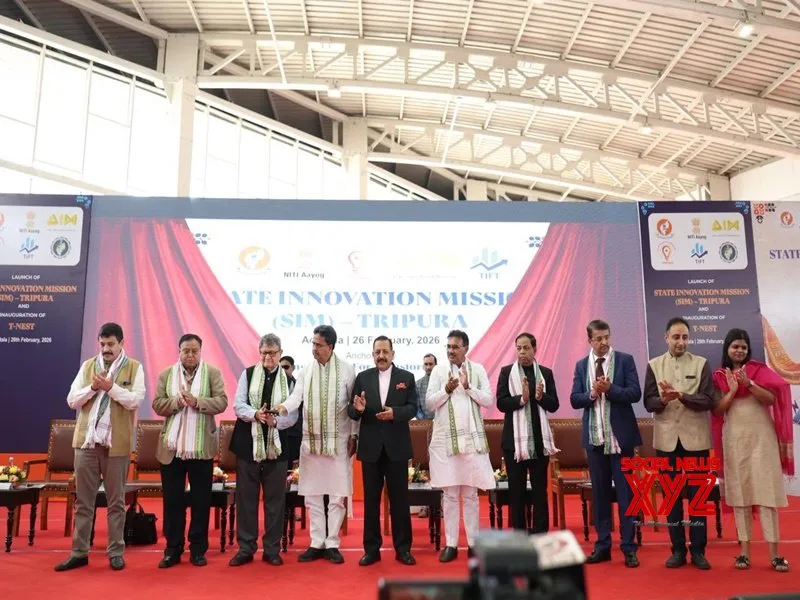
The Atal Innovation Mission (AIM) under NITI Aayog has launched the first State Innovation Mission (SIM) in Tripura. The initiative, part of AIM 2.0 under the State Support Mission, seeks to embed innovation and entrepreneurship into long-term state development planning through institutional and ecosystem-level reforms.
Q1. What is the State Innovation Mission (SIM) and why was it introduced?
- SIM is a long-term institutional mechanism under AIM 2.0.
- Designed to help States and UTs build structured innovation ecosystems.
- Aligns national innovation priorities with local economic strengths.
- Moves beyond isolated startup schemes toward systemic capacity building.
- Addresses uneven innovation capacity across states.
- Encourages state-led, context-specific innovation strategies.
Q2. How is the SIM structured in Tripura?
- Institutionalised under Tripura Institution for Transformation (TIFT).
- Launch of T-NEST (Tripura – Nurturing Entrepreneurship and Startups) incubation centre.
- Innovation Centres to be set up across all 8 districts.
- Focus on women and tribal innovation ecosystems.
- Introduction of District Innovator Fellowship (DIF) for grassroots innovators.
- Plan to introduce a State AI Policy.
- Proposal for an AI City in Agartala.
The structure links grassroots innovation to incubation and state policy.
Q3. How does SIM align with national innovation objectives?
- Part of AIM 2.0 under NITI Aayog.
- Supports the vision of Aatmanirbhar Bharat through innovation.
- Encourages state-level participation in Viksit Bharat 2047.
- Shifts development focus from centralised planning to innovation-led growth.
- Promotes cooperative federalism in innovation policy.
Transition from Planning Commission era to NITI Aayog reflects shift from planning to innovation governance.
Q4. What sectors and lifecycle stages does SIM aim to strengthen?
- Innovation education from school level onwards.
- Startup incubation and mentorship.
- Access to risk capital and funding pathways.
- Industry-academia-government collaboration.
- Capacity building of state institutions.
- Peer learning between states.
SIM operates across the full innovation lifecycle rather than focusing only on startups.
Q5. What are the governance and administrative dimensions of SIM?
- Institutional anchoring under state transformation bodies.
- Coordination between central mission (AIM) and state governments.
- Multi-stakeholder collaboration:
- Government
- Academia
- Industry
- Civil society
- Focus on district-level decentralisation.
- Policy harmonisation with national digital and AI strategies.
Federal innovation architecture is strengthened.
Q6. What are the benefits and potential challenges of SIM?
Benefits
- Promotes regional balance in innovation growth.
- Encourages inclusion of women and tribal innovators.
- Builds long-term innovation infrastructure.
- Enhances state economic competitiveness.
- Strengthens local-to-global innovation pipeline.
Challenges
- Sustained funding and political commitment required.
- Risk of duplication if coordination is weak.
- Capacity constraints in smaller states.
- Monitoring and measurable outcomes may be difficult.
- Need for strong public-private partnerships.
Implementation quality will determine actual ecosystem transformation.
Q7. What is the broader significance of launching SIM in Tripura?
- First operational model of AIM 2.0 at state level.
- Demonstrates innovation-led development beyond metropolitan regions.
- Reinforces cooperative federalism in innovation policy.
- Integrates AI governance at state level.
- Signals decentralisation of innovation capacity.
Tripura serves as a pilot model for other states.
Conclusion
The launch of the State Innovation Mission in Tripura represents a structural shift toward decentralised, innovation-driven development. By institutionalising state-led innovation ecosystems under AIM 2.0, the initiative aligns grassroots entrepreneurship with national growth objectives. Its long-term success will depend on sustained capacity building, inclusive participation, and strong Centre–State coordination within India’s evolving innovation federalism framework.